

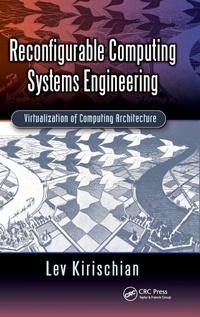
Reconfigurable Computing Systems Engineering
Virtualization of Computing Architecture
1st Edition
Published on 24. May 2016
Book
Hardback
320 pages
978-1-4398-5621-5 (ISBN)
Description
Reconfigurable Computing Systems Engineering: Virtualization of Computing Architecture describes the organization of reconfigurable computing system (RCS) architecture and discusses the pros and cons of different RCS architecture implementations. Providing a solid understanding of RCS technology and where it's most effective, this book:
Details the architecture organization of RCS platforms for application-specific workloads
Covers the process of the architectural synthesis of hardware components for system-on-chip (SoC) for the RCS
Explores the virtualization of RCS architecture from the system and on-chip levels
Presents methodologies for RCS architecture run-time integration according to mode of operation and rapid adaptation to changes of multi-parametric constraints
Includes illustrative examples, case studies, homework problems, and references to important literature
A solutions manual is available with qualifying course adoption.
Reconfigurable Computing Systems Engineering: Virtualization of Computing Architecture offers a complete road map to the synthesis of RCS architecture, exposing hardware design engineers, system architects, and students specializing in designing FPGA-based embedded systems to novel concepts in RCS architecture organization and virtualization.
Details the architecture organization of RCS platforms for application-specific workloads
Covers the process of the architectural synthesis of hardware components for system-on-chip (SoC) for the RCS
Explores the virtualization of RCS architecture from the system and on-chip levels
Presents methodologies for RCS architecture run-time integration according to mode of operation and rapid adaptation to changes of multi-parametric constraints
Includes illustrative examples, case studies, homework problems, and references to important literature
A solutions manual is available with qualifying course adoption.
Reconfigurable Computing Systems Engineering: Virtualization of Computing Architecture offers a complete road map to the synthesis of RCS architecture, exposing hardware design engineers, system architects, and students specializing in designing FPGA-based embedded systems to novel concepts in RCS architecture organization and virtualization.
Reviews / Votes
"Other texts having a similar focus tend to become entangled in technical details relating to a particular programming language, set of computer aided design tools, or device technology. As a result, these texts usually have a relatively short shelf life before they become obsolete. This text, on the other hand, is unique in that it stays within the realm of concepts and top-level design analysis and methodology, allowing it to be, and remain, applicable and relevant over a wide range of technologies."-Dr. Jason D. Bakos, University of South Carolina, Columbia, USA
"The systematic representation of material, the detailed discussion of the main concepts, and the analysis of pros/cons of different approaches in architecture virtualization and static and dynamic integration will make this book very useful for engineers and students specializing in the development and design of field-programmable gate array (FPGA)-based reconfigurable computing systems."
-From the Foreword by Dr. Karen Safaryan, Vice President and Chief Technology Officer, Unique Broadband Systems, Ltd. and Director of R&D and Engineering, UBS-Axcera, Inc. Canada
More details
Language
English
Place of publication
Bosa Roca
United States
Publishing group
Taylor & Francis Inc
Target group
College/higher education
Professional and scholarly
Academic and Professional Practice & Development
Illustrations
114 s/w Abbildungen, 18 farbige Abbildungen, 10 s/w Tabellen
10 Tables, black and white; 18 Illustrations, color; 114 Illustrations, black and white
Dimensions
Height: 240 mm
Width: 161 mm
Thickness: 27 mm
Weight
942 gr
ISBN-13
978-1-4398-5621-5 (9781439856215)
Copyright in bibliographic data and cover images is held by Nielsen Book Services Limited or by the publishers or by their respective licensors: all rights reserved.
Schweitzer Classification
Other editions
Additional editions
Book
03/2021
1st Edition
CRC Press
€65.60
Shipment within 15-20 days
E-Book
12/2017
CRC Press
€69.99
Available for download
E-Book
12/2017
CRC Press
€69.99
Available for download

Other
CRC Press
€106.00
The article will not be published
Person
Lev Kirischian, Ph.D, P.Eng, Member IEEE, has been affiliated with Ryerson University, Canada for 18 years. His research involves dynamically reconfigurable computing systems, automated architectural synthesis of data-stream processors, and workload-adaptive and self-healing reconfigurable architectures. He participated in the research and development of the first-generation Soviet supercomputers with reconfigurable architectures in the 1980s, FPGA-based segment of COFDM modulation technology for digital audio/video broadcasting systems for satellite and terrestrial networks (used in the SiriusXM satellite radio network), workload adaptive and self-restorable space-borne embedded computer platforms, and 3D-panoramic machine vision systems, among other technologies. In the last decade, he has developed and taught several courses associated with high-performance and reconfigurable computing as well as high-level synthesis of application-specific processors.
Content
Introduction to Reconfigurable Computing Systems. Organization of the Field of Configurable Resources. Architecture of the On-Chip Processing Elements. Reconfigurable Communication Infrastructure in the FCR. System-Level Organization of the FCR. Configuration Memory and Architecture Virtualization in RCS. Reconfiguration Process Organization in the On-Chip Level of a Reconfigurable Computing System. RCS Architecture Configuration and Runtime Reconfiguration. Virtualization of the Architectural Components of a System on Chip. Virtualization of Reconfigurable Computing System Architecture.