

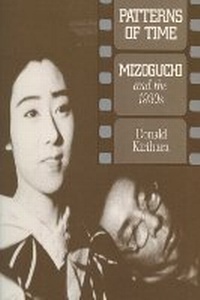
Patterns of Time
Mizoguchi and the 1930S
Will be published approx. on 15. June 1992
Book
Paperback/Softback
240 pages
978-0-299-13244-6 (ISBN)
Description
Although Kenji Mizoguchi is one of the three most important Japanese directors (along with Yasujiro Ozu and Akira Kurosawa), there has been no systematic critical study of his work in English. Correcting this omission. Donald Kirihara examines in detail the brilliant early works of one of the world's great film directors, offering an analysis of his career. The book targets a key phase of Mizoguchi's career, the 1930s. It was in that period that conditions within the Japanese film industry allowed Mizoguchi more freedom to experiment with film style and narrative structure. Kirihara analyzes the formal and stylistic components of four of Mizoguchi's films. "The Downfall of Osen" (1935), "Naniwa Elegy" (1936), "Sisters of the Gion" (1936) and "The Story of the Last Chrysanthemum" (1939), while considering the historical context in which they were produced and consumed. Using scores of frame enlargements, drawing from a variety of historical sources, and integrating concepts from contemporary film theory, Kirihara proposes a new way of understanding Mizoguchi's films.
He argues that at the heart of Mizoguchi's brilliance as a filmmaker is an obsessive need to challenge spectators, implicating them in the production of meaning through the dynamic manipulation of spatio-temporal relations. The result is a film style that self-consciously leads, frustrates and surprises.
He argues that at the heart of Mizoguchi's brilliance as a filmmaker is an obsessive need to challenge spectators, implicating them in the production of meaning through the dynamic manipulation of spatio-temporal relations. The result is a film style that self-consciously leads, frustrates and surprises.
Reviews / Votes
"Patterns of Time is a most welcome addition to the field of Japanese film studies, where it will have an immediate impact. Moreover, it is a welcome addition to all of Film Studies, not simply for the international stature of Mizoguchi, but for the meticulously applied methodology employed by the author."-David Desser, University of Illinois at Urbana-Champaign"It is one of the scandals of English language film study that there is no book-length study of Mizoguchi. This book fills a gaping hole. There is basically nothing that approaches this work in depth and thoroughness. For specialists in Japanese film and twentieth century Japanese culture, this is an invaluable work. "-Tom Gunning, State University of New York at Purchase
More details
Series
Language
English
Place of publication
Wisconsin
United States
Target group
College/higher education
Product notice
Paperback (trade)
Illustrations
176 illustrations
Dimensions
Height: 241 mm
ISBN-13
978-0-299-13244-6 (9780299132446)
Copyright in bibliographic data and cover images is held by Nielsen Book Services Limited or by the publishers or by their respective licensors: all rights reserved.
Schweitzer Classification
Person
Donald Kirihara teaches courses in film history, criticism and theory at the University of Arizona. He is a former editor of The Velvet Light Trap and Wide Angle.