


Global Security Governance
Competing Perceptions of Security in the Twenty-First Century
1st Edition
Published on 15. February 2007
Book
Hardback
294 pages
978-0-415-39161-0 (ISBN)
Description
This book demarcates the barriers and pathways to major power security cooperation and provides an empirical analysis of threat perception among the world's major powers.
Divided into three parts, Emil Kirchner and James Sperling use a common analytical framework for the changing security agenda in Canada, France, Germany, Italy, Japan, the Russian Federation, the United States, the United Kingdom, and the EU. Each chapter features:
an examination of national 'exceptionalism' that accounts for foreign and security policy idiosyncrasies
definitions of the range of threats preoccupying the government, foreign policy elites and the public
assessments of the institutional and instrumental preferences shaping national security policies
investigations on the allocation of resources between the various categories of security expenditure
details on the elements of the national security culture and its consequences for security cooperation.
Global Security Governance combines a coherent theoretical framework with strong comparative case studies, making it ideal reading for all students of security studies.
Divided into three parts, Emil Kirchner and James Sperling use a common analytical framework for the changing security agenda in Canada, France, Germany, Italy, Japan, the Russian Federation, the United States, the United Kingdom, and the EU. Each chapter features:
an examination of national 'exceptionalism' that accounts for foreign and security policy idiosyncrasies
definitions of the range of threats preoccupying the government, foreign policy elites and the public
assessments of the institutional and instrumental preferences shaping national security policies
investigations on the allocation of resources between the various categories of security expenditure
details on the elements of the national security culture and its consequences for security cooperation.
Global Security Governance combines a coherent theoretical framework with strong comparative case studies, making it ideal reading for all students of security studies.
Reviews / Votes
'Global Security Governance is a distinct contribution to our understanding of international security cooperation in the contemporary world. Using a common framework, 12 excellent surveys examine national perceptions of security threats, institutional and instrumental preferences over policy, and the allocation of security resources. Integrating these essays, the editors insightfully probe the potentials and pitfalls for global and regional security governance. This thoughtful volume will be of interest to scholars of international relations and policy makers alike.' - David A. Lake, University of California, USA'Global Security Governance makes an important and timely contribution to the ongoing debate about the nature and scope of security in the 21st century. The individual country-study chapters, disciplined by a common grid, represent an exemplary example of comparative foreign policy analysis. This empirically grounded and theoretically informed collection deserves a wide readership among practitioners and scholars alike.' - Antonio Missiroli, European Policy Centre, Brussels
'This book contributes a most valuable novel approach to security studies and significantly adds to our knowledge of contemporary security threats.' - Knud Erik Jorgensen, Arhus University, Denmark
More details
Language
English
Place of publication
London
United Kingdom
Publishing group
Taylor & Francis Ltd
Target group
College/higher education
Illustrations
70 s/w Tabellen
70 Tables, black and white
Dimensions
Height: 240 mm
Width: 161 mm
Thickness: 21 mm
Weight
634 gr
ISBN-13
978-0-415-39161-0 (9780415391610)
Copyright in bibliographic data and cover images is held by Nielsen Book Services Limited or by the publishers or by their respective licensors: all rights reserved.
Schweitzer Classification
Other editions
Additional editions
Emil J. Kirchner | James Sperling
Global Security Governance
Competing Perceptions of Security in the Twenty-First Century
E-Book
04/2007
Routledge
€69.99
Available for download
Emil J. Kirchner | James Sperling
Global Security Governance
Competing Perceptions of Security in the Twenty-First Century
E-Book
04/2007
Routledge
€69.99
Available for download
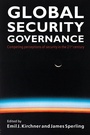
Emil J. Kirchner | James Sperling
Global Security Governance
Competing Perceptions of Security in the Twenty-First Century
Book
02/2007
1st Edition
Routledge
€76.90
Shipment within 15-20 days
Persons
Emil Kirchner is Jean Monnet Professor of European Integration at the University of Essex. He is Associate Editor of the Journal of European Integration.
James Sperling is Professor of Political Science at the University of Akron, Texas, USA.
James Sperling is Professor of Political Science at the University of Akron, Texas, USA.
Content
Introduction 1. Regional and Global Security: Changing Threats and Institutional Responses Part 1: Europe 2. France: Between Exceptionalism and Orthodoxy 3. Germany: From a Reluctant Power to a Constructive Power? 4. Italy: New Ambitions and Old Deficiencies 5. United Kingdom: Punching above its Weight 6. European Union: The European Security Strategy versus National Preferences Part 2: North America 7. Canada: Taking Security Seriously after 11 September? 8. United States: The Unrelenting Search for an Existential Threat in the Twenty-First Century Part 3: Eurasia 9. China: Security Cooperation with Reservations 10. Japan: Recasting the Post-War Security Consensus 11. Russia: Struggling for Dignity Conclusion 12. Regional or Global Security Cooperation? The Vertices of Conflict and Interstices of Cooperation