

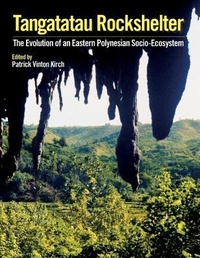
Tangatatau Rockshelter
The Evolution of an Eastern Polynesian Socio-Ecosystem
Published on 30. April 2017
Book
Hardback
348 pages
978-1-938770-10-4 (ISBN)
Description
Tangatatau Rockshelter on Mangaia Island in the Southern Cook Islands, excavated by a multidisciplinary team in 1989-1991, produced one of the richest stratigraphic sequences of artifacts, faunal assemblages, and archaeobotanical materials in Eastern Polynesia. More than seventy radiocarbon dates provide a tight chronology from AD 1000 to European contact in about 1800. The faunal assemblage provides compelling evidence for dramatic reductions in indigenous bird life following Polynesian colonization, one of the best documented cases for human-induced impacts on island biota. Tangatatau is unique among Polynesian archaeological sites in the extent to which fishing was dominated by freshwater fishes and eels. The site also yielded an extensive suite of carbonized plant materials, including sweet potato tubers, demonstrating that this South American domesticate had reached Eastern Polynesia by AD 1400. Mangaia illustrates the often far-reaching consequences of human land use and resource exploitation on small and vulnerable islands.
More details
Series
Language
English
Place of publication
Los Angeles
United States
Target group
College/higher education
Professional and scholarly
Product notice
Laminated cover
Dimensions
Height: 229 mm
Width: 153 mm
Thickness: 18 mm
Weight
1315 gr
ISBN-13
978-1-938770-10-4 (9781938770104)
Copyright in bibliographic data and cover images is held by Nielsen Book Services Limited or by the publishers or by their respective licensors: all rights reserved.
Schweitzer Classification
Other editions
Additional editions
E-Book
12/2017
Cotsen Institute of Archaeology
€96.49
Available for download
Person
Patrick Vinton Kirch is a Chancellor's Professor Emeritus and the Class of 1954 Professor of Anthropology and Integrative Biology Emeritus at the University of California, Berkeley, and the Curator of Oceanic Archaeology in the P. A. Hearst Museum of Anthropology at Berkeley.