

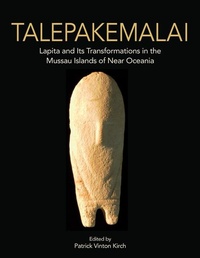
Talepakemalai
Lapita and Its Transformations in the Mussau Islands of Near Oceania
Published on 28. January 2022
Book
Hardback
592 pages
978-1-950446-17-9 (ISBN)
Description
This book is a study of the Lapita Cultural Complex, a region spanning both Melanesia and Western Polynesia. The Lapita culture has been interpreted as the archaeological manifestation of a diaspora of Austronesian-speaking people (specifically of Proto-Oceanic language) who rapidly expanded from the New Guinea region into Remote Oceania.
The Lapita Cultural Complex--first uncovered in the mid-20th century as a widespread archaeological complex spanning both Melanesia and Western Polynesia--has subsequently become recognized as of fundamental importance to Oceanic prehistory. Notable for its highly distinctive, elaborate, dentate-stamped pottery, Lapita sites date to between 3500-2700 BP, spanning the geographic range from the Bismarck Archipelago to Tonga and Samoa.
The Lapita culture has been interpreted as the archaeological manifestation of a diaspora of Austronesian-speaking people (specifically of Proto-Oceanic language) who rapidly expanded from Near Oceania (the New Guinea-Bismarcks region) into Remote Oceania, where no humans had previously ventured. Lapita is thus a foundational culture throughout much of the southwestern Pacific, ancestral to much of the later, ethnographically-attested cultural diversity of the region.
The Lapita Cultural Complex--first uncovered in the mid-20th century as a widespread archaeological complex spanning both Melanesia and Western Polynesia--has subsequently become recognized as of fundamental importance to Oceanic prehistory. Notable for its highly distinctive, elaborate, dentate-stamped pottery, Lapita sites date to between 3500-2700 BP, spanning the geographic range from the Bismarck Archipelago to Tonga and Samoa.
The Lapita culture has been interpreted as the archaeological manifestation of a diaspora of Austronesian-speaking people (specifically of Proto-Oceanic language) who rapidly expanded from Near Oceania (the New Guinea-Bismarcks region) into Remote Oceania, where no humans had previously ventured. Lapita is thus a foundational culture throughout much of the southwestern Pacific, ancestral to much of the later, ethnographically-attested cultural diversity of the region.
More details
Series
Language
English
Place of publication
Los Angeles
United States
Target group
College/higher education
Professional and scholarly
Product notice
Laminated cover
Illustrations
343 figures
Dimensions
Height: 229 mm
Width: 153 mm
Thickness: 30 mm
Weight
1022 gr
ISBN-13
978-1-950446-17-9 (9781950446179)
Copyright in bibliographic data and cover images is held by Nielsen Book Services Limited or by the publishers or by their respective licensors: all rights reserved.
Schweitzer Classification
Other editions
Additional editions
Brian S. Bauer | Brian S. Bauer
Talepakemalai
Lapita and Its Transformations in the Mussau Islands of Near Oceania
E-Book
11/2021
Cotsen Institute of Archaeology Press
€118.99
Available for download