

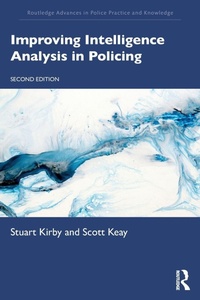
Improving Intelligence Analysis in Policing
2nd Edition
Will be published approx. on 26. February 2026
Book
Paperback/Softback
208 pages
978-1-032-91481-7 (ISBN)
Description
The use of criminal intelligence remains a significant area of growth, especially across the wider 'policing' arena. This book offers an accessible and critical account of how intelligence analysis can improve policing and law enforcement.
This second edition has been updated with new research and material offering inventive modes of critical thinking, including both practical knowledge and an evaluative understanding of the applications and risks associated with intelligence. Some of the key features of the book include:
Advances theories of intelligence analysis
Critical evaluation of intelligence sources
Includes recommendations to improve practice
Leadership and management approaches in intelligence-led policing
Strategic applications of intelligence for crime reduction
Technological innovation and data science integration in intelligence work
Future-focused and offers new ideas to develop policy and practice
This volume is aimed at students and scholars of law enforcement intelligence studies, policing, and criminology. It will also be a useful resource for policymakers as well as practitioners in a range of law enforcement settings.
This second edition has been updated with new research and material offering inventive modes of critical thinking, including both practical knowledge and an evaluative understanding of the applications and risks associated with intelligence. Some of the key features of the book include:
Advances theories of intelligence analysis
Critical evaluation of intelligence sources
Includes recommendations to improve practice
Leadership and management approaches in intelligence-led policing
Strategic applications of intelligence for crime reduction
Technological innovation and data science integration in intelligence work
Future-focused and offers new ideas to develop policy and practice
This volume is aimed at students and scholars of law enforcement intelligence studies, policing, and criminology. It will also be a useful resource for policymakers as well as practitioners in a range of law enforcement settings.
Reviews / Votes
Improving Intelligence Analysis in Policing is one of the few academic books that succeeds on multiple levels. First, by combining clarity with insight and originality, Stuart Kirby and Scott Keay have created a resource that is as useful for scholars as it is for practitioners and students. Second, they have written a new edition that improves on rather than simply adds to the original. Finally, and perhaps most importantly, they have achieved their own goal, producing an outstanding study that lays the foundation for bridging the theory-practice gap.Rafe McGregor, Reader in Criminology, Edge Hill University
This book represents a well-crafted fusion of research, theory, and practice from the intelligence and analysis in policing domain. I Particularly like the chapter linking intelligence, analysis, and crime prevention. Unlike many second editions, it explores previous areas in more depth and also boasts additional areas not previously covered. An excellent resource for students, researchers, and police personnel alike.
Jason Roach, Professor of Psychology and Policing, University of Huddersfield
Intelligence analysis is critical for effective, efficient and fair policing. This book provides an authoritative and accessible account of what effective intelligence analysis involves. It is an important and timely resource for practitioners, researchers and students.
Aiden Sidebottom, Professor of Policing and Crime Prevention, UCL Jill Dando Institute of Security and Crime Science
More details
Series
Edition
2nd edition
Language
English
Place of publication
London
United Kingdom
Publishing group
Taylor & Francis Ltd
Target group
College/higher education
Professional and scholarly
Postgraduate, Professional Practice & Development, Professional Training, and Undergraduate Advanced
Illustrations
5 s/w Tabellen, 6 s/w Zeichnungen, 6 s/w Abbildungen
5 Tables, black and white; 6 Line drawings, black and white; 6 Illustrations, black and white
Dimensions
Height: 234 mm
Width: 156 mm
Thickness: 11 mm
Weight
322 gr
ISBN-13
978-1-032-91481-7 (9781032914817)
Copyright in bibliographic data and cover images is held by Nielsen Book Services Limited or by the publishers or by their respective licensors: all rights reserved.
Schweitzer Classification
Other editions
Additional editions
Stuart Kirby | Scott Keay
Improving Intelligence Analysis in Policing
E-Book
02/2026
2nd Edition
Routledge
€55.49
Available for download
Stuart Kirby | Scott Keay
Improving Intelligence Analysis in Policing
E-Book
02/2026
2nd Edition
Routledge
€55.49
Available for download
Stuart Kirby | Scott Keay
Improving Intelligence Analysis in Policing
Book
approx. 02/2026
2nd Edition
Routledge
€211.10
Not yet published
Previous edition
Stuart Kirby | Scott Keay
Improving Intelligence Analysis in Policing
Book
06/2021
1st Edition
Routledge
€59.90
Shipment within 15-20 days
Persons
Stuart Kirby is a Chartered Psychologist who previously served as a Detective Chief Superintendent (Lancashire UK), with responsibility for Intelligence, Forensic, Major Crime, Organised Crime and Counter Terrorism. On retirement he became an academic and is now Emeritus Professor in Policing at the University of Lancashire.
Scott Keay is a senior lecturer in Policing at Edge Hill University (UK). He is a former intelligence analyst and worked in various analytical roles from criminal intelligence through to community safety and partnership intelligence. His research continues to develop and support crime and intelligence analysis.
Scott Keay is a senior lecturer in Policing at Edge Hill University (UK). He is a former intelligence analyst and worked in various analytical roles from criminal intelligence through to community safety and partnership intelligence. His research continues to develop and support crime and intelligence analysis.
Content
1. Why intelligence analysis remains essential in policing 2. Understanding the value and danger of intelligence sources 3. How leaders / managers improve the intelligence process 4. How analysts can improve intelligence analysis 5. Intelligence and crime reduction 6. The use of intelligence techniques in reactive and proactive investigations 7. The enduring importance of partnership intelligence 8. Technology and data science 9. Improving intelligence analysis to meet future challenges