

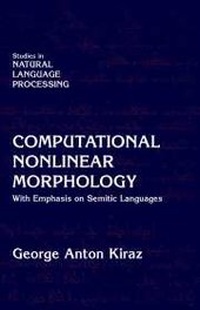
Computational Nonlinear Morphology
With Emphasis on Semitic Languages
Book
Paperback/Softback
193 pages
978-0-521-03225-4 (ISBN)
Description
By the late 1970s phonologists, and later morphologists, had departed from a linear approach for describing morphophonological operations to a non-linear one. Computational models, however, remain faithful to the linear model, making it very difficult, if not impossible, to implement the morphology of languages whose morphology is non-concatenative. Computational Nonlinear Morphology aims at presenting a computational system that counters the development in linguistics. It provides a detailed computational analysis of the complex morphophonological phenomena found in Semitic languages based on linguistically motivated models. The book outlines a generalized regular rewrite rule system that employs multi-tape finite-state automata to cater for root-and-pattern morphology, infixation, circumfixation and other complex operations such as the broken plural derivation problem found in Arabic and Ethiopic.
Reviews / Votes
"I would recommend it as a useful source of inspiration for researchers in the field..." Computational LinguisticsMore details
Series
Language
English
Place of publication
Cambridge
United Kingdom
Target group
Professional and scholarly
Product notice
Paperback (trade)
Illustrations
84 Line drawings, unspecified
Dimensions
Height: 228 mm
Width: 152 mm
ISBN-13
978-0-521-03225-4 (9780521032254)
Copyright in bibliographic data and cover images is held by Nielsen Book Services Limited or by the publishers or by their respective licensors: all rights reserved.
Schweitzer Classification
Other editions
New editions
Book
12/2001
Cambridge University Press
€124.00
Article exhausted; check different version
Additional editions
Book
12/2001
Cambridge University Press
€124.00
Article exhausted; check different version

Online / Databases
Cambridge University Press
€103.05
Article exhausted; check different version
Person
Content
Preface; Abbreviations and acronyms; Transliteration of Semitic; Errata and corrigenda; 1. Introduction; 2. Survey of semitic nonlinear morphology; 3. Survey of finite-state morphology; 4. Survey of semitic computational morphology; 5. A multitier nonlinear model; 6. Modeling semitic nonlinear morphology; 7. Compiliation into multitape automata; 8. Conclusion; References; Quotation credits; Language, word, and morpheme index; Name index; Subject index.