

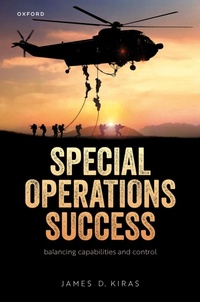
Special Operations Success
Balancing Capabilities and Control
Published on 26. November 2024
Book
Hardback
528 pages
978-0-19-890206-5 (ISBN)
Description
Special Operations Success establishes a new benchmark in military theory in this deeply analytic and innovative work. It answers several pressing questions: How successful have American special operations been over the past quarter-century? Are special forces fated to cycles of expansion and misuse? Will special forces invariably exceed the authorities granted to them because of they are? Is a general theory of special operations feasible given the range of activities and conditions that fall under the category?
Kiras' work is based on two decades of practical, teaching, and consulting experience within different special operations communities, and its analysis and conclusions are designed to inform practitioners, policymakers, educators, and the general public. The book develops a framework, in the form of a theory comprising capabilities and control, for the comprehensively evaluating special operations success, and is divided into three parts: Part I lays the foundation for a general theory of special operations, Part II explores the two component parts of theory, capabilities and control, and Part III uses various aspects of the theory, depending on available information, to assess the success of special operations over a twenty-year period in the United Kingdom, South Africa, and the United States.
Kiras' work is based on two decades of practical, teaching, and consulting experience within different special operations communities, and its analysis and conclusions are designed to inform practitioners, policymakers, educators, and the general public. The book develops a framework, in the form of a theory comprising capabilities and control, for the comprehensively evaluating special operations success, and is divided into three parts: Part I lays the foundation for a general theory of special operations, Part II explores the two component parts of theory, capabilities and control, and Part III uses various aspects of the theory, depending on available information, to assess the success of special operations over a twenty-year period in the United Kingdom, South Africa, and the United States.
Reviews / Votes
In the aftermath of the use - and at times, misuse - of special operations forces in Iraq and Afghanistan in particular, a fresh examination of the theory underlying special operations is very germane. At least in the US and likely elsewhere, some of the core aspects of special operations seem to be in doubt. In many ways, a thorough re-examination of underlying principles and desired capabilities has become increasingly important. Although some readers in the policy world might find some of the theoretical background in this book rather heavy going, it is highly recommended for both policy makers and analysts to develop fresh approaches to the strategic use and control of special operations forces. * Lawrence E. Cline, Defense & Security Analysis *More details
Language
English
Place of publication
Oxford
United Kingdom
Target group
Professional and scholarly
Product notice
sewn/stitched
Cloth over boards
Dimensions
Height: 236 mm
Width: 164 mm
Thickness: 37 mm
Weight
943 gr
ISBN-13
978-0-19-890206-5 (9780198902065)
Copyright in bibliographic data and cover images is held by Nielsen Book Services Limited or by the publishers or by their respective licensors: all rights reserved.
Schweitzer Classification
Other editions
Additional editions
E-Book
10/2024
OUP eBook
€132.99
Available for download
E-Book
10/2024
OUP eBook
€132.99
Available for download
Person
James D. Kiras has taught at the US Air Force's school of strategy for 20 years. He has published numerous works on irregular warfare, including special operations, terrorism, and insurgency, and serves on the board of special operations organizations in the US and Sweden. He co-founded the Special Operations Research Association and co-edits Inter Populum: The Journal of Special Operations and Irregular Warfare. Professor Kiras served in the Pentagon following the 9/11 attacks and he routinely consults with various special operations units and planning and strategy staffs.
Content
List of Figures
List of Table
List of Maps
List of Abbreviations
Part I
1: Introduction
2: Special Operations Precedents
Part II
3: Special Operations Capabilities
4: Control of Special Operations and Vertical Integration
5: The Theory of Special Operations Coherence
Part III
6: Stretched beyond Footholds: The United Kingdom, 1971-1991
7: System within a System: South African Special Forces, 1972-1992
8: Redefining the System: US Special Operations, 1996-2016
9: Conclusion
Bibliography
Index
List of Table
List of Maps
List of Abbreviations
Part I
1: Introduction
2: Special Operations Precedents
Part II
3: Special Operations Capabilities
4: Control of Special Operations and Vertical Integration
5: The Theory of Special Operations Coherence
Part III
6: Stretched beyond Footholds: The United Kingdom, 1971-1991
7: System within a System: South African Special Forces, 1972-1992
8: Redefining the System: US Special Operations, 1996-2016
9: Conclusion
Bibliography
Index