

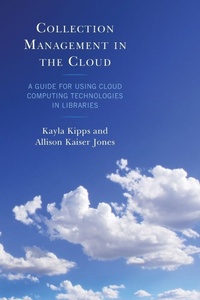
Collection Management in the Cloud
A Guide for Using Cloud Computing Technologies in Libraries
Published on 11. March 2022
Book
Paperback/Softback
180 pages
978-1-5381-5189-1 (ISBN)
Description
As remote work has become routine, cloud-based technology tools have become increasingly necessary to communicate with other library staff and with faculty and staff to continue providing seamless and uninterrupted access to library resources and collections for our campus community.
Cloud-based technology tools such as Google Forms and Google Sheets are used to gather faculty requests for collection development, tools such as Tableau are used to illustrate material budget balances, and platforms such as Trello have been adopted to track subscription renewal cycles and manage other projects.
This guide discusses the benefits of using these powerful cloud-based and little to no additional cost technology tools through the lens of a particular area in librarianship such as documentation, data and project management, communication, data storage, and data visualization. While the real-world examples provided throughout focus on technical services staff operations, specifically acquisitions and electronic collection management, each tool's features and use cases are transferable among all areas of librarianship.
This guide provides insights into how collaborative, dynamic, and accessible these cloud-based solutions are for a technologically shifting workplace as well as considers the challenges to adopting cloud-based solutions such as administrative buy-in, aversion to change, and steeper learning curves as well.
Readers will gain practical experiential examples that have been instrumental in creating efficiencies in collection management workflows for technical services staff. The use cases illustrated exemplify enhancements that librarians can incorporate into their own collection management practices to further engage with their colleagues, their patrons, and their larger communities more effectively and efficiently.
Cloud-based technology tools such as Google Forms and Google Sheets are used to gather faculty requests for collection development, tools such as Tableau are used to illustrate material budget balances, and platforms such as Trello have been adopted to track subscription renewal cycles and manage other projects.
This guide discusses the benefits of using these powerful cloud-based and little to no additional cost technology tools through the lens of a particular area in librarianship such as documentation, data and project management, communication, data storage, and data visualization. While the real-world examples provided throughout focus on technical services staff operations, specifically acquisitions and electronic collection management, each tool's features and use cases are transferable among all areas of librarianship.
This guide provides insights into how collaborative, dynamic, and accessible these cloud-based solutions are for a technologically shifting workplace as well as considers the challenges to adopting cloud-based solutions such as administrative buy-in, aversion to change, and steeper learning curves as well.
Readers will gain practical experiential examples that have been instrumental in creating efficiencies in collection management workflows for technical services staff. The use cases illustrated exemplify enhancements that librarians can incorporate into their own collection management practices to further engage with their colleagues, their patrons, and their larger communities more effectively and efficiently.
Reviews / Votes
Cloud computing technologies have rapidly expanded in the 21st century. In this detailed work, collection development librarian Kipps and electronic resources and serials librarian Jones explore cloud computing and its benefits for collection management librarians.... In evaluating those tools most useful for librarians, the authors consider features such as versatility, functionality, cost, and security. They conclude this work with a chapter considering the future of cloud computing in libraries, a glossary of terms, and a bibliography. With remote work becoming more common, this practical and well-organized work is timely and recommended for librarians wishing to enhance their collection management practices. * Library Journal * Recent practices in online remote workplace environments have benefited from cloud computing technologies. Two collection management scholars at the College of Charleston explore the possible incorporation of cloud technology tools into library management using a collection lens.... The writing is clear and detailed, reflecting the authors' well-honed experiences. Librarians will find this practical book a good resource when considering how to incorporate cloud computer technologies effectively, even beyond collection development. * Booklist * Collection Management in the Cloud provides a practical, budget-minded approach to using cloud-based tools for collection management workflows. Kipps and Jones review several of these tools, including instructions for set up, details on how to use in the library, and concerns such as cost and security, in easy-to-understand language. -- Leah Hinds, executive director, Charleston Hub (Home of the Charleston Conference and Against the Grain) An interesting and engaging overview of essential tools and strategies for 21st century librarians. -- Tim Bucknall, founder of the Carolina Consortium Any collections or electronic resources manager will benefit from the in-depth analysis of the tools and services described in this book. Its publication is especially timely given the sudden and recent increase in remote work. -- Leslie O'Brien, director of Collections and Technical Services, Virginia Tech, University Libraries This incredibly informative resource fills a critical void regarding the use of cloud-based technologies in libraries. Not only does the book provide a broad overview of available technologies, but it includes detailed explorations of specific products and software and the ways in which those tools impact library workflows and processes. -- Christopher D. Vidas, electronic resources librarian, acting head of collection management, Clemson University, Library Depot Kipps and Jones compiled a helpful overview of various cloud technology tools that could benefit collection management librarians in their work. The authors reviewed products based on their functionality, data security, and affordability. Many "freemium" products offer tiered options, and often the basic free plans are sufficient. This book covers cloud-based tools for data storage, documentation, data management, visualization, project management, communication, and library management systems. Many readers will be familiar with such resources as Google Drive, but some resources, e.g., Airtable, are more novel. The authors parsing of the unique features of products currently available will assist librarians in collaborating more effectively, especially now that remote work is more prevalent. Limitations of the technology are defined, and security verifications are listed for each platform and provide useful information for those with privacy concerns. Any infrastructure, platform, or service should improve workflows. This book is recommended for graduate students, professionals. * Choice Reviews * The aim of this book is assisting collection management librarians to incorporate cloud technology tools into their workflows, along with providing concrete examples and actual scenarios. Functionality, applicability, and limitations are also discussed as various cloud-based tools are featured. The authors provide lots of details related to the various applications and functionality of each cloud-based tool, along with numerous tables, charts, figures, and screenshots. I found this book highly valuable as a one-source reference on cloud-based tools available for use in collection management activities, and highly recommend it. * Journal of Electronic Resources Librarianship * From my perspective, this book provides a plethora of timely information, written in an easy to understand writing style, and is set up in such a way that a reader could easily read cover to cover, or just specific chapters of interest for those already using some of these applications. In general, this book could be useful for students, newer collection management and technical services professionals, or those lookingto move toward using cloud-based tools, though many of the applications discussed could be beneficial to most library professionals regardless of department. * Technical Services Quarterly *
More details
Series
Language
English
Place of publication
United States
Publishing group
Bloomsbury Publishing Plc
Target group
Professional and scholarly
Illustrations
6 b/w photos
Dimensions
Height: 229 mm
Width: 152 mm
Thickness: 10 mm
Weight
270 gr
ISBN-13
978-1-5381-5189-1 (9781538151891)
Copyright in bibliographic data and cover images is held by Nielsen Book Services Limited or by the publishers or by their respective licensors: all rights reserved.
Schweitzer Classification
Other editions
Additional editions
Kayla Kipps | Allison Kaiser Jones
Collection Management in the Cloud
A Guide for Using Cloud Computing Technologies in Libraries
E-Book
03/2022
1st Edition
Bloomsbury eBooks US
€40.49
Available for download
Persons
Kayla Kipps is the collection development librarian at the College of Charleston Libraries. Kipps earned an MLIS from San Jose State University and an BA in English from Virginia Tech. She has been working in technical services roles for over eight years in areas such as collections processing, collection assessment, collection development, and electronic resource management.
Allison Kaiser Jones is the electronic resources & serials librarian at the College of Charleston Libraries. In this role, she oversees all aspects of the Libraries' subscription-based resources in both print and electronic formats. Her presentations and publications primarily focus on serial life-cycle workflows and integrating cloud-based technologies into collection management. Jones earned a MLIS from the University of South Carolina and a MA in British and American Literature from the University of Charleston. She has worked with library collections and in technical services roles for over fifteen years.
Allison Kaiser Jones is the electronic resources & serials librarian at the College of Charleston Libraries. In this role, she oversees all aspects of the Libraries' subscription-based resources in both print and electronic formats. Her presentations and publications primarily focus on serial life-cycle workflows and integrating cloud-based technologies into collection management. Jones earned a MLIS from the University of South Carolina and a MA in British and American Literature from the University of Charleston. She has worked with library collections and in technical services roles for over fifteen years.
Content
Acknowledgements
Preface
Introduction
1: Data Storage in the Cloud
Cloud StorageCloud Storage in LibrariesMicrosoft OneDriveGoogle DriveDropbox: An Alternative to OneDrive and Google DriveSummary2: Documentation in the Cloud
Cloud DocumentationDocumentation in LibrariesGoogle DocsMicrosoft 365Dropbox Paper: An Alternative to Google Docs, Word, and OneNoteSummary3: Data Management in the Cloud
Data Management in LibrariesCloud Data ManagementAirtableGoogle Sheets for Data ManagementGoogle Forms: An Alternative to Airtable and Google SheetsSummary4: Data Visualization in the Cloud
Data Visualization in LibrariesCloud Data VisualizationTableauGoogle Sheets for Data VisualizationLibInsight: An Alternative to Tableau and Google SheetsSummary5: Project Management in the Cloud
Project Management in LibrariesCloud Tools for Project ManagementTrello Microsoft TeamsAsana (R) Collaboration Work Management Platform: An Alternative to Trello and Microsoft TeamsSummary6: Communication in the Cloud
Cloud CommunicationSlack (R) Collaboration Software for Informal CommunicationZoom for Formal CommunicationMicrosoft Teams: An Alternative to Slack Collaboration Software and ZoomSummary7: Library Management Systems in the Cloud
Cloud-Based Library Management SystemsEx Libris AlmaKoha Library SoftwareFOLIO: An Alternative to Ex Libris Alma and Koha Library SoftwareFrom Millennium to Alma: One Library's Migration ExperienceSummary8: Looking Ahead at Using Cloud-Based Tools in Libraries
Glossary of Terms
Bibliography
About the Authors
Preface
Introduction
1: Data Storage in the Cloud
Cloud StorageCloud Storage in LibrariesMicrosoft OneDriveGoogle DriveDropbox: An Alternative to OneDrive and Google DriveSummary2: Documentation in the Cloud
Cloud DocumentationDocumentation in LibrariesGoogle DocsMicrosoft 365Dropbox Paper: An Alternative to Google Docs, Word, and OneNoteSummary3: Data Management in the Cloud
Data Management in LibrariesCloud Data ManagementAirtableGoogle Sheets for Data ManagementGoogle Forms: An Alternative to Airtable and Google SheetsSummary4: Data Visualization in the Cloud
Data Visualization in LibrariesCloud Data VisualizationTableauGoogle Sheets for Data VisualizationLibInsight: An Alternative to Tableau and Google SheetsSummary5: Project Management in the Cloud
Project Management in LibrariesCloud Tools for Project ManagementTrello Microsoft TeamsAsana (R) Collaboration Work Management Platform: An Alternative to Trello and Microsoft TeamsSummary6: Communication in the Cloud
Cloud CommunicationSlack (R) Collaboration Software for Informal CommunicationZoom for Formal CommunicationMicrosoft Teams: An Alternative to Slack Collaboration Software and ZoomSummary7: Library Management Systems in the Cloud
Cloud-Based Library Management SystemsEx Libris AlmaKoha Library SoftwareFOLIO: An Alternative to Ex Libris Alma and Koha Library SoftwareFrom Millennium to Alma: One Library's Migration ExperienceSummary8: Looking Ahead at Using Cloud-Based Tools in Libraries
Glossary of Terms
Bibliography
About the Authors