

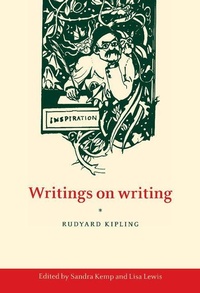
Writings on Writing
Edited by Sandra Lewis, Lisa Kemp
Published on 26. July 1996
Book
Hardback
242 pages
978-0-521-44527-6 (ISBN)
Description
Unlike his contemporaries Virginia Woolf and Henry James, Kipling always denied he was a critic. But his letters, speeches, and stories are full of comments on writing and writers. This collection, including many formerly unpublished private letters and papers, details Kipling's response to the commercialisation of literature and the emerging role of the writer as celebrity in the turbulent literary world of the 1890s and beyond. They reveal a mind intensely concerned with questions of literary value, with language and imagination, with truth, realism, and romanticism. Kipling's fame made him a significant spokesperson for important segments of the reading public - the soldiers, engineers, and functionaries central to Britain's imperial expansion. He profoundly influenced English literary language and our perception of English national character. This book offers access to the private and public history of a writer whose continuing influence is still a matter of fierce controversy.
More details
Language
English
Place of publication
Cambridge
United Kingdom
Illustrations
7 Halftones, unspecified
Dimensions
Height: 235 mm
Width: 157 mm
Thickness: 19 mm
Weight
549 gr
ISBN-13
978-0-521-44527-6 (9780521445276)
Copyright in bibliographic data and cover images is held by Nielsen Book Services Limited or by the publishers or by their respective licensors: all rights reserved.
Schweitzer Classification
Persons
English novelist, short-story author, poet, and journalist Joseph Rudyard Kipling (30 December 1865 - 18 January 1936) was also a journalist. He was born in British India, which greatly influenced his creative output. He is regarded as a pioneer in the field of short story writing. His children's books are classics, and one reviewer called them "gifts of narrative that are versatile and luminous." In the late 19th and early 20th centuries, Kipling was one of the most well-liked authors in the UK. According to Henry James, "Kipling strikes me personally as the most complete man of genius, as distinct from fine intelligence, that I have ever known." He received the Nobel Prize in Literature in 1907, becoming the first English-language author to do so and the prize's youngest recipient ever at age 41. After that, Kipling's fame evolved along with the political and social context of the time. He was the subject of conflicting opinions for the majority of the 20th century.
Content
1. Portrait of the artist as a young man; 2. Aesthetics; 3. How to write: ingredients and methods; 4. History and contemporary culture; 5. The commerce of literature; 6. The writer and his critics; 7. Afterword; Notes; Index.