

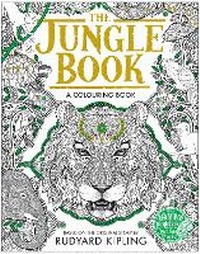
The Jungle Book Colouring Book
Published on 10. March 2016
Book
Paperback/Softback
96 pages
978-1-5098-2392-5 (ISBN)
Description
This beautifully produced colouring book contains all your favourite characters from Kipling's classic story - Mowgli, Baloo the Bear, Bagheera the Panther, Kaa the Snake, not forgetting the terrifying tiger, Shere Khan. Many of the drawings in this book were inspired the original illustrations by Kipling's father, J. Lockwood Kipling, who illustrated the first edition of The Jungle Book, published by Macmillan in 1894. With additional decorations and drawings based on traditional Indian designs, and with panels of text from the original story, this book will give hours of colouring fun, and is a wonderful introduction to this well-loved tale and Kipling's unforgettable characters. As the original publisher of The Jungle Book in 1894, Macmillan is publishing this book is part of a range of titles to celebrate the 150th anniversary of Kipling's birth in 1865. Printed on high-quality paper that will take crayon, paint or felt pen.
More details
Series
Language
English
Place of publication
London
United Kingdom
Publishing group
Pan Macmillan
Target group
Children/juvenile
Interest Age: From 9 to 11 years
Dimensions
Height: 287 mm
Width: 225 mm
Thickness: 12 mm
Weight
510 gr
ISBN-13
978-1-5098-2392-5 (9781509823925)
Copyright in bibliographic data and cover images is held by Nielsen Book Services Limited or by the publishers or by their respective licensors: all rights reserved.
Schweitzer Classification
Person
Rudyard Kipling was born in India in 1865. After intermittently moving between India and England during his early life, he settled in the latter in 1889, published his novel The Light That Failed in 1891 and married Caroline (Carrie) Balestier the following year. They returned to her home in Brattleboro, Vermont, where Kipling wrote both The Jungle Book and its sequel, as well as Captains Courageous. He continued to write prolifically and was the first Englishman to receive the Nobel Prize for Literature in 1907 but his later years were darkened by the death of his son John at the Battle of Loos in 1915. He died in 1936.