

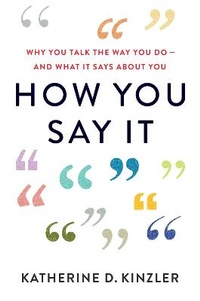
How You Say It
Published on 4. July 2020
Book
Hardback
256 pages
978-0-544-98655-8 (ISBN)
Description
From "one of the most brilliant young psychologists of her generation" (Paul Bloom), a groundbreaking examination of how speech causes some of our deepest social divides-and how it can help us overcome them.
We gravitate toward people like us; it's human nature. Race, class, and gender shape our social identities, and thus who we perceive as "like us" or "not like us". But one overlooked factor can be even more powerful: the way we speak. As the pioneering psychologist Katherine Kinzler reveals in How You Say It, the way we talk is central to our social identity because our speech largely reflects the voices we heard as children. We can change how we speak to some extent, whether by "code-switching" between dialects or learning a new language; over time, your speech even changes to reflect your evolving social identity and aspirations. But for the most part, we are forever marked by our native tongue-and are hardwired to prejudge others by theirs, often with serious consequences. Your accent alone can determine the economic opportunity or discrimination you encounter in life, making speech one of the most urgent social-justice issues of our day. Our linguistic differences present challenges, Kinzler shows, but they also can be a force for good. Humans can benefit from being exposed to multiple languages -a paradox that should inspire us to master this ancient source of tribalism, and rethink the role that speech plays in our society.
We gravitate toward people like us; it's human nature. Race, class, and gender shape our social identities, and thus who we perceive as "like us" or "not like us". But one overlooked factor can be even more powerful: the way we speak. As the pioneering psychologist Katherine Kinzler reveals in How You Say It, the way we talk is central to our social identity because our speech largely reflects the voices we heard as children. We can change how we speak to some extent, whether by "code-switching" between dialects or learning a new language; over time, your speech even changes to reflect your evolving social identity and aspirations. But for the most part, we are forever marked by our native tongue-and are hardwired to prejudge others by theirs, often with serious consequences. Your accent alone can determine the economic opportunity or discrimination you encounter in life, making speech one of the most urgent social-justice issues of our day. Our linguistic differences present challenges, Kinzler shows, but they also can be a force for good. Humans can benefit from being exposed to multiple languages -a paradox that should inspire us to master this ancient source of tribalism, and rethink the role that speech plays in our society.
More details
Language
English
Place of publication
London
United Kingdom
Publishing group
HarperCollins Publishers
Dimensions
Height: 236 mm
Width: 160 mm
Thickness: 25 mm
Weight
446 gr
ISBN-13
978-0-544-98655-8 (9780544986558)
Copyright in bibliographic data and cover images is held by Nielsen Book Services Limited or by the publishers or by their respective licensors: all rights reserved.
Schweitzer Classification