

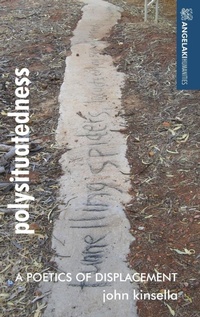
Polysituatedness
A Poetics of Displacement
Will be published approx. on 19. January 2017
Book
Hardback
448 pages
978-1-5261-1334-4 (ISBN)
Description
This book is concerned with the complexities of defining 'place', of observing and 'seeing' place, and how we might write a poetics of place. From Kathy Acker to indigenous Australian poet Jack Davis, the book touches on other writers and theorists, but in essence is a hands-on 'praxis' book of poetic practice. The work extends John Kinsella's theory of 'international regionalism' and posits new ways of reading the relationship between place and individual, between individual and the natural environment, and how place occupies the person as much as the person occupies place. It provides alternative readings of writers through place and space, especially Australian writers, but also non-Australian. Further, close consideration is given to being of 'famine-migrant' Irish heritage and the complexities of 'returning'. A close-up examination of 'belonging' and exclusion is made on a day-to-day basis. The book offers an approach to creating poems and literary texts constituted by experiencing multiple places, developing a model of polyvalent belonging known as 'polysituatedness'. It works as a companion volume to Kinsella's earlier Manchester University Press critical work, Disclosed Poetics: Beyond Landscape to Lyricism. -- .
Reviews / Votes
'The collection of critical essays, journal entries and poems, concerned with the complexities of defining 'place', ways of seeing and a poetics of place, explores his praxis in Jam Tree Gully, near Western Australian wheatbelt, the Mizen head peninsula, west Cork, and at Churchill College, Cambridge. He argues that one's place-identification is polyvalent and that place is a paradoxical condition of presence in recognition that individuals occupy many spaces at once and that no place is isolated from others. His engagement with displacement, the politics of making poems out of place, migration, and concern with animal, land and human rights radically challenges and offers a feast for the reader.'Tears in the fence Issue 66
'This work [...] is extraordinarily timely, and capable of stirring fruitful, productive reflection and action on how our capacity and capability with language can affect and interact with our place in the natural and social environment, the ecosphere.'
Stride Magazine
'The result is a book that provides so much to think about regarding our social, cultural, and political relationships to the world, that one picks it up and reexamines it over time, not only because of its 428 pages, including a rich bibliography, but also because of Kinsella's creative use of language. There is pleasure in engaging his vocabulary and looking up the words for poetic forms or geological formations-concretions, djitty-djitty, boustrophedon.'
Wendy Singer, Kenyon Review September 2018 -- .
More details
Series
Language
English
Place of publication
Manchester
United Kingdom
Target group
College/higher education
Professional and scholarly
Illustrations
28 black & white illustrations
Dimensions
Height: 240 mm
Width: 161 mm
Thickness: 29 mm
Weight
837 gr
ISBN-13
978-1-5261-1334-4 (9781526113344)
Copyright in bibliographic data and cover images is held by Nielsen Book Services Limited or by the publishers or by their respective licensors: all rights reserved.
Schweitzer Classification
Other editions
Additional editions
E-Book
01/2017
1st Edition
Manchester University Press
€189.99
Available for download
E-Book
01/2017
Manchester University Press
€127.99
Available for download
Person
John Kinsella is Professor of Literature and Sustainability at Curtin University and a Fellow of Churchill College, Cambridge University -- .
Content
Preface / synopsis
1. On place itself
2. Where we are
3. Displaced acts of writing
4. Sublimated displacements in read texts
5. Emplacement
6. Weirding place / Antibucolic
7. Appendices
Index -- .
1. On place itself
2. Where we are
3. Displaced acts of writing
4. Sublimated displacements in read texts
5. Emplacement
6. Weirding place / Antibucolic
7. Appendices
Index -- .