

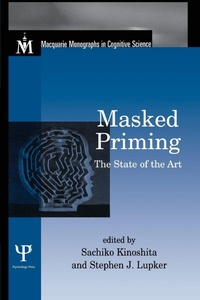
Masked Priming
The State of the Art
1st Edition
Published on 8. July 2013
Book
Paperback/Softback
512 pages
978-0-415-64993-3 (ISBN)
Description
Masked priming has a short and somewhat controversial history. When used as a tool to study whether semantic processing can occur in the absence of conscious awareness, considerable debate followed, mainly about whether masked priming truly tapped unconscious processes. For research into other components of visual word processing, however - in particular, orthographic, phonological, and morphological - a general consensus about the evidence provided by masked priming results has emerged. This book contains thirteen original chapters in which these three components of visual word processing are examined using the masked priming procedure. The chapters showcase the advantages of masked priming as an alternative to more standard methods of studying language processing that require comparisons of matched items. Based on a recent conference, this book offers up-to-date research findings, and would be valuable to researchers and students of word recognition, psycholinguistics, or reading.
More details
Series
Language
English
Place of publication
Hove
United Kingdom
Publishing group
Taylor & Francis Ltd
Target group
College/higher education
Illustrations
10 farbige Abbildungen
10 Illustrations, color
Dimensions
Height: 229 mm
Width: 152 mm
Thickness: 21 mm
Weight
558 gr
ISBN-13
978-0-415-64993-3 (9780415649933)
Copyright in bibliographic data and cover images is held by Nielsen Book Services Limited or by the publishers or by their respective licensors: all rights reserved.
Schweitzer Classification
Other editions
Additional editions
E-Book
06/2004
Psychology Press Ltd
€77.99
Available for download
E-Book
06/2004
Psychology Press Ltd
€77.99
Available for download

Book
06/2003
Psychology Press Ltd
€208.70
Article not available at the moment
Persons
Sachiko Kinoshita, Stephen J. Lupker
Content
Preface.
Section 1: Mechanisms. The Mechanics ofMasked Priming Kenneth I. Forster, Kathleen Mohan & JoHector.An Abstractionist Account of Masked and Long-TermPrimingJeffrey Bowers. A Retrospective View of MaskedPriming: Toward a Unified Account of Masked and Long-TermRepetition PrimingMichael E.J. Masson & Glen E. Bodner.
Section 2: Orthographics Effects. Transposed-LetterConfusability Effects in Masked Form Priming Manuel Perea& Stephen J. Lupker. Factors Underlying Masked PrimingEffects in Competitive Network Models of Visual WordRecognitionColin J. Davis
Section 3: Phonological Effects. The Robustness of Phonological Effects in FastPrimingRam Frost. Dissociating Automatic Orthographicand Phonological Codes in Lexical Access and LexicalAcquisition Michael B. Johnston & Anne E. Castles TheNature of Masked Onset Priming Effect in Naming: A ReviewSachiko Kinoshita.
Section 4: Morphological Effects. Racehorses, Reindeers and Sparrows: Using Masked Primingto Investigate Morphological Influences on Compound WordIdentification Natalie Shoolman and Sally Andrews.Reading Morphologically-Complex Words: Some Thoughts fromMasked Priming Kathleen Rastle and Matthew H.Davis.
Section 5: Masked Priming in Special Populations.
Masked Priming Across Languages: AnInsight into Bilingual Lexical Processing Chris Davis,Jeesun Kim & Rosa Sanchez-Casas Bilingual Visual WordRecognition: Evidence from Masked Phonological PrimingMarc Brysbaert
Word Recognition Development inChildren: Insights from Masked-PrimingAnne Castles,Chris Davis & Kenneth I. Forster
Section 1: Mechanisms. The Mechanics ofMasked Priming Kenneth I. Forster, Kathleen Mohan & JoHector.An Abstractionist Account of Masked and Long-TermPrimingJeffrey Bowers. A Retrospective View of MaskedPriming: Toward a Unified Account of Masked and Long-TermRepetition PrimingMichael E.J. Masson & Glen E. Bodner.
Section 2: Orthographics Effects. Transposed-LetterConfusability Effects in Masked Form Priming Manuel Perea& Stephen J. Lupker. Factors Underlying Masked PrimingEffects in Competitive Network Models of Visual WordRecognitionColin J. Davis
Section 3: Phonological Effects. The Robustness of Phonological Effects in FastPrimingRam Frost. Dissociating Automatic Orthographicand Phonological Codes in Lexical Access and LexicalAcquisition Michael B. Johnston & Anne E. Castles TheNature of Masked Onset Priming Effect in Naming: A ReviewSachiko Kinoshita.
Section 4: Morphological Effects. Racehorses, Reindeers and Sparrows: Using Masked Primingto Investigate Morphological Influences on Compound WordIdentification Natalie Shoolman and Sally Andrews.Reading Morphologically-Complex Words: Some Thoughts fromMasked Priming Kathleen Rastle and Matthew H.Davis.
Section 5: Masked Priming in Special Populations.
Masked Priming Across Languages: AnInsight into Bilingual Lexical Processing Chris Davis,Jeesun Kim & Rosa Sanchez-Casas Bilingual Visual WordRecognition: Evidence from Masked Phonological PrimingMarc Brysbaert
Word Recognition Development inChildren: Insights from Masked-PrimingAnne Castles,Chris Davis & Kenneth I. Forster