

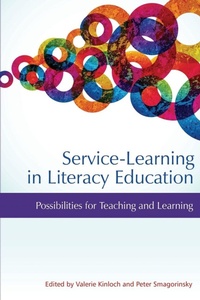
Service-Learning in Literacy Education
Possibilities for Teaching and Learning
Published on 13. March 2014
Book
Paperback/Softback
272 pages
978-1-62396-499-3 (ISBN)
Description
This edited collection will stand as the first volume that specifically describes service-learning programs and courses designed as part of teacher education programs in the fields of literacy education, secondary English education, elementary language arts education, and related fields. The contributing authors describe the programs they have developed at their universities and/or in their local communities, providing information about the rationale for their initiative, the design of the course, the outcomes of the experience, and other matters that will help literacy educators develop similar courses and experiences of their own.
Additionally, this edited collection will fill a great gap in the field's knowledge of alternative forms of teacher education. It will provide descriptions of service-learning initiatives that have been field-tested with demonstrable results. Thus far the field has produced widely scattered articles in journals covering a variety of disciplines, but no definitive collection of papers in which service-learning designed to promote literacy instruction is housed in a single volume edited for cross-referencing and thematic categorization.
The two editors have developed courses and received grants to support service-learning initiatives at their universities and believe that others might develop similar programs if they had better understandings of their value and design. Their intention with this volume is to promote service-learning more broadly among literacy educators.
Additionally, this edited collection will fill a great gap in the field's knowledge of alternative forms of teacher education. It will provide descriptions of service-learning initiatives that have been field-tested with demonstrable results. Thus far the field has produced widely scattered articles in journals covering a variety of disciplines, but no definitive collection of papers in which service-learning designed to promote literacy instruction is housed in a single volume edited for cross-referencing and thematic categorization.
The two editors have developed courses and received grants to support service-learning initiatives at their universities and believe that others might develop similar programs if they had better understandings of their value and design. Their intention with this volume is to promote service-learning more broadly among literacy educators.
More details
Language
English
Place of publication
Charlotte
United States
Publishing group
Emerald Publishing Inc
Target group
College/higher education
Dimensions
Height: 234 mm
Width: 156 mm
Thickness: 15 mm
Weight
418 gr
ISBN-13
978-1-62396-499-3 (9781623964993)
Copyright in bibliographic data and cover images is held by Nielsen Book Services Limited or by the publishers or by their respective licensors: all rights reserved.
Schweitzer Classification
Other editions
Additional editions
Valerie Kinloch | Peter Smagorinsky
Service-Learning in Literacy Education
Possibilities for Teaching and Learning
E-Book
03/2014
1st Edition
Information Age Publishing
from
€62.33
Available for download
Persons
Valerie Kinloch, The Ohio State University, USA
Peter Smagorinsky, The University of Georgia, USA
Peter Smagorinsky, The University of Georgia, USA
Content
Introduction, Peter Smagorinsky and Valerie Kinloch.
Part I. Service Learning in Schools and Communities.
Chapter 1. Transformative Service-Learning Initiatives in Urban Schools and Communities: Learning From Challenges, Emily Nemeth, Tamara Butler, Valerie Kinloch, Tori Washington, and Pam Reed.
Chapter 2. Garden in a Vacant Lot: Growing Thinkers at Tree House Books, Darcy Luetzow, Lauren Macaluso, and Eli Goldblatt.
Chapter 3. From San Francisco to Senegal: A Case Study of International Service-Learning Partnership Development, Dale Allender.
Chapter 4. An Authentic, Curriculum-Based Approach to Service-Learning, Meghan B. Thornton.
Part II. Service-Learning in Teaching and Teacher Education.
Chapter 5. Service-Learning in an Alternative School as Mediated Through Book Club Discussions, Peter Smagorinsky.
Chapter 6. Service-Learning and the Field-Based Literacy Methods Course, Michael Moore.
Chapter 7. Service-Learning and the Role of Teacher: An Initiative Working With Homeless Youth, Heidi Hallman and Melanie Burdick.
Chapter 8. From Service-Learning to Learning to Serve: Preparing Urban English Teachers as Organic Intellectuals, David E. Kirkland.
Chapter 9. Creating and Sustaining Service-Learning Tutoring Partnerships for English Learners, Paul H. Matthews.
Part III. Service Learning in the Humanities.
Chapter 10. Sustainability at a Distance: Service-Learning Relationships Across Time and Place, Lorelei Blackburn and Ellen Cushman.
Partnership Service-Learning Between Maya Immigrants and the University: Searching for a Path to Maya Children Success in the Schools, Alan Lebaron.
Chapter 11. English Comp and Service Learning: Bringing Life to the Classroom, Maria Mikolchak.
Chapter 12. Service-Learning and Civic Engagement: Pathway to Latin@ Immigrant Success Through Servant Leadership, Federico Marquez.
Part I. Service Learning in Schools and Communities.
Chapter 1. Transformative Service-Learning Initiatives in Urban Schools and Communities: Learning From Challenges, Emily Nemeth, Tamara Butler, Valerie Kinloch, Tori Washington, and Pam Reed.
Chapter 2. Garden in a Vacant Lot: Growing Thinkers at Tree House Books, Darcy Luetzow, Lauren Macaluso, and Eli Goldblatt.
Chapter 3. From San Francisco to Senegal: A Case Study of International Service-Learning Partnership Development, Dale Allender.
Chapter 4. An Authentic, Curriculum-Based Approach to Service-Learning, Meghan B. Thornton.
Part II. Service-Learning in Teaching and Teacher Education.
Chapter 5. Service-Learning in an Alternative School as Mediated Through Book Club Discussions, Peter Smagorinsky.
Chapter 6. Service-Learning and the Field-Based Literacy Methods Course, Michael Moore.
Chapter 7. Service-Learning and the Role of Teacher: An Initiative Working With Homeless Youth, Heidi Hallman and Melanie Burdick.
Chapter 8. From Service-Learning to Learning to Serve: Preparing Urban English Teachers as Organic Intellectuals, David E. Kirkland.
Chapter 9. Creating and Sustaining Service-Learning Tutoring Partnerships for English Learners, Paul H. Matthews.
Part III. Service Learning in the Humanities.
Chapter 10. Sustainability at a Distance: Service-Learning Relationships Across Time and Place, Lorelei Blackburn and Ellen Cushman.
Partnership Service-Learning Between Maya Immigrants and the University: Searching for a Path to Maya Children Success in the Schools, Alan Lebaron.
Chapter 11. English Comp and Service Learning: Bringing Life to the Classroom, Maria Mikolchak.
Chapter 12. Service-Learning and Civic Engagement: Pathway to Latin@ Immigrant Success Through Servant Leadership, Federico Marquez.