

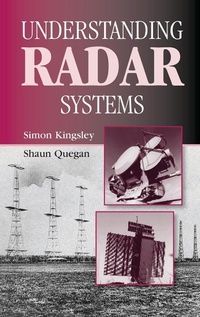
Understanding Radar Systems
Published on 30. June 1999
Book
Hardback
384 pages
978-1-891121-05-0 (ISBN)
Description
What is radar? What systems are currently in use? How do they work? Understanding Radar Systems provides engineers and scientists with answers to these critical questions, focusing on actual radar systems in use today. It's the perfect resource for those just entering the field or a quick refresher for experienced practitioners. The book leads readers through the specialized language and calculations that comprise the complex world of modern radar engineering as seen in dozens of state-of-the-art radar systems. The authors stress practical concepts that apply to all radar, keeping math to a minimum. Most of the book is based on real radar systems rather than theoretical studies. The result is a valuable, easy-to-use guide that makes the difficult parts of the field easier and helps readers do performance calculations quickly and easily.
More details
Series
Language
English
Place of publication
New York
United States
Target group
College/higher education
Professional and scholarly
Product notice
sewn/stitched
Cloth over boards
Dimensions
Height: 240 mm
Width: 161 mm
Thickness: 25 mm
Weight
751 gr
ISBN-13
978-1-891121-05-0 (9781891121050)
Copyright in bibliographic data and cover images is held by Nielsen Book Services Limited or by the publishers or by their respective licensors: all rights reserved.
Schweitzer Classification
Other editions
Additional editions
Simon Kingsley | Shaun Quegan
Understanding Radar Systems
E-Book
05/2014
1st Edition
SciTech Publishing Inc
€119.59
Available for download
Persons
Dr. Simon Kingsley is a lecturer at Sheffield University. He began a lifetime career in radar research with a PhD project that used radar to study the upper atmosphere. After a period as an advanced research fellow, he joined the Marconi Research Centre and led a group concerned with long range radar detection and tracking theory. In 1987 he joined Sheffield University to concentrate on the development of radar techniques, mainly for remote sensing.
Dr. Shaun Quegan is Director of the Sheffield Centre for Earth Observation Science and leads its Synthetic Aperture Radar (SAR) Research Group.
Dr. Shaun Quegan is Director of the Sheffield Centre for Earth Observation Science and leads its Synthetic Aperture Radar (SAR) Research Group.
Content
Chapter 1: Fundamentals
Chapter 2: Designing a surveillance radar
Chapter 3: Tracking radar
Chapter 4: Radar detection theory
Chapter 5: Signal and data processing
Chapter 6: Designing radar waveforms
Chapter 7: Secondary surveillance radar
Chapter 8: Propagation aspects
Chapter 9: Radar studies of the atmosphere
Chapter 10: Over-the-horizon radar
Chapter 11: Radar remote sensing
Chapter 12: Ground-probing radar
Chapter 13: Multistatic radar
Chapter 14: Electronic warfare
Chapter 15: Recent developments
Chapter 16: The future of radar
Appendix I: Symbols, their meaning and SI units
Appendix II: Acronyms and abbreviations
Appendix III: Useful conversion factors
Appendix IV: Using decibels
Appendix V: Solutions to problems
Chapter 2: Designing a surveillance radar
Chapter 3: Tracking radar
Chapter 4: Radar detection theory
Chapter 5: Signal and data processing
Chapter 6: Designing radar waveforms
Chapter 7: Secondary surveillance radar
Chapter 8: Propagation aspects
Chapter 9: Radar studies of the atmosphere
Chapter 10: Over-the-horizon radar
Chapter 11: Radar remote sensing
Chapter 12: Ground-probing radar
Chapter 13: Multistatic radar
Chapter 14: Electronic warfare
Chapter 15: Recent developments
Chapter 16: The future of radar
Appendix I: Symbols, their meaning and SI units
Appendix II: Acronyms and abbreviations
Appendix III: Useful conversion factors
Appendix IV: Using decibels
Appendix V: Solutions to problems