

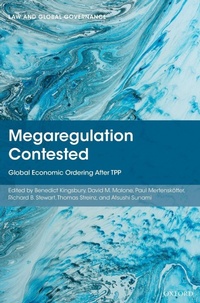
Megaregulation Contested
Global Economic Ordering After TPP
Published on 11. June 2019
Book
Hardback
752 pages
978-0-19-882529-6 (ISBN)
Description
The Japan-led Trans-Pacific Partnership (CPTPPA) of 2018 is the most far-reaching 'megaregional' economic agreement in force, with several major countries beyond its eleven negotiating countries also interested. Still bearing the stamp of the original US involvement before the Trump-era reversal, TPP is the first instance of 'megaregulation': a demanding combination of inter-state economic ordering and national regulatory governance on a highly ambitious substantive and trans-regional scale. Its text and ambition have influenced other negotiations ranging from the Japan-EU Agreement (JEEPA) and the US-Mexico-Canada Agreement (USMCA) to the projected Pan-Asian Regional Comprehensive Economic Partnership (RCEP).
This book provides an extensive analysis of TPP as a megaregulatory project for channelling and managing new pressures of globalization, and of core critical arguments made against economic megaregulation from standpoints of development, inequality, labour rights, environmental interests, corporate capture, and elite governance. Specialized chapters cover supply chains, digital economy, trade facilitation, intellectual property, currency levels, competition and state-owned enterprises, government procurement, investment, prescriptions for national regulation, and the TPP institutions. Country studies include detailed analyses of TPP-related politics and approaches in Japan, Mexico, Brazil, China, India, Indonesia, and Thailand. Contributors include leading practitioners and scholars in law, economics, and political science. At a time when the WTO and other global-scale institutions are struggling with economic nationalism and geopolitics, and bilateral and regional agreements are pressed by public disagreement and incompatibility with digital and capital and value chain flows, the megaregional ambition of TPP is increasingly important as a precedent requiring the close scrutiny this book presents.
This book provides an extensive analysis of TPP as a megaregulatory project for channelling and managing new pressures of globalization, and of core critical arguments made against economic megaregulation from standpoints of development, inequality, labour rights, environmental interests, corporate capture, and elite governance. Specialized chapters cover supply chains, digital economy, trade facilitation, intellectual property, currency levels, competition and state-owned enterprises, government procurement, investment, prescriptions for national regulation, and the TPP institutions. Country studies include detailed analyses of TPP-related politics and approaches in Japan, Mexico, Brazil, China, India, Indonesia, and Thailand. Contributors include leading practitioners and scholars in law, economics, and political science. At a time when the WTO and other global-scale institutions are struggling with economic nationalism and geopolitics, and bilateral and regional agreements are pressed by public disagreement and incompatibility with digital and capital and value chain flows, the megaregional ambition of TPP is increasingly important as a precedent requiring the close scrutiny this book presents.
More details
Series
Language
English
Place of publication
Oxford
United Kingdom
Target group
Professional and scholarly
Dimensions
Height: 250 mm
Width: 175 mm
Thickness: 44 mm
Weight
1447 gr
ISBN-13
978-0-19-882529-6 (9780198825296)
Copyright in bibliographic data and cover images is held by Nielsen Book Services Limited or by the publishers or by their respective licensors: all rights reserved.
Schweitzer Classification
Other editions
Additional editions
Benedict Kingsbury | David M. Malone | Paul Mertenskötter
Megaregulation Contested
Global Economic Ordering After TPP
E-Book
06/2019
1st Edition
OUP eBook
€79.49
Available for download
Benedict Kingsbury | David M. Malone | Paul Mertenskötter
Megaregulation Contested
Global Economic Ordering After TPP
E-Book
06/2019
1st Edition
OUP eBook
€91.49
Available for download
Persons
Benedict Kingsbury is Vice Dean and Murry and Ida Becker Professor of Law at New York University School of Law. He also serves as Director of the Institute for International Law and Justice and Faculty Director of the Guarini Institute for Global Legal Studies. His major current projects focus on large scale global ordering such as TPP and the Belt & Road Initiative; physical, digital, and informational infrastructure; and global data/tech law. He is one of the editors (with Andrew Hurrell of Oxford University, and Richard B. Stewart) of the Law and Global Governance series. His research projects on global governance issues have been supported by the National Science Foundation, Carnegie Corporation of New York, the Bill & Melinda Gates Foundation, and the Rockefeller Foundation.
David M. Malone is UN Under-Secretary General and Rector of the United Nations University. Malone previously served as President of Canada's International Development Research Centre; Canada's Representative to the UN Economic and Social Council and as Ambassador and Deputy Permanent Representative of Canada to the United Nations; as Director General of the Policy, International Organizations and Global Issues Bureaus within Canada's Department of Foreign Affairs and International Trade; as President of the International Peace Academy (now International Peace Institute); as DFAIT Assistant Deputy Minister for Global Issues; and as Canada's High Commissioner to India, and non-resident Ambassador to Bhutan and Nepal (2006-2008).
Paul Mertenskoetter is a Fellow at the Institute for International Law and Justice at NYU Law and a PhD candidate at Humboldt University of Berlin. He was a law clerk at the International Court of Justice and holds a JD from NYU Law and a BA from the University of York.
Richard B. Stewart (1940-2023) was University Professor and John Edward Sexton Professor of Law at New York University School of Law. Prior to joining the NYU School of Law faculty, he served as a Byrne Professor of Administrative Law at Harvard Law School and a member of the faculty of the Kennedy School of Government at Harvard; Assistant Attorney General in charge of the Environment and Natural Resource Division of the U.S. Department of Justice; and Chairman of the Environmental Defense Fund.
Thomas Streinz is Adjunct Professor of Law at NYU Law and a Fellow at the Institute for International Law and Justice. Prior to moving to New York, he studied law at the University of Bayreuth and Ludwig Maximilians University of Munich. He holds the EUI's Diploma in European law and an LLM from NYU Law.
Atsushi Sunami is currently Professor and Vice President at the National Graduate Institute for Policy Studies, Japan. He also serves as Special Advisor to Cabinet Office responsible for Science and Technology and Innovation. He is also a member of the Advisory Board for the Promotion of Science and Technology Diplomacy in Ministry of Foreign Affairs of Japan, the Council for Science and Technology in Ministry of Education, Culture, Sports, Science and Technology and the Expert Panel on Basic Policy in Council for Science, Technology and Innovation of Cabinet office.
David M. Malone is UN Under-Secretary General and Rector of the United Nations University. Malone previously served as President of Canada's International Development Research Centre; Canada's Representative to the UN Economic and Social Council and as Ambassador and Deputy Permanent Representative of Canada to the United Nations; as Director General of the Policy, International Organizations and Global Issues Bureaus within Canada's Department of Foreign Affairs and International Trade; as President of the International Peace Academy (now International Peace Institute); as DFAIT Assistant Deputy Minister for Global Issues; and as Canada's High Commissioner to India, and non-resident Ambassador to Bhutan and Nepal (2006-2008).
Paul Mertenskoetter is a Fellow at the Institute for International Law and Justice at NYU Law and a PhD candidate at Humboldt University of Berlin. He was a law clerk at the International Court of Justice and holds a JD from NYU Law and a BA from the University of York.
Richard B. Stewart (1940-2023) was University Professor and John Edward Sexton Professor of Law at New York University School of Law. Prior to joining the NYU School of Law faculty, he served as a Byrne Professor of Administrative Law at Harvard Law School and a member of the faculty of the Kennedy School of Government at Harvard; Assistant Attorney General in charge of the Environment and Natural Resource Division of the U.S. Department of Justice; and Chairman of the Environmental Defense Fund.
Thomas Streinz is Adjunct Professor of Law at NYU Law and a Fellow at the Institute for International Law and Justice. Prior to moving to New York, he studied law at the University of Bayreuth and Ludwig Maximilians University of Munich. He holds the EUI's Diploma in European law and an LLM from NYU Law.
Atsushi Sunami is currently Professor and Vice President at the National Graduate Institute for Policy Studies, Japan. He also serves as Special Advisor to Cabinet Office responsible for Science and Technology and Innovation. He is also a member of the Advisory Board for the Promotion of Science and Technology Diplomacy in Ministry of Foreign Affairs of Japan, the Council for Science and Technology in Ministry of Education, Culture, Sports, Science and Technology and the Expert Panel on Basic Policy in Council for Science, Technology and Innovation of Cabinet office.
Editor
Murry and Ida Becker Professor of Law and director of the Institute for International Law and JusticeMurry and Ida Becker Professor of Law and director of the Institute for International Law and Justice, NYU Law
Rector of the United Nations University and Under-Secretary-General of the United NationsRector of the United Nations University and Under-Secretary-General of the United Nations, United Nations University, Tokyo
FellowFellow, NYU Law
John Edward Sexton Professor of LawJohn Edward Sexton Professor of Law, NYU Law
FellowFellow, NYU Law
Vice President and ProfessorVice President and Professor, National Graduate Institute for Policy Studies, Tokyo
Content
List of Contributors
Abbreviations
1: Benedict Kingsbury, David M. Malone, Paul Mertenskoetter, Richard B. Stewart, Thomas Streinz, and Atsushi Sunami: Introduction: The Essence, Significance, and Problems of the Trans-Pacific Partnership
I . MEGAREGUL ATION, GEOPOLITICS, AND ORDERING PROJECTS
2: Benedict Kingsbury, Paul Mertenskoetter, Richard B. Stewart, and Thomas Streinz: The Trans-Pacific Partnership as Megaregulation
3: David M. Malone: The Uncertain Geo-Strategic Outlook for the US in Asia: The Pivot, the Re-Balance, TPP, and Now What?
4: Jing Tao: TPP and China: A Tale of Two Economic Orderings?
II. CONTESTING MEGAREGUL ATION: DISTRIBUTION, INEQUALIT Y, AND DEVELOPMENT
5: Annelise Riles: The Politics of Expertise in Transnational Economic Governance: Breaking the Cycle
6: B. S. Chimni: Power and Inequality in Megaregulation: The TPP Model
7: Alvaro Santos: The Lessons of TPP and the Future of Labor Chapters in Trade Agreements
8: Errol Meidinger: TPP and Environmental Regulation
9: Antonia Eliason: Customs Administration and Trade Facilitation in TPP: The Missing Development Agenda
III. TRANSNATIONAL BUSINESS: GLOBAL VALUE CHAINS AND THE DIGITAL ECONOMY
10: Bernard Hoekman and Charles F. Sabel: In a World of Value Chains: What Space for Regulatory Coherence and Cooperation in Trade Agreements?
11: Donald Robertson: The Regulation of Firms in Globally Intertwined Markets: The Case of Payment Systems
12: Dan Ciuriak: TPP's Business Asymmetries: Megaregulation and the Conditions of Competition Between MNCs and SMEs
13: Iain Osgood: Sales, Sourcing, or Regulation? Evidence from TPP on What Drives Corporate Support for Trade
14: Thomas Streinz: Digital Megaregulation Uncontested? TPP's Model for the Global Digital Economy
IV. MEGAREGUL ATION, THE REGUL ATORY STATE, AND THE MARKET
15: Rochelle Cooper Dreyfuss: Harmonization: Top Down, Bottom Up-and Now Sideways? The Impact of the IP Provisions of Megaregional Agreements on Third Party States
16: Kiyoshi Adachi: Thailand and Public Health: Looking Beyond the Intellectual Property Chapter of TPP
17: Paul Mertenskoetter and Richard B. Stewart: Remote Control: TPP's Administrative Law Requirements as Megaregulation
18: Daniel Francis: Choices and Consequences: Internationalizing Competition Policy After TPP
19: Wahyuni Bahar and Joseph Wira Koesnaidi: How Ready Is Indonesia to Open Government Procurement a la TPP?
20: Kenichi Kawasaki, Atsushi Sunami, Yoko Ikeda, and Michael C. Huang: Japan: Leveraging National Regulatory Reform and the Economic Modeling of Trade Agreements
21: Michael Livermore and Jason Schwartz: Regulating Regulation: Impact Assessment and Trade
22: Matthias Helble, Pornpinun Chantapacdepong, and Naoyuki Yoshino: Trade and Exchange Rates: The Joint Declaration of the Macroeconomic Policy Authorities of TPP Countries
V. MEGAREGULATORY TREATY INSTITUTIONS
23: Robert Howse: The Institutions of TPP11: Back to the Future?
24: Donald McRae: State-to-State Dispute Settlement in Megaregionals
25: Chin Leng Lim: Finding a Workable Balance Between Investor Protection and the Public Interest in the Trans-Pacific Partnership
VI. NATIONAL POLITICS OF MEGAREGUL ATORY AGREEMENTS
26: Christina L. Davis: Japan: Interest Group Politics, Foreign Policy Linkages, and TPP
27: Robert Gulotty: Structuring Participation: Public Comments and the Dynamics of US Trade Negotiations
28: Alejandro Rodiles: After TPP Is Before TPP: Mexican Politics for Economic Globalization and the Lost Chance for Reflection
29: Rodrigo Polanco Lazo: Regional and Preferential Agreements: The 'Pacific' and 'Atlantic' Styles in Latin America
30: Brazil in the Shadow of Megaregional Trade and Investment Standards: Beyond the Grand Debate, Pragmatic Responses: Brazil in the Shadow of Megaregional Trade and Investment Standards: Beyond the Grand Debate, Pragmatic Responses
31: Harsha Vardhana Singh: TPP and India: Inspirations for Sequenced Reforms
Index
Abbreviations
1: Benedict Kingsbury, David M. Malone, Paul Mertenskoetter, Richard B. Stewart, Thomas Streinz, and Atsushi Sunami: Introduction: The Essence, Significance, and Problems of the Trans-Pacific Partnership
I . MEGAREGUL ATION, GEOPOLITICS, AND ORDERING PROJECTS
2: Benedict Kingsbury, Paul Mertenskoetter, Richard B. Stewart, and Thomas Streinz: The Trans-Pacific Partnership as Megaregulation
3: David M. Malone: The Uncertain Geo-Strategic Outlook for the US in Asia: The Pivot, the Re-Balance, TPP, and Now What?
4: Jing Tao: TPP and China: A Tale of Two Economic Orderings?
II. CONTESTING MEGAREGUL ATION: DISTRIBUTION, INEQUALIT Y, AND DEVELOPMENT
5: Annelise Riles: The Politics of Expertise in Transnational Economic Governance: Breaking the Cycle
6: B. S. Chimni: Power and Inequality in Megaregulation: The TPP Model
7: Alvaro Santos: The Lessons of TPP and the Future of Labor Chapters in Trade Agreements
8: Errol Meidinger: TPP and Environmental Regulation
9: Antonia Eliason: Customs Administration and Trade Facilitation in TPP: The Missing Development Agenda
III. TRANSNATIONAL BUSINESS: GLOBAL VALUE CHAINS AND THE DIGITAL ECONOMY
10: Bernard Hoekman and Charles F. Sabel: In a World of Value Chains: What Space for Regulatory Coherence and Cooperation in Trade Agreements?
11: Donald Robertson: The Regulation of Firms in Globally Intertwined Markets: The Case of Payment Systems
12: Dan Ciuriak: TPP's Business Asymmetries: Megaregulation and the Conditions of Competition Between MNCs and SMEs
13: Iain Osgood: Sales, Sourcing, or Regulation? Evidence from TPP on What Drives Corporate Support for Trade
14: Thomas Streinz: Digital Megaregulation Uncontested? TPP's Model for the Global Digital Economy
IV. MEGAREGUL ATION, THE REGUL ATORY STATE, AND THE MARKET
15: Rochelle Cooper Dreyfuss: Harmonization: Top Down, Bottom Up-and Now Sideways? The Impact of the IP Provisions of Megaregional Agreements on Third Party States
16: Kiyoshi Adachi: Thailand and Public Health: Looking Beyond the Intellectual Property Chapter of TPP
17: Paul Mertenskoetter and Richard B. Stewart: Remote Control: TPP's Administrative Law Requirements as Megaregulation
18: Daniel Francis: Choices and Consequences: Internationalizing Competition Policy After TPP
19: Wahyuni Bahar and Joseph Wira Koesnaidi: How Ready Is Indonesia to Open Government Procurement a la TPP?
20: Kenichi Kawasaki, Atsushi Sunami, Yoko Ikeda, and Michael C. Huang: Japan: Leveraging National Regulatory Reform and the Economic Modeling of Trade Agreements
21: Michael Livermore and Jason Schwartz: Regulating Regulation: Impact Assessment and Trade
22: Matthias Helble, Pornpinun Chantapacdepong, and Naoyuki Yoshino: Trade and Exchange Rates: The Joint Declaration of the Macroeconomic Policy Authorities of TPP Countries
V. MEGAREGULATORY TREATY INSTITUTIONS
23: Robert Howse: The Institutions of TPP11: Back to the Future?
24: Donald McRae: State-to-State Dispute Settlement in Megaregionals
25: Chin Leng Lim: Finding a Workable Balance Between Investor Protection and the Public Interest in the Trans-Pacific Partnership
VI. NATIONAL POLITICS OF MEGAREGUL ATORY AGREEMENTS
26: Christina L. Davis: Japan: Interest Group Politics, Foreign Policy Linkages, and TPP
27: Robert Gulotty: Structuring Participation: Public Comments and the Dynamics of US Trade Negotiations
28: Alejandro Rodiles: After TPP Is Before TPP: Mexican Politics for Economic Globalization and the Lost Chance for Reflection
29: Rodrigo Polanco Lazo: Regional and Preferential Agreements: The 'Pacific' and 'Atlantic' Styles in Latin America
30: Brazil in the Shadow of Megaregional Trade and Investment Standards: Beyond the Grand Debate, Pragmatic Responses: Brazil in the Shadow of Megaregional Trade and Investment Standards: Beyond the Grand Debate, Pragmatic Responses
31: Harsha Vardhana Singh: TPP and India: Inspirations for Sequenced Reforms
Index