

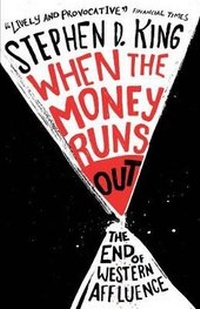
When the Money Runs Out
The End of Western Affluence
Published on 15. March 2014
Book
Paperback/Softback
304 pages
978-0-300-20523-7 (ISBN)
Description
An esteemed economist warns that Western societies' economic expectations for the future are about to collide with reality
The Western world has experienced extraordinary economic progress throughout the last six decades, a prosperous period so extended that continuous economic growth has come to seem normal. But such an era of continuously rising living standards is a historical anomaly, economist Stephen D. King warns, and the current stagnation of Western economies threatens to reach crisis proportions in the not-so-distant future. Praised for the "dose of realism" he provided in his book Losing Control, King follows up in this volume with a plain-spoken assessment of where the West stands today. It's not just the end of an age of affluence, he shows. We have made promises to ourselves that are achievable only through ongoing economic expansion. The future benefits we expect-pensions, healthcare, and social security, for example-may be larger than tomorrow's resources. And if we reach that point, which promises will be broken and who will lose out? The lessons of history offer compelling evidence that political and social upheaval are often born of economic stagnation. King addresses these lessons with a multifaceted plan that involves painful-but necessary-steps toward a stable and just economic future.
The Western world has experienced extraordinary economic progress throughout the last six decades, a prosperous period so extended that continuous economic growth has come to seem normal. But such an era of continuously rising living standards is a historical anomaly, economist Stephen D. King warns, and the current stagnation of Western economies threatens to reach crisis proportions in the not-so-distant future. Praised for the "dose of realism" he provided in his book Losing Control, King follows up in this volume with a plain-spoken assessment of where the West stands today. It's not just the end of an age of affluence, he shows. We have made promises to ourselves that are achievable only through ongoing economic expansion. The future benefits we expect-pensions, healthcare, and social security, for example-may be larger than tomorrow's resources. And if we reach that point, which promises will be broken and who will lose out? The lessons of history offer compelling evidence that political and social upheaval are often born of economic stagnation. King addresses these lessons with a multifaceted plan that involves painful-but necessary-steps toward a stable and just economic future.
Reviews / Votes
"'For many, the financial crisis is a temporary interruption in the rise of western prosperity that is due to easily remedied policy mistakes. The Keynesians believe this, as do anti-Keynesians on the free-market right. King argues, instead, that the future is not what it used to be. We have made promises to ourselves we cannot afford to keep. The argument is important.' (Martin Wolf, Financial Times) 'Well-written, thoughtful and highly convincing... King's clear-eyed assessment of the problems ahead makes the book essential reading.' (The Economist) 'The conclusions are clear and compelling... The book should appeal to a wider audience than economists. The author is a newspaper columnist as well as a professional economist, and it shows in the crisp and easy style of his prose. I recommend it heartily.' (Erik Britton, Management Today) 'an interesting and well-written book' (Paul Ormerod, City AM) 'The book is jammed full of history and is highly readable - being rich in the economic history that he argues was lacking in pre-crisis economic analysis. It is accompanied by some wonderful anecdotes and provides a good mix of economics and politics in addition to its historical detail.' (George Buckley, Financial World) 'Overall, as Charles Moore notes in The Daily Telegraph, 'it's alarmingly difficult to disagree' with this book.' (Matthew Partridge, Money Week)"More details
Language
English
Place of publication
United States
Product notice
Paperback (trade)
Dimensions
Height: 197 mm
Width: 127 mm
Weight
331 gr
ISBN-13
978-0-300-20523-7 (9780300205237)
Copyright in bibliographic data and cover images is held by Nielsen Book Services Limited or by the publishers or by their respective licensors: all rights reserved.
Schweitzer Classification
Other editions
New editions
Book
04/2018
Yale University Press
€19.00
Shipment within 10-20 days
Person
Stephen D. King is Group Chief Economist and Global Head of Economics and Asset Allocation research at HSBC. He lives in London.