

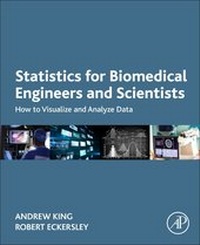
Statistics for Biomedical Engineers and Scientists
How to Visualize and Analyze Data
Published on 21. May 2019
Book
Paperback/Softback
274 pages
978-0-08-102939-8 (ISBN)
Description
Statistics for Biomedical Engineers and Scientists: How to Analyze and Visualize Data provides an intuitive understanding of the concepts of basic statistics, with a focus on solving biomedical problems. Readers will learn how to understand the fundamental concepts of descriptive and inferential statistics, analyze data and choose an appropriate hypothesis test to answer a given question, compute numerical statistical measures and perform hypothesis tests 'by hand', and visualize data and perform statistical analysis using MATLAB. Practical activities and exercises are provided, making this an ideal resource for students in biomedical engineering and the biomedical sciences who are in a course on basic statistics.
Reviews / Votes
"This book is a very interesting introduction to the basic concepts of statistics. The majority of examples are taken from medicine and biology. However, the scope of the book is more general, so it is worth to be read by everybody, who wants to apply statistical methods in any field." --zbMATHMore details
Language
English
Place of publication
London
United Kingdom
Publishing group
Elsevier Science & Technology
Target group
College/higher education
Biomedical; Engineers, biomedical sciences; Students, researchers
Dimensions
Height: 235 mm
Width: 191 mm
Weight
560 gr
ISBN-13
978-0-08-102939-8 (9780081029398)
Copyright in bibliographic data and cover images is held by Nielsen Book Services Limited or by the publishers or by their respective licensors: all rights reserved.
Schweitzer Classification
Other editions
Additional editions
Andrew P. King | Robert Eckersley
Statistics for Biomedical Engineers and Scientists
How to Visualize and Analyze Data
E-Book
05/2019
Academic Press
€51.99
Available for download
Persons
Dr King has over 20 years of experience of teaching computing courses at university level. He is currently a Reader in the Biomedical Engineering department at King's College London. With Paul Aljabar, he designed and developed the Computer Programming module for Biomedical Engineering students upon which this book was based. The module has been running since 2014 and Andrew still co-organises and teaches on it. Between 2001-2005, Andrew worked as an Assistant Professor in the Computer Science department at Mekelle University in Ethiopia, and was responsible for curriculum development, and design and delivery of a number of computing modules. Andrew's research interests focus mainly on the use of machine learning and artificial intelligence techniques to tackle problems in medical imaging, with a special focus on dynamic imaging data, i.e. moving organs (Google Scholar: https://goo.gl/ZZGrGr, group web site: http://kclmmag.org). Dr. Robert Eckersley is a Senior Lecturer in the School of Biomedical Engineering and Imaging Sciences at King's College London. His research interests include all aspects of the physics and engineering of medical ultrasound imaging. He has a long standing interest in the development of microbubble contrast agents for quantitative functional imaging with ultrasound. He is currently PI on an EPSRC grant investigating the development of super-resolution strategies for ultrasound imaging and is an co-investigator on the Wellcome and EPSRC funded iFind project http://www.ifindproject.com.
Content
1. Descriptive Statistics I: Univariate Statistics
2. Descriptive Statistics II: Bivariate Statistics
3. Descriptive Statistics III: ROC Analysis
4. Inferential Statistics I: Basic Concepts
5. Inferential Statistics II: Parametric Hypothesis Testing
6. Inferential Statistics III: Nonparametric Hypothesis Testing
7. Inferential Statistics IV: Choosing a Hypothesis Test
8. Inferential Statistics V: Multiple Hypothesis Testing
9. Experimental Design and Sample Size Calculations
10. Statistical Shape Models
11. Case Study on Descriptive and Inferential Statistics
2. Descriptive Statistics II: Bivariate Statistics
3. Descriptive Statistics III: ROC Analysis
4. Inferential Statistics I: Basic Concepts
5. Inferential Statistics II: Parametric Hypothesis Testing
6. Inferential Statistics III: Nonparametric Hypothesis Testing
7. Inferential Statistics IV: Choosing a Hypothesis Test
8. Inferential Statistics V: Multiple Hypothesis Testing
9. Experimental Design and Sample Size Calculations
10. Statistical Shape Models
11. Case Study on Descriptive and Inferential Statistics