

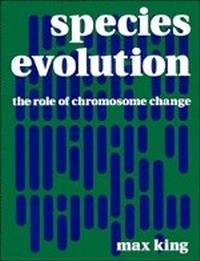
Species Evolution
The Role of Chromosome Change
Published on 23. September 1993
Book
Hardback
358 pages
978-0-521-35308-3 (ISBN)
Description
What are species? What are the factors involved in their evolution? Dr Max King presents an up-to-date synthesis of theoretical, experimental and descriptive perspectives on speciation in higher organisms. The book provides a fresh insight into the processes involved in speciation utilizing the multi-dimensional databases now available. The author clearly and concisely analyses the most recent research in plant and animal populations, concentrating on the evolutionary processes, the role of chromosomes and the genetic mechanisms involved in speciation. This book will be essential reading for research workers in genetics, evolutionary studies, botany and zoology, as well as being of interest to advanced students entering the field.
Reviews / Votes
'All in all, I recommend cytogeneticists to read Max King's book to discover the maximum possible impact chromosomes may have on speciation. However, his ideas may be a long way from the truth ... the debate on speciation continues.' Jeremy Searle, Chromosome ResearchMore details
Language
English
Place of publication
Cambridge
United Kingdom
Target group
Professional and scholarly
Illustrations
15 Tables, unspecified; 10 Halftones, unspecified; 20 Line drawings, unspecified
Dimensions
Height: 253 mm
Width: 195 mm
Thickness: 22 mm
Weight
975 gr
ISBN-13
978-0-521-35308-3 (9780521353083)
Copyright in bibliographic data and cover images is held by Nielsen Book Services Limited or by the publishers or by their respective licensors: all rights reserved.
Schweitzer Classification
Other editions
New editions
Book
01/1995
Cambridge University Press
€110.10
Shipment within 15-20 days
Additional editions
Book
01/1995
Cambridge University Press
€110.10
Shipment within 15-20 days
Content
1. Introduction; 2. The species - what's in a name?; 3. Speciation in allopatric populations; 4. The founder effect; 5. Chromosomal isolating mechanisms; 6. The fixation of rearrangements; 7. Fertility, viability and hybridity; 8. Genic change and chromosomal speciation; 9. Chromosomal speciation; 10. Molecular mechanisms and speciation; 11. Conclusions and perspectives; References; Index.