

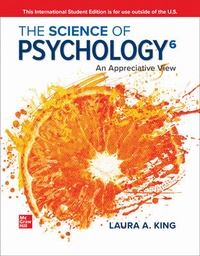
The Science of Psychology: An Appreciative View ISE
6th Edition
Published on 15. November 2022
Book
Paperback/Softback
1536 pages
978-1-265-20022-0 (ISBN)
Description
Focusing on why things go right, The Science of Psychology: An Appreciative View, helps students understand and appreciate psychology as a science and as an integrated whole. Informed by student data, the program extends these themes and enhances their pedagogical value by guiding students toward topics they find the most challenging and offering new learning resources to master them. When paired with Connect, students will also benefit from Thematic Relevancy Modules (brief, thought-provoking modules tied to the APA's IPI Student Learning Outcomes), Interactivities and Application-Based-Activities, Psych-at-Work videos (interviews with real people), and more to help further prepare them to be successful in this course.
More details
Edition
6th edition
Language
English
Place of publication
OH
United States
Target group
College/higher education
US School Grade: From College Freshman to College Graduate Student
Illustrations
183 Illustrations
Dimensions
Height: 277 mm
Width: 229 mm
Thickness: 30 mm
Weight
1291 gr
ISBN-13
978-1-265-20022-0 (9781265200220)
Copyright in bibliographic data and cover images is held by Nielsen Book Services Limited or by the publishers or by their respective licensors: all rights reserved.
Schweitzer Classification
Person
Laura King did her undergraduate work at Kenyon College, where, an English major, she declared a second major, in psychology, during the second semester of her junior year. She completed her A.B. in English with high honors and distinction and in psychology with distinction in 1986. Laura then did graduate work at Michigan State University and the University of California, Davis, receiving her Ph.D. in personality psychology in 1991.Laura began her career at Southern Methodist University in Dallas, moving to the University of Missouri, Columbia, in 2001, where she is now a professor. In addition to seminars in the development of character, social psychology, and personality psychology, she has taught undergraduate lecture courses in introductory psychology, introduction to personality psychology, and social psychology. At SMU, she received six different teaching awards, including the "M" award for "sustained excellence" in 1999. At the University of Missouri, she received the Chancellor's Award for Outstanding Research and Creative Activity in 2004.Her research, which has been funded by the National Institutes for Mental Health, has focused on a variety of topics relevant to the question of what it is that makes for a good life. She has studied goals, life stories, happiness, well-being, and meaning in life. In general, her work reflects an enduring interest in studying what is good and healthy in people. In 2001, her research accomplishments were recognized by a Templeton Prize in positive psychology. Laura's research (often in collaboration with undergraduate and graduate students) has been published in the Journal of Personality and Social Psychology, Personality and Social Psychology Bulletin, Cognition and Emotion, the Journal of Personality, and other publications . A new paper on the place of regrets in maturity is forthcoming in the American Psychologist.Currently editor-in-chief of the Journal of Research in Personality, Laura has also served as associate editor of Personality and Social Psychology Bulletin and the Journal of Personality and Social Psychology, as well as on numerous grant panels. She has edited or co-edited special sections of the Journal of Personality and the American Psychologist. In "real life," Laura is an accomplished cook and enjoys listening to music (mostly jazz vocalists and singer-songwriters), gardening, and chasing Sam, her 3-year-old son.
Content
Chapter 1: What is Psychology?
Chapter 2: Psychology's Scientific Method
Chapter 3: Biological Foundations of Behavior
Chapter 4: Sensation and Perception
Chapter 5: States of Consciousness
Chapter 6: Learning
Chapter 7: Memory
Chapter 8: Thinking, Intelligence, and Language
Chapter 9: Human Development
Chapter 10: Motivation and Emotion
Chapter 11: Gender, Sex, and Sexuality
Chapter 12: Personality
Chapter 13: Social Psychology
Chapter 14: Industrial and Organizational Psychology
Chapter 15: Psychological Disorders
Chapter 16: Therapies
Chapter 17: Health Psychology
Chapter 2: Psychology's Scientific Method
Chapter 3: Biological Foundations of Behavior
Chapter 4: Sensation and Perception
Chapter 5: States of Consciousness
Chapter 6: Learning
Chapter 7: Memory
Chapter 8: Thinking, Intelligence, and Language
Chapter 9: Human Development
Chapter 10: Motivation and Emotion
Chapter 11: Gender, Sex, and Sexuality
Chapter 12: Personality
Chapter 13: Social Psychology
Chapter 14: Industrial and Organizational Psychology
Chapter 15: Psychological Disorders
Chapter 16: Therapies
Chapter 17: Health Psychology