

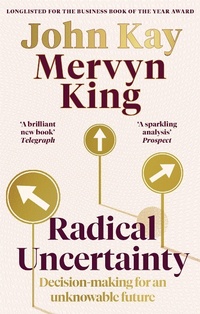
Radical Uncertainty
Decision-making for an unknowable future
Published on 2. September 2021
Book
Paperback/Softback
560 pages
978-0-349-14399-6 (ISBN)
Description
'A brilliant new book'
Daily Telegraph
'Well written . . . and often entertaining'
The Times
'A sparkling analysis'
Prospect
When uncertainty is all around us, and the facts are not clear, how can we make good decisions?
We do not know what the future will hold, particularly in the midst of a crisis, but we must make decisions anyway. We regularly crave certainties which cannot exist and invent knowledge we cannot have, forgetting that humans are successful because we have adapted to an environment that we understand only imperfectly. Throughout history we have developed a variety of ways of coping with the radical uncertainty that defines our lives.
This incisive and eye-opening book draws on biography, history, mathematics, economics and philosophy to highlight the most successful - and most short-sighted - methods of dealing with an unknowable future. Ultimately, the authors argue, the prevalent method of our age falls short, giving us a false understanding of our power to make predictions, leading to many of the problems we experience today.
Tightly argued, provocative and written with wit and flair, Radical Uncertainty is at once an exploration of the limits of numbers and a celebration of human instinct and wisdom.
Daily Telegraph
'Well written . . . and often entertaining'
The Times
'A sparkling analysis'
Prospect
When uncertainty is all around us, and the facts are not clear, how can we make good decisions?
We do not know what the future will hold, particularly in the midst of a crisis, but we must make decisions anyway. We regularly crave certainties which cannot exist and invent knowledge we cannot have, forgetting that humans are successful because we have adapted to an environment that we understand only imperfectly. Throughout history we have developed a variety of ways of coping with the radical uncertainty that defines our lives.
This incisive and eye-opening book draws on biography, history, mathematics, economics and philosophy to highlight the most successful - and most short-sighted - methods of dealing with an unknowable future. Ultimately, the authors argue, the prevalent method of our age falls short, giving us a false understanding of our power to make predictions, leading to many of the problems we experience today.
Tightly argued, provocative and written with wit and flair, Radical Uncertainty is at once an exploration of the limits of numbers and a celebration of human instinct and wisdom.
More details
Language
English
Place of publication
United Kingdom
Publishing group
Little, Brown Book Group
Target group
College/higher education
Professional and scholarly
Dimensions
Height: 198 mm
Width: 131 mm
Thickness: 41 mm
Weight
433 gr
ISBN-13
978-0-349-14399-6 (9780349143996)
Copyright in bibliographic data and cover images is held by Nielsen Book Services Limited or by the publishers or by their respective licensors: all rights reserved.
Schweitzer Classification
Other editions
Additional editions
E-Book
03/2020
The Bridge Street Press
€3.99
Available for download
Persons
Mervyn King was Governor of the Bank of England from 2003 to 2013, and is currently Professor of Economics and Law at New York University and School Professor of Economics at the London School of Economics. Lord King was made a life peer in 2013, and appointed by the Queen a Knight of the Garter in 2014.
John Kay is a visiting professor at the London School of Economics and a Fellow of St John's College, Oxford. He is a director of several public companies and contributes a weekly column to the Financial Times. He chaired the UK government review of equity markets which reported in 2012 recommending substantial reforms. He is the author of many books including Other People's Money, The Truth about Markets, The Long and the Short of It and Obliquity.
John Kay is a visiting professor at the London School of Economics and a Fellow of St John's College, Oxford. He is a director of several public companies and contributes a weekly column to the Financial Times. He chaired the UK government review of equity markets which reported in 2012 recommending substantial reforms. He is the author of many books including Other People's Money, The Truth about Markets, The Long and the Short of It and Obliquity.