

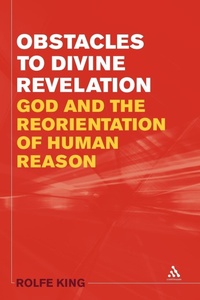
Obstacles to Divine Revelation
God and the Reorientation of Human Reason
Published on 5. January 2012
Book
Paperback/Softback
292 pages
978-1-4411-3454-7 (ISBN)
Description
Obstacles to Divine Revelation applies a philosophical approach to examining the concept of divine revelation and explores the notion that it may not be a simple matter for God, if there is a God, to give revelation to human beings. Rolfe King argues that there are obstacles to divine revelation and that exploring these leads to a significant clarification of the idea of evidence for God. These obstacles may also account for aspects of divine hiddenness which have not been adequately explored in philosophy of religion or theology. King contends that it is impossible for God to give human beings knowledge of God unless they also have some trust, or faith, in God, and that it is impossible to separate the concept of evidence of possible divine revelation from notions of divine plans. The idea of a necessary structure of revelation, should there be a God who chooses to give revelation, is explored, and it is argued that this leads to Hume's famous argument about miracles being turned on its head. A unique explanation of the narrative power of the incarnation in Christian theology is given, seeing incarnation as part of the best divine plan to overcome obstacles to revelation.
King highlights a new theory of religious truth as part of a suggested wider theory of knowledge which will be of interest to philosophers in both the Anglo-American and continental traditions of philosophy.
King highlights a new theory of religious truth as part of a suggested wider theory of knowledge which will be of interest to philosophers in both the Anglo-American and continental traditions of philosophy.
Reviews / Votes
'A wide-ranging and probing treatment of an interesting but neglected topic. Benefitting from both continental and analytic philosophy, King develops a theistic epistemology more theologically sensitive than many on offer today.' J.L. Schellenberg, Professor of Philosophy, Mount Saint Vincent University, Canada 'This is a bold and imaginative book that puts forward the thesis that there are, by the nature of the created order, aspects of existence that block or hinder some forms of divine disclosure. It proposes that there is a logically given structure to revelation, which God, if there is such a being, must work within. A main virtue of Obstacles to Divine Revelation is that it approaches familiar theological issue from the perspective and using the tools of analytical philosophy. It would be useful to advanced students of theologians as well as philosophers because it offers fair expositions of the work of many key thinkers and takes provocative, well-argued positions within a number of current debates in the field. This is an excellent addition to the literature dealing with revelation.' Revd Dr Adam Hood, Vice Principal & Director of Graduate and Research Centre, The University of Birmingham, UK 'Lucid and well-informed, this book makes a constructive contribution to contemporary philosophy of religion. It breaks new ground with its fascinating focus on the constraints facing any divine revelation within the created order.' Roger Trig& Emeritus Professor of Philosophy, University of Warwick, UK In this important work, King asks an interesting question: 'what obstacles does God face when it comes to self-disclosure?' Many will be struck by the somewhat unusual nature of such a project, for it seems that focus within contemporary philosophy of religion is centred more on the problem of religious knowing from the human perspective. For King, the obstacles to divine revelation are not features of God (i.e. are not some kind of inner deficiency within God), but are features of the created order. King is concerned with identifying the necessary structure of revelation given the limits presented by the created order. The text is written in an admirably clear and vivid style, and readers will find that, as well as advancing- its main arguments, the book provides an illuminating account of important debates in the philosophy of religious epistemology. One of the main claims to emerge from King's book is that it is impossible for God to give revelation to us if we will not place some trust in God ourselves. Thus, in the end, he proposes the notion of 'journey-epistemology' that links head and heart. I highly recommend this book!' - David Cheetham, Director of Postgraduate Studies, School of Philosophy, Theology and Religion, University of Birmingham, UK "This book provides an analytically acute, religiously sensitive treatment of some of the most fundamental issues in the epistemology of religion. It examines, clearly and carefully, the question of how we might assess a purported revelation's claim to divine provenance, and considers the role in the life of faith of evidence and trust, of character and desire, and the willingness to commit oneself to a journey:" - Dr Mark Wynn, Department of Theology, University of Exeter, UK "What is original is King's taking obstacle to divine revelation as the focal issue through which to view much discussed issues in the epistemology of religious belief Conducting the inquiry from this fresh perspective proves both stimulating and fruitful: Philosophers of religion--and epistemologists generally--will profit from engaging with King's work." -- Notre Dame Philosophical Reviews (reviewer: John Bishop, University of Auckland) 'King's book contributes uniquely to Anglo-American philosophy of religion. He suggests that it may not be a simple matter for God, if there is a God (an ambiguity he frequently mentions), to provide a revelation experience to all humans. Rather, features in the created order might exist that can block or hinder forms of divine disclosure. Here the obstacles are not features of God, but rather are rooted in the human condition. [...]The types of obstacles to revelation range from emotional deficiencies to lack of cognitive skills. K.'s lucid and exacting analysis reflects the development of the Christian tradition from the Scriptures through the Church Fathers on into the medieval, Reformation, and modern eras. The obstacles to revelation lie in ourselves, and that is what makes the discipline of theology so exciting." -- Theological Studies "If there is a God, then there seems [sic] to be significant hindrances or obstacles in the way in which God reveals himself to his creation. What are these obstacles? Can these obstacles be overcome? Are there necessary limits to the way in which God must operate when it comes to divine revelation? If there are necessary limits, is this a feature of the created order or is this a feature of God himself? Given these limitations, what sort of divine acts must God use in order to reveal himself? In Obstacles to Divine Revelation, Rolfe King provides some stimulating answers to the above questions and, interestingly, brings the discussion to the centre of epistemology. It is the latter contribution, I think, that is unique to King's project. [...] I find King's Obstacles to Divine Revelation both interesting and compelling. Students and scholars who work in religious epistemology and philosophy of religion will find King's work to be of value as it examines and advances many contemporary issues in those fields." -European Journal of Philosophy of Religion (Tony Bolos, University of Edinburgh)More details
Language
English
Place of publication
New York
United States
Target group
College/higher education
Professional and scholarly
Dimensions
Height: 234 mm
Width: 156 mm
Thickness: 16 mm
Weight
447 gr
ISBN-13
978-1-4411-3454-7 (9781441134547)
Copyright in bibliographic data and cover images is held by Nielsen Book Services Limited or by the publishers or by their respective licensors: all rights reserved.
Schweitzer Classification
Other editions
Additional editions
E-Book
11/2011
1st Edition
Bloomsbury Continuum
€43.49
Available for download
E-Book
01/2009
1st Edition
Continuum Publishing Corporation
€42.99
Available for download
Person
Rolfe King is an Honorary Lecturer in the School of Philosophy, Theology and Religion at the University of Birmingham, UK. He was formerly Senior Lecturer in the Department of Theology at Newman College (now Newman University College), Birmingham. He is currently engaged in research projects at both the University of Birmingham and the University of Aberdeen.
Content
Chapter 1: Initial Reflections; 1.1 Introduction; 1.2 Identifying our topic; 1.3 Comments on method; 1.4 Some key assumptions; 1.5 Adjusting the focus; 1.6 Some illustrations; Chapter 2: The God of History?; 2.1 Recording history; 2.2 Revelation as history; 2.3 Hermeneutics; 2.4 Some general features of obstacles to revelation; Chapter 3: Starting the Process; 3.1 The Eden parable; 3.2 Revelation and necessity; 3.3 Analysing God's options; 3.4 God's limited options; 3.5 Evidence and the best plan; 3.6 Some possible criticisms; Chapter 4: Evidence and Direct Cognition of God; 4.1 Some background; 4.2 Internalism v. Externamlism; 4.3 Models of direct knowledge of the truth of testimony; 4.4 Evaluation of the models; Chapter 5: Knowledge and the Perception of God; 5.1 Can God be perceived?; 5.2 Language games and the name of God; 5.3 Seeing the essence of God; 5.4 Seeing the glory of God; Chapter 6: Knowledge and Obstacles to Direct Cognition; 6.1 Direct cognition: a summary; 6.2 Plantinga and the maximum pace of revelation; 6.3 Obstacles to direct cognition; 6.4 Coherence rationality and union with God; 6.5 A Theory of Knowledge; 6.6 The Eden parable revisited; Chapter 7: Major and Discreet Revelation; 7.1 Great evidence; 7.2 The "Gal" thought-experiment; 7.3 Results and application; 7.4 Obstacles to major revelation; 7.5 Discreet revelation: the best strategy?; Chapter 8: Eschatological Revelation; 8.1 The parable of the Throne and the Seed; 8.2 Judgment and revelation; 8.3 Judgement and the vision of God; 8.4 The general problem of special revelation; Chapter 9: Divine Hiddenness; 9.1 A third factor; 9.2 The choice to hide; 9.3 Obstacles or hiding?; 9.4 Apophatic theology; Chapter 10: The Necessary Structure of Revelation; 10.1 The story so far; 10.2 God's limited opinions: types of divine self-testimony; 10.3 Evidence, divine plans and the "Version B Model"; 10.4 Features of the necessary structure; 10.5 Approaching assurance; 10.6 Miracles and necessity; 10.7 Does Kant make any difference?; Chapter 11: Divine Self-testimony and the Journey to God; 11.1 God and the contemporary debate over testimony; 11.2 Journey-epistemology; 11.3 Two kinds of rationality; 11.4 Traditions and the awakening of the human ideal; 11.5 The knowledge of God: head and heart; Chapter 12: The journey of Faith; 12.1 Confident faith?; 12.2 Choosing to trust?; 12.3 The moral ideal and the journey towards God; 12.4 Faith and reason; Chapter 13: Providence and Revelation; 13.1 The problem of evil; 13.2 Modest theodicy 13.3 Providence and free will; 13.4 Modeling omnipotence; Conclusion; References; Index.