

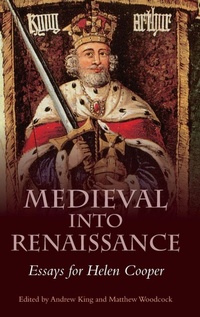
Medieval into Renaissance
Essays for Helen Cooper
Published on 17. March 2016
Book
Hardback
295 pages
978-1-84384-432-7 (ISBN)
Description
Essays on topics of literary interest crossing the boundaries between the medieval and early modern period.
The borderline between the periods commonly termed "medieval" and "Renaissance", or "medieval" and "early modern", is one of the most hotly, energetically and productively contested faultlines in literary history studies. The essays presented in this volume both build upon and respond to the work of Professor Helen Cooper, a scholar who has long been committed to exploring the complex connections and interactions between medieval and Renaissance literature. The contributors re-examine a range of ideas, authors and genres addressed in her work, including pastoral, chivalric romance, early English drama, and the writings of Chaucer, Langland, Spenser and Shakespeare. As a whole, thevolume aims to stimulate active debates on the ways in which Renaissance writers used, adapted, and remembered aspects of the medieval.
Andrew King is Lecturer in Medieval and Renaissance Literature at University College, Cork; Matthew Woodcock is Senior Lecturer in Medieval and Renaissance Literature at the University of East Anglia.
Contributors: Joyce Boro, Aisling Byrne, Nandini Das, Mary C. Flannery, Alexandra Gillespie, AndrewKing, Megan G. Leitch, R.W. Maslen, Jason Powell, Helen Vincent, James Wade, Matthew Woodcock
The borderline between the periods commonly termed "medieval" and "Renaissance", or "medieval" and "early modern", is one of the most hotly, energetically and productively contested faultlines in literary history studies. The essays presented in this volume both build upon and respond to the work of Professor Helen Cooper, a scholar who has long been committed to exploring the complex connections and interactions between medieval and Renaissance literature. The contributors re-examine a range of ideas, authors and genres addressed in her work, including pastoral, chivalric romance, early English drama, and the writings of Chaucer, Langland, Spenser and Shakespeare. As a whole, thevolume aims to stimulate active debates on the ways in which Renaissance writers used, adapted, and remembered aspects of the medieval.
Andrew King is Lecturer in Medieval and Renaissance Literature at University College, Cork; Matthew Woodcock is Senior Lecturer in Medieval and Renaissance Literature at the University of East Anglia.
Contributors: Joyce Boro, Aisling Byrne, Nandini Das, Mary C. Flannery, Alexandra Gillespie, AndrewKing, Megan G. Leitch, R.W. Maslen, Jason Powell, Helen Vincent, James Wade, Matthew Woodcock
Reviews / Votes
Each of these essays, in and of itself, well worth reading: the collection confirms the importance and influence of Helen Cooper's lifetime of scholarship and the intellectual legacy that is her students. * SIXTEENTH CENTURY JOURNAL * Every chapter builds on or imitates-in the Renaissance sense of that word-some aspect of Cooper's research. And happily, this volume achieves a satisfying conceptual unity: this edited volume succeeds in becoming a book . In each chapter, smart, sophisticated readings and interpretations are very much on display . this volume demonstrates that at least in certain cases a collection of essays can actually make an argument more effectively than a single-authored book. * RENAISSANCE QUARTERLY * All essays are of exceptional quality, making this collection a fine and hugely deserved tribute to an outstanding scholar. * ARCHIV * [A] lovely thank-you note to Professor Helen Cooper from her former research students ... this collection encourages the reader to defy the cliche of period labels and generic assumptions by using the irresistible weight of textual evidence. * MEDIEVALLY SPEAKING * This handsome volume honors a preeminent scholar on romance as well as one who has done much in her scholarship to explore the continuities and connections between the medieval and Renaissance periods in a variety of genres, including drama and pastoral . Beyond her evident influence on the contributors, at the end of the book Professor Cooper's impact is reflected in a noteworthy tabula gratulatoria. Medieval into Renaissance is a welcome tribute for her as well as a valuable contribution to the study of medieval and early modern literature, particularly as regards questions of periodization. * THE MEDIEVAL REVIEW *More details
Language
English
Place of publication
Cambridge
United Kingdom
Publishing group
Boydell & Brewer Ltd
Target group
Professional and scholarly
Product notice
Cloth over boards
Illustrations
5 s/w Abbildungen
5 b/w illus.
Dimensions
Height: 240 mm
Width: 161 mm
Thickness: 21 mm
Weight
611 gr
ISBN-13
978-1-84384-432-7 (9781843844327)
Copyright in bibliographic data and cover images is held by Nielsen Book Services Limited or by the publishers or by their respective licensors: all rights reserved.
Schweitzer Classification
Other editions
Additional editions
E-Book
03/2016
1st Edition
De Gruyter
€48.99
Available for download
Persons
MEGAN G. LEITCH is the Professor and Chair of Medieval English Literature and Culture at the University of Groningen.
Content
Introduction - Andrew King and Matthew Woodcock
Unknowe, unkow, Vncovthe, uncouth: From Chaucer and Gower to Spenser and Milton - Alexandra Gillespie
Armour that doesn't work: An Anti-meme in Medieval and Renaissance Romance - Robert Maslen
'Of his ffader spak he no thing': Family Resemblance and Anxiety of Influence in Fifteenth-Century Prose Romance - Megan G. Leitch
Writing Westwards: Medieval English Romances and their Early Modern Irish Audiences - Aisling Byrne
Penitential Romance after the Reformation - James Wade
The English Laureate in Time: John Skelton's Garland of Laurel - Mary C. Flannery
Thomas Churchyard and the Medieval Complaint Tradition - Matthew Woodcock
Placing Arcadia - Nandini Das
Fathers, Sons and Surrogates: Fatherly Advice in Hamlet - Jason Powell
'To visit the sick court': Misogyny as Disease in Swetnam the Woman-Hater' - Joyce Boro
The Monument of Uncertainty: Sovereign and Literary Authority in Samuel Sheppard's The Faerie King - Andrew King
Mopsa's Arcadia: Choice Flowers Gathered out of Sir Philip Sidney's Rare Garden into Eighteenth-Century Chapbooks - Helen Vincent
Bibliography
Index
A Bibliography of Helen Cooper's Published Works
Unknowe, unkow, Vncovthe, uncouth: From Chaucer and Gower to Spenser and Milton - Alexandra Gillespie
Armour that doesn't work: An Anti-meme in Medieval and Renaissance Romance - Robert Maslen
'Of his ffader spak he no thing': Family Resemblance and Anxiety of Influence in Fifteenth-Century Prose Romance - Megan G. Leitch
Writing Westwards: Medieval English Romances and their Early Modern Irish Audiences - Aisling Byrne
Penitential Romance after the Reformation - James Wade
The English Laureate in Time: John Skelton's Garland of Laurel - Mary C. Flannery
Thomas Churchyard and the Medieval Complaint Tradition - Matthew Woodcock
Placing Arcadia - Nandini Das
Fathers, Sons and Surrogates: Fatherly Advice in Hamlet - Jason Powell
'To visit the sick court': Misogyny as Disease in Swetnam the Woman-Hater' - Joyce Boro
The Monument of Uncertainty: Sovereign and Literary Authority in Samuel Sheppard's The Faerie King - Andrew King
Mopsa's Arcadia: Choice Flowers Gathered out of Sir Philip Sidney's Rare Garden into Eighteenth-Century Chapbooks - Helen Vincent
Bibliography
Index
A Bibliography of Helen Cooper's Published Works