

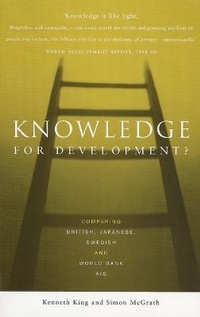
Knowledge for Development?
Comparing British, Japanese, Swedish and World Bank Aid
Published on 1. February 2004
Book
Hardback
256 pages
978-1-84277-324-6 (ISBN)
Description
In 1996, the World Bank President, James Wolfensohn, declared that his organization would henceforth be 'the knowledge bank'. This marked the beginning of a new discourse of knowledge-based aid, which has spread rapidly across the development field. This book is the first detailed attempt to analyse this new discourse.
Through an examination of four agencies -- the World Bank, the British Department for International Development, the Japan International Cooperation Agency and the Swedish International Development Cooperation Agency -- the book explores what this new approach to aid means in both theory and practice. It concludes that too much emphasis has been on developing capacity within agencies rather than addressing the expressed needs of Southern 'partners'. It also questions whether knowledge-based aid leads to greater agency certainty about what constitutes good development.
Through an examination of four agencies -- the World Bank, the British Department for International Development, the Japan International Cooperation Agency and the Swedish International Development Cooperation Agency -- the book explores what this new approach to aid means in both theory and practice. It concludes that too much emphasis has been on developing capacity within agencies rather than addressing the expressed needs of Southern 'partners'. It also questions whether knowledge-based aid leads to greater agency certainty about what constitutes good development.
Reviews / Votes
'In this excellent book the authors present a detailed analysis and a balanced assessment of the prospects for knowledge-based aid to achieve the goal of improving aid-effectiveness. Based on conceptual framework setting and a close examination of actual experience they reach the conclusion that success depends on reconceptualizing aid itself, in the direction of capacity building in poor countries.'Ravi Kanbur, Cornell University
'Knowledge management is popular. Aid agencies talk easily of sharing stories, communities of practice and double-loop learning. But are they ready to sacrifice a preoccupation with results and a concern to disseminate 'best-practice' - in favour of real partnership and mutual learning across divergent networks? McGrath and King are sceptical. Their case studies and their thesis challenge all of us involved in the production, sharing, and use of knowledge.'
Simon Maxwell, Overseas Development Institute, and President of the Development Studies Association of the UK and Ireland
More details
Language
English
Place of publication
United Kingdom
Publishing group
Bloomsbury Publishing PLC
Target group
College/higher education
Professional and scholarly
ISBN-13
978-1-84277-324-6 (9781842773246)
Copyright in bibliographic data and cover images is held by Nielsen Book Services Limited or by the publishers or by their respective licensors: all rights reserved.
Other editions
Additional editions
Kenneth King | Simon McGrath
Knowledge for Development?
Comparing British, Japanese, Swedish and World Bank Aid
E-Book
02/2008
1st Edition
Zed Books Ltd
€39.99
Available for download
Persons
Kenneth King is Professor of International and Comparative Education and Director of the Centre of African Studies, University of Edinburgh. He is the author or editor of several books , including 'Aid and Education' and 'Changing International Aid to Education' (edited with Lene Buchert).
Simon McGrath has been a research fellow at the Centre of African Studies, and became Research Director at the Human Sciences Research Council in Pretoria, South Africa in October 2002.
Both authors have published extensively in African Studies and International Comparative Education and have been researching development cooperation for a number of years.
Simon McGrath has been a research fellow at the Centre of African Studies, and became Research Director at the Human Sciences Research Council in Pretoria, South Africa in October 2002.
Both authors have published extensively in African Studies and International Comparative Education and have been researching development cooperation for a number of years.
Content
1. Researching Knowledge-Based Aid
2. The New Aid Agenda
3. Knowledge for Development
4. The World Bank or the Knowledge Bank?
5. From Information Management to Knowledge Sharing: DFID's Unfinished Revolution
6. Knowledge, Learning and Capacity in the Swedish Approach to Development Cooperation
7. Experience, Experts and Knowledge in Japanese Aid Policy and Practice
8. Conclusions and Implications for Knowledge, Aid and Development
2. The New Aid Agenda
3. Knowledge for Development
4. The World Bank or the Knowledge Bank?
5. From Information Management to Knowledge Sharing: DFID's Unfinished Revolution
6. Knowledge, Learning and Capacity in the Swedish Approach to Development Cooperation
7. Experience, Experts and Knowledge in Japanese Aid Policy and Practice
8. Conclusions and Implications for Knowledge, Aid and Development