

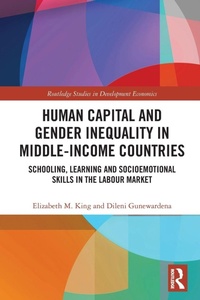
Human Capital and Gender Inequality in Middle-Income Countries
Schooling, Learning and Socioemotional Skills in the Labour Market
1st Edition
Published on 27. May 2024
Book
Paperback/Softback
244 pages
978-0-367-77495-0 (ISBN)
Description
The role of cognitive and socioemotional skills alongside education in determining people's success in the labour market has been the topic of a growing body of research - but previous studies have mostly missed middle-income countries and the developing world because measures of those skills and data on employment and earnings on large enough samples of adults have typically not been available.
Using comparable survey data on these schooling, skills and labour market outcomes from 13 developing and emerging economies worldwide, this book revisits human capital and gender inequality models. It presents new estimates of the returns to different levels of schooling as well as cognitive and socioemotional skills for women and men. It examines whether those returns are due to levels of human capital or to structural bias in labour markets, and how these two factors work across the earnings spectrum. The book examines the existence of 'glass ceilings' and 'sticky floors' for women using this expanded measure of human capital. Further, by analyzing a group of countries of wide-ranging levels of economic development and socio-political contexts, the book reveals patterns and insights into how context mediates the relationship between skills and gender gaps in labour market outcomes.
This book will be of interest to scholars of human capital and gender inequality in the labour market and development economics, as well as gender and development policy makers.
Using comparable survey data on these schooling, skills and labour market outcomes from 13 developing and emerging economies worldwide, this book revisits human capital and gender inequality models. It presents new estimates of the returns to different levels of schooling as well as cognitive and socioemotional skills for women and men. It examines whether those returns are due to levels of human capital or to structural bias in labour markets, and how these two factors work across the earnings spectrum. The book examines the existence of 'glass ceilings' and 'sticky floors' for women using this expanded measure of human capital. Further, by analyzing a group of countries of wide-ranging levels of economic development and socio-political contexts, the book reveals patterns and insights into how context mediates the relationship between skills and gender gaps in labour market outcomes.
This book will be of interest to scholars of human capital and gender inequality in the labour market and development economics, as well as gender and development policy makers.
Reviews / Votes
"This is a very timely volume. The importance of gender equality cannot be overemphasized given the historical low participation of women in schooling and in the labour market. The volume also provides great insights on the differential impact of socioemotional skills on labour market outcomes."-Jane Mariara, Executive Director, Partnership for Economic Policy (PEP).
"This book by Elizabeth King and Dileni Gunewardena analyzes gender differences in educational human capital and their effects on the labor earnings gaps observed across different income levels and in a diverse set of country circumstances. The authors draw attention to the role of cognitive and socioemotional skill components of human capital in informing such earnings gaps in addition to the conventional measure of years of schooling. Using primary survey data of 13 countries and innovative quantitative methods and interpretations, the book provides solid evidence on the simultaneous and stubborn presence of "glass ceilings" and "sticky floors" experienced by women in different parts of the world. This book will be found very useful to students of gender economics, labor economists, policy practitioners, and gender activists."
-Binayak Sen, Director-General, Bangladesh Institute of Development Studies
More details
Series
Language
English
Place of publication
London
United Kingdom
Publishing group
Taylor & Francis Ltd
Target group
College/higher education
Postgraduate
Illustrations
23 s/w Tabellen, 28 s/w Abbildungen, 1 s/w Photographie bzw. Rasterbild, 27 s/w Zeichnungen
23 Tables, black and white; 27 Line drawings, black and white; 1 Halftones, black and white; 28 Illustrations, black and white
Dimensions
Height: 234 mm
Width: 156 mm
Thickness: 14 mm
Weight
406 gr
ISBN-13
978-0-367-77495-0 (9780367774950)
Copyright in bibliographic data and cover images is held by Nielsen Book Services Limited or by the publishers or by their respective licensors: all rights reserved.
Schweitzer Classification
Other editions
Additional editions
Elizabeth M. King | Dileni Gunewardena
Human Capital and Gender Inequality in Middle-Income Countries
Schooling, Learning and Socioemotional Skills in the Labour Market
E-Book
11/2022
1st Edition
Routledge
€55.49
Available for download
Elizabeth M. King | Dileni Gunewardena
Human Capital and Gender Inequality in Middle-Income Countries
Schooling, Learning and Socioemotional Skills in the Labour Market
E-Book
11/2022
1st Edition
Routledge
€55.49
Available for download
Elizabeth M. King | Dileni Gunewardena
Human Capital and Gender Inequality in Middle-Income Countries
Schooling, Learning and Socioemotional Skills in the Labour Market
Book
11/2022
1st Edition
Routledge
€186.30
Shipment within 15-20 days
Persons
Elizabeth M. King is Non-resident Senior Fellow at the Brookings Institution and Adjunct Professor at Georgetown University, Washington, DC, USA.
Dileni Gunewardena is Professor of Economics at the University of Peradeniya, Sri Lanka, and Non-resident Fellow, Verite Research, Sri Lanka.
Dileni Gunewardena is Professor of Economics at the University of Peradeniya, Sri Lanka, and Non-resident Fellow, Verite Research, Sri Lanka.
Content
1.Human capital, gender and labour markets 2. A human capital model of gender inequality in the workplace 3. The premium to education and cognitive skills 4. The premium to socioemotional skills in the labour market 5. Education and skills, glass ceilings and sticky floors 6. Human capital: Challenges and roads to gender equality Appendices