

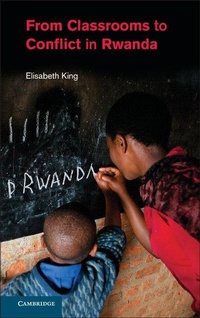
From Classrooms to Conflict in Rwanda
Published on 16. December 2013
Book
Hardback
226 pages
978-1-107-03933-9 (ISBN)
Description
This book questions the conventional wisdom that education builds peace by exploring the ways in which ordinary schooling can contribute to intergroup conflict. Based on fieldwork and comparative historical analysis of Rwanda, it argues that from the colonial period to the genocide, schooling was a key instrument of the state in contributing to the construction, awareness, collectivization and inequality of ethnic groups in Rwanda - all factors that underlay conflict. The book further argues that today's post-genocide schools are dangerously replicating past trends. This book is the first to offer an in-depth study of education in Rwanda and to analyze its role in the genesis of conflict. The book demonstrates that to build peace, we cannot simply prescribe more education, but must understand who has access to schools, how schools are set up, and what and how they teach.
Reviews / Votes
'From Classrooms to Conflict in Rwanda argues that the content and format of education, not just its availability, really matter. Elisabeth King proposes that in each of Rwanda's three principal modern political epochs - colonial, republic, and post-genocide - education and schooling exacerbated differences and horizontal inequalities, fostered stigma, and nourished competition for resources. King's writing is clear and lively, her organization is solid, and her thesis is firmly delivered. [She] has a very sensitive and intuitive understanding of the complexities of Rwandan history and of Rwandan political life today. This book is a gem.' Mark A. Drumbl, Class of 1975 Alumni Professor of Law and Director, Transnational Law Institute, Washington and Lee University 'While other analyses of the Rwandan genocide have mentioned education among the many factors making the violence possible, this is the first attempt to look systematically at the role of education in relationship to conflict in Rwanda. This is also one of very few texts to look at Rwanda both before and after the genocide, rather than focusing on one era or the other. King draws extensively on secondary sources but also on a number of interviews that she conducted with people who have been either students or teachers in Rwandan schools at different points of time as well as with experts in education in Rwanda. This book should have broad interest, appealing to those with interests in education, conflict, and African affairs.' Timothy P. Longman, Director, African Studies Center, Boston UniversityMore details
Language
English
Place of publication
Cambridge
United Kingdom
Target group
Professional and scholarly
Illustrations
11 Tables, unspecified; 1 Maps; 2 Line drawings, unspecified
Dimensions
Height: 235 mm
Width: 157 mm
Thickness: 18 mm
Weight
524 gr
ISBN-13
978-1-107-03933-9 (9781107039339)
Copyright in bibliographic data and cover images is held by Nielsen Book Services Limited or by the publishers or by their respective licensors: all rights reserved.
Schweitzer Classification
Other editions
Additional editions
Elisabeth King
From Classrooms to Conflict in Rwanda
Book
08/2015
Cambridge University Press
€45.90
Shipment within 15-20 days
Elisabeth King
From Classrooms to Conflict in Rwanda
E-Book
12/2013
Cambridge University Press
€21.99
Available for download
Elisabeth King
From Classrooms to Conflict in Rwanda
E-Book
08/2013
Cambridge University Press
€23.49
Available for download
Person
Elisabeth King is Associate Professor at the Steinhardt School of Culture, Education and Human Development, New York University. Her work focuses on conflict, peace building, and development in sub-Saharan Africa. King's work has appeared in such journals as African Studies Review, the Journal of Genocide Studies and Prevention, and the Journal of Development Effectiveness, as well as several edited volumes. King has conducted fieldwork in Croatia, India, Kenya, Liberia, Rwanda, and Tanzania. She has worked with NGOs and policy makers on the global land-mine crisis, education issues, and community-driven development. King uses a variety of research methods to examine how development and peace-building interventions really work (or not) for people in the global south.
Content
1. Moving education from the margins to the mainstream; 2. Colonial schooling; 3. Schooling under the Rwandan republics; 4. Schooling after genocide; 5. Education for peace building: Rwanda in comparative perspective; 6. Conclusion.