

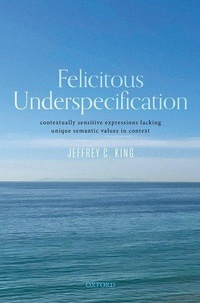
Felicitous Underspecification
Contextually Sensitive Expressions Lacking Unique Semantic Values in Context
Published on 21. December 2021
Book
Hardback
176 pages
978-0-19-285705-7 (ISBN)
Description
Felicitous uses of contextually sensitive expressions generally have unique semantic values in context. For example, a felicitous use of the singular pronoun 'she' generally has a single female as its unique semantic value in context. In the present work, Jeffrey C. King argues that contextually sensitive expressions have felicitous uses where they lack unique semantic values in context. He calls such uses instances of felicitous underspecification. In such cases, he says that the underspecified expression is associated with a range of candidate semantic values in context. King provides a rule for updating the Stalnakerian common ground when sentences containing felicitous underspecified expressions are uttered and accepted in a conversation. He also gives an account of the mechanism that associates the range of candidate semantic values in context with an underspecified expression. Sentences containing felicitous underspecified expressions can be embedded in various constructions. King considers the result of embedding such sentences under negation and verbs of propositional attitude. He also considers the question of why some uses of underspecified expressions are felicitous and others aren't. This investigation yields the notion of a context being appropriate for a sentence (LF), where a context is appropriate for a sentence containing an underspecified expression if the sentence is felicitous in that context. Finally, he considers some difficulties that arise in virtue of the fact that pronouns and demonstratives have some sorts of implications of uniqueness that clash with their being underspecified.
More details
Language
English
Place of publication
Oxford
United Kingdom
Target group
Professional and scholarly
Product notice
sewn/stitched
Cloth over boards
Dimensions
Height: 207 mm
Width: 144 mm
Thickness: 15 mm
Weight
313 gr
ISBN-13
978-0-19-285705-7 (9780192857057)
Copyright in bibliographic data and cover images is held by Nielsen Book Services Limited or by the publishers or by their respective licensors: all rights reserved.
Schweitzer Classification
Other editions
Additional editions
Jeffrey C. King
Felicitous Underspecification
Contextually Sensitive Expressions Lacking Unique Semantic Values in Context
E-Book
12/2021
1st Edition
OUP eBook
€37.99
Available for download
Jeffrey C. King
Felicitous Underspecification
Contextually Sensitive Expressions Lacking Unique Semantic Values in Context
E-Book
12/2021
1st Edition
OUP eBook
€37.99
Available for download
Person
Jeffrey C. King completed his Ph.D. at the University of California, San Diego in 1985. He taught at California State
University, San Bernardino from 1985-1990. Professor King then moved to University of California, Davis, where
he taught from 1991-2004. In 2004 he took a job at University of Southern California, where he remained until
2007. He moved to Rutgers University in 2007, where he currently teaches. He became Distinguished Professor
there in 2011. His main research areas are philosophy of language, formal semantics, philosophical logic, and
metaphysics.
University, San Bernardino from 1985-1990. Professor King then moved to University of California, Davis, where
he taught from 1991-2004. In 2004 he took a job at University of Southern California, where he remained until
2007. He moved to Rutgers University in 2007, where he currently teaches. He became Distinguished Professor
there in 2011. His main research areas are philosophy of language, formal semantics, philosophical logic, and
metaphysics.
Content
- Introduction
- 1: Felicitous underspecification and updates
- 2: An update rule for cases of felicitous underspecification
- 3: Felicitous underspecification and metasemantics
- 4: Embeddings
- 5: Appropriateness
- 6: The problem of definites and possessives