

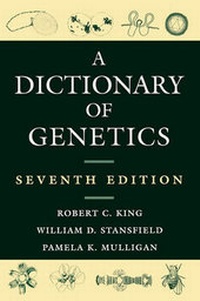
A Dictionary of Genetics
7th Edition
Published on 10. August 2006
Book
Hardback
608 pages
978-0-19-530762-7 (ISBN)
Description
The field of genetics continues to advance at an ever-accelerating pace, marked by numerous extraordinary achievements in recent years: BLThe human genome project was completed BLBreakthroughs in public health have been achieved in relation to newly available genome sequences for parasitic vectors. BLDNA microarrays have taken the study of gene expression and genetic variation to a global, genome-wide scale. BLThe proteomes of key model organisms have been comparatively analyzed in amazing detail. Such momentous advances in genetics have been accompanied by a deluge of new experimental techniques, computational technologies, databases, Internet sites, periodicals, books, and of course, concepts and terms. As new terminology emerges, many old terms recede from use or require revision. New material for this new edition of both the dictionary and its appendices has accumulated more rapidly than in the past. In the proposed new edition the term "genetics" itself is re-defined, reflecting recent technical advances, and with them, the convergence of classical and molecular genetics.
Genetics today is no longer simply the study of heredity in the old sense (the study of the inheritance of biological traits from one generation to the next) but also the study of the basic units of heredity, or genes. Geneticists of the post-genomics era identify genetic elements using forward or reverse genetics and decipher the molecular nature of genes, how they function, and how genetic variation - whether introduced in the lab or present in natural populations - affects the phenotype of the cell or organism. With widespread applications, today's genetics thus also unify the biological sciences, medical sciences, and evolutionary studies. As compared with the current sixth edition, the seventh edition will have many more new and revised entries. The sixth edition had 6,580 definitions; the seventh has 511 new and 980 revised definitions - a 23% change in content.
Genetics today is no longer simply the study of heredity in the old sense (the study of the inheritance of biological traits from one generation to the next) but also the study of the basic units of heredity, or genes. Geneticists of the post-genomics era identify genetic elements using forward or reverse genetics and decipher the molecular nature of genes, how they function, and how genetic variation - whether introduced in the lab or present in natural populations - affects the phenotype of the cell or organism. With widespread applications, today's genetics thus also unify the biological sciences, medical sciences, and evolutionary studies. As compared with the current sixth edition, the seventh edition will have many more new and revised entries. The sixth edition had 6,580 definitions; the seventh has 511 new and 980 revised definitions - a 23% change in content.
More details
Edition
7th Revised edition
Language
English
Place of publication
New York
United States
Target group
Professional and scholarly
Edition type
Revised edition
Illustrations
314 s/w Abbildungen
314 black and white illustrations
Dimensions
Height: 253 mm
Width: 176 mm
Thickness: 33 mm
Weight
1195 gr
ISBN-13
978-0-19-530762-7 (9780195307627)
Copyright in bibliographic data and cover images is held by Nielsen Book Services Limited or by the publishers or by their respective licensors: all rights reserved.
Schweitzer Classification
Other editions
New editions
Robert C. King | Pamela Mulligan | William Stansfield
A Dictionary of Genetics
Book
01/2013
8th Edition
Oxford University Press Inc
€102.60
Shipment within 15-20 days
Previous edition

Robert C. King
A Dictionary of Genetics
Book
07/2002
6th Edition
Oxford University Press Inc
€74.28
Article exhausted; check for reprint