

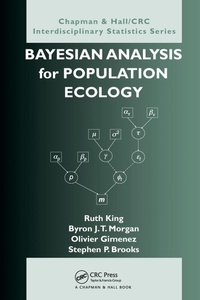
Bayesian Analysis for Population Ecology
1st Edition
Published on 21. January 2023
Book
Paperback/Softback
456 pages
978-1-032-47771-8 (ISBN)
Description
Novel Statistical Tools for Conserving and Managing Populations
By gathering information on key demographic parameters, scientists can often predict how populations will develop in the future and relate these parameters to external influences, such as global warming. Because of their ability to easily incorporate random effects, fit state-space models, evaluate posterior model probabilities, and deal with missing data, modern Bayesian methods have become important in this area of statistical inference and forecasting.
Emphasising model choice and model averaging, Bayesian Analysis for Population Ecology presents up-to-date methods for analysing complex ecological data. Leaders in the statistical ecology field, the authors apply the theory to a wide range of actual case studies and illustrate the methods using WinBUGS and R. The computer programs and full details of the data sets are available on the book's website.
The first part of the book focuses on models and their corresponding likelihood functions. The authors examine classical methods of inference for estimating model parameters, including maximum-likelihood estimates of parameters using numerical optimisation algorithms. After building this foundation, the authors develop the Bayesian approach for fitting models to data. They also compare Bayesian and traditional approaches to model fitting and inference.
Exploring challenging problems in population ecology, this book shows how to use the latest Bayesian methods to analyse data. It enables readers to apply the methods to their own problems with confidence.
By gathering information on key demographic parameters, scientists can often predict how populations will develop in the future and relate these parameters to external influences, such as global warming. Because of their ability to easily incorporate random effects, fit state-space models, evaluate posterior model probabilities, and deal with missing data, modern Bayesian methods have become important in this area of statistical inference and forecasting.
Emphasising model choice and model averaging, Bayesian Analysis for Population Ecology presents up-to-date methods for analysing complex ecological data. Leaders in the statistical ecology field, the authors apply the theory to a wide range of actual case studies and illustrate the methods using WinBUGS and R. The computer programs and full details of the data sets are available on the book's website.
The first part of the book focuses on models and their corresponding likelihood functions. The authors examine classical methods of inference for estimating model parameters, including maximum-likelihood estimates of parameters using numerical optimisation algorithms. After building this foundation, the authors develop the Bayesian approach for fitting models to data. They also compare Bayesian and traditional approaches to model fitting and inference.
Exploring challenging problems in population ecology, this book shows how to use the latest Bayesian methods to analyse data. It enables readers to apply the methods to their own problems with confidence.
Reviews / Votes
"Although the book draws largely from questions and issues relevant to wildlife management, it serves as a useful guide for individuals outside the field. Overall, Bayesian Analysis for Population Ecology makes a great addition to a practicing ecologist's statistical bookshelf. As the author's state, the volume can also serve as a textbook and form a strong base for teaching an upper-division or graduate-level course in Bayesian statistics."-Bret D. Elderd, The Quarterly Review of Biology, March 2013
"The primary strengths of this book are the authors' extensive practical experience in applying Bayesian methods and the advanced material on model selection and multimodel inference, particularly via reversible jump Markov chain Monte Carlo. This would be a valuable reference for those already familiar with core Bayesian methods, and who are looking to learn more about ecological statistics or to implement these methods for complex ecological data. ... Several fully worked examples taken mostly from the authors' own research are presented in each chapter, and these go a long way in helping to unravel some of the art of Bayesian inference. The material is well presented and will be informative both to statisticians seeking an introduction to ecological modeling and to ecologists wishing to learn about Bayesian inference."
-Simon Bonner, Biometrics, 2011
"The book is divided into three parts. ... Part 1 contains a wealth of material on aspects of such data, models analysis as well as the [historical] evolution of the subject. Part 2 is a good, self-contained introduction to Bayesian analysis ... Part 3 is a collection of interesting special topics in ecological applications. ... The authors write very well and illustrate with good examples. Both the technical and nontechnical discussions are good."
-International Statistical Review (2011), 79, 1
"... the book under review will be of value for quantitative ecologists. The authors offer good practical advice on the implementation of MCMC and model selection, using data types familiar to wildlife ecologists. The text includes exercises at the end of each chapter in Sections 1 and 2; these and the primers on programs R and WinBUGS are attractive features. The authors have had a leading role promoting Reversible Jump MCMC as a tool for multimodel inference in wildlife and ecological applications, and their book continues this work."
-The American Statistician, February 2011, Vol. 65, No. 1
"... a solid introduction to Bayesian modeling. ... The authors have produced a text that is not only of good use to those who are analyzing population ecological data, but to anyone desiring a good overview of Bayesian modeling in general. The examples are interesting and do not hinder those not in the discipline of population ecology from understanding the explanation of the statistical principles being discussed. I recommend the book for a graduate-level course on Bayesian modeling, as well as any course related to the Bayesian modeling of population ecological data. The reader is not expected to have a prior knowledge of Bayesian modeling, nor is there an assumption that readers are familiar with R or WinBUGS. ..."
-Journal of Statistical Software, August 2010, Volume 36
More details
Series
Language
English
Place of publication
United Kingdom
Publishing group
Taylor & Francis Ltd
Target group
Professional and scholarly
Professional Practice & Development
Illustrations
93 s/w Abbildungen
93 Illustrations, black and white
Dimensions
Height: 234 mm
Width: 156 mm
Thickness: 25 mm
Weight
690 gr
ISBN-13
978-1-032-47771-8 (9781032477718)
Copyright in bibliographic data and cover images is held by Nielsen Book Services Limited or by the publishers or by their respective licensors: all rights reserved.
Schweitzer Classification
Other editions
Additional editions
Ruth King | Byron Morgan | Olivier Gimenez
Bayesian Analysis for Population Ecology
E-Book
10/2009
1st Edition
Chapman & Hall/CRC
€64.49
Available for download
Ruth King | Byron Morgan | Olivier Gimenez
Bayesian Analysis for Population Ecology
Book
10/2009
1st Edition
Chapman & Hall/CRC
€207.90
Shipment within 15-20 days
Ruth King | Byron Morgan | Olivier Gimenez
Bayesian Analysis for Population Ecology
E-Book
10/2009
1st Edition
Chapman and Hall
€64.49
Available for download
Persons
Ruth King is a reader in statistics at the University of St. Andrews and a former EPSRC post-doctoral Research Fellow.
Byron J.T. Morgan is a professor of applied statistics at the University of Kent and co-director of the EPSRC National Centre for Statistical Ecology.
Olivier Gimenez is a research scientist in biostatistics at CNRS and a former Marie Curie research fellow.
Stephen P. Brooks is director of research at ATASS Ltd and a former professor of statistics at the University of Cambridge and EPSRC Advanced Fellow.
Byron J.T. Morgan is a professor of applied statistics at the University of Kent and co-director of the EPSRC National Centre for Statistical Ecology.
Olivier Gimenez is a research scientist in biostatistics at CNRS and a former Marie Curie research fellow.
Stephen P. Brooks is director of research at ATASS Ltd and a former professor of statistics at the University of Cambridge and EPSRC Advanced Fellow.
Content
Introduction to Statistical Analysis of Ecological Data. Bayesian Techniques and Tools. Ecological Applications. Appendices. References. Index.