

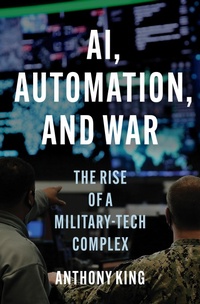
AI, Automation, and War
The Rise of a Military-Tech Complex
Published on 19. August 2025
Book
Hardback
240 pages
978-0-691-26514-8 (ISBN)
Description
Why AI will not replace human strategic judgement in war
Is AI about to automate war? Will autonomous drone swarms and killer robots controlled by AI dominate the battlespace and determine the winner? In AI, Automation, and War, Anthony King debunks this science fiction-tinged narrative of AI's military potential, exploring instead the actual applications of AI by the armed forces over the last decade. He finds that AI is not going to replace human commanders and combatants; the machines are not about to take over. Rather, the military has used, and will continue to use, AI to process data at a scale and speed that exceeds the capacity of humans. AI will be used primarily to improve military understanding and intelligence.
King explains that military commanders, enabled by the data processing power of AI, will be able to see the battlespace at a previously unattainable depth, fidelity, and speed. AI will help the armed forces plan, target, and conduct cyber operations faster and more effectively. In order to harness AI in this way, however, a radical organisational transformation is taking place. The armed forces are integrating civilian technologists into operational headquarters to work alongside military staff. This partnership between the armed forces and the technology sector signals the emergence of a military-tech complex that promises to be as powerful in this century as the military-industrial complex was in the last.
Is AI about to automate war? Will autonomous drone swarms and killer robots controlled by AI dominate the battlespace and determine the winner? In AI, Automation, and War, Anthony King debunks this science fiction-tinged narrative of AI's military potential, exploring instead the actual applications of AI by the armed forces over the last decade. He finds that AI is not going to replace human commanders and combatants; the machines are not about to take over. Rather, the military has used, and will continue to use, AI to process data at a scale and speed that exceeds the capacity of humans. AI will be used primarily to improve military understanding and intelligence.
King explains that military commanders, enabled by the data processing power of AI, will be able to see the battlespace at a previously unattainable depth, fidelity, and speed. AI will help the armed forces plan, target, and conduct cyber operations faster and more effectively. In order to harness AI in this way, however, a radical organisational transformation is taking place. The armed forces are integrating civilian technologists into operational headquarters to work alongside military staff. This partnership between the armed forces and the technology sector signals the emergence of a military-tech complex that promises to be as powerful in this century as the military-industrial complex was in the last.
More details
Language
English
Place of publication
New Jersey
United States
Target group
College/higher education
Professional and scholarly
Product notice
Trade binding
Illustrations
1 table.
Dimensions
Height: 235 mm
Width: 163 mm
Thickness: 22 mm
Weight
560 gr
ISBN-13
978-0-691-26514-8 (9780691265148)
Copyright in bibliographic data and cover images is held by Nielsen Book Services Limited or by the publishers or by their respective licensors: all rights reserved.
Schweitzer Classification
Other editions
Additional editions
E-Book
07/2025
1st Edition
Princeton University Press
€30.99
Available for download
Person
Anthony King is professor of war studies and director of the Strategy and Security Institute at the University of Exeter. He is the author of Command: The Twenty-First-Century General and Urban Warfare in the Twenty-First Century.