

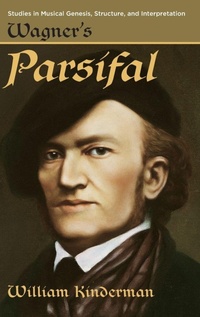
Wagner's Parsifal
Published on 15. August 2013
Book
Hardback
336 pages
978-0-19-536692-1 (ISBN)
Description
William Kinderman's detailed study of Parsifal, described by the composer as his "last card," explores the evolution of the text and music of this inexhaustible yet highly controversial music drama across Wagner's entire career, and offers a reassessment of the ideological and political history of Parsifal, shedding new light on the connection of Wagner's legacy to the rise of National Socialism in Germany. The compositional genesis is traced through many unfamiliar manuscript sources, revealing unsuspected models and veiled connections to Wagner's earlier works. Fresh analytic perspectives are revealed, casting the dramatic meaning of Parsifal in a new light. Much debated aspects of the work, such as Kundry's death at the conclusion, are discussed in the context of its stage history.
Path-breaking as well is Kinderman's analysis of the religious and ideological context of Parsifal. During the half-century after the composer's death, the Wagner family and the so-called Bayreuth circle sought to exploit Wagner's work for political purposes, thereby promoting racial nationalism and anti-Semitism. Hitherto unnoticed connections between Hitler and Wagner's legacy at Bayreuth are explored here, while differences between the composer's politics as an 1849 revolutionary and the later response of his family to National Socialism are weighed in a nuanced account. Kinderman combines new historical research, sensitive aesthetic criticism, and probing philosophical reflection in this most intensive examination of Wagner's culminating music drama.
Path-breaking as well is Kinderman's analysis of the religious and ideological context of Parsifal. During the half-century after the composer's death, the Wagner family and the so-called Bayreuth circle sought to exploit Wagner's work for political purposes, thereby promoting racial nationalism and anti-Semitism. Hitherto unnoticed connections between Hitler and Wagner's legacy at Bayreuth are explored here, while differences between the composer's politics as an 1849 revolutionary and the later response of his family to National Socialism are weighed in a nuanced account. Kinderman combines new historical research, sensitive aesthetic criticism, and probing philosophical reflection in this most intensive examination of Wagner's culminating music drama.
Reviews / Votes
I am eager with anticipation of this new book and will carry it with me for years to come! * Eric Halfvarson, Bass * The best of the bicentennial books that I have examined...Elegantly written, drawing from cutting-edge scholarship and historical sources, Kinderman's study probes the genesis, literary roots, music and afterlives of Parsifal along with its many contradictions, chief among them that a work centering on compassion and reconciliation was one from which Hitler drew inspiration. * Marion Lignana Rosenberg, WQXR Operavore * a rich genetic study of Wagner's Parsifal ... [that] illuminates the dramatic content of the work in new and provocative ways ... this book is obligatory reading for Wagner listeners, as well as for readers interested in the creative process in general * Anna Stoll Knecht, The Wagner Journal * William Kinderman points out, in his new book on Wagner's Parsifal, that the opera is arguably the 19th-century musical/dramatic work with the richest trove of documentary sources-sources that can enable us follow its creation with unprecedented precision...Kinderman is the first scholar to master all this material, even including numerous snippets of manuscript that Wagner cut out of his main working sheets as he thought of new musical ideas. Kinderman tells a fascinating, if intricate story--a story told here fully for the first time, and one in which a deft combination of source study, analytical skill, and a deep understanding of Wagner and his work all illuminate the opera in fresh and engaging ways. This is a welcome, and musically sensitive contribution to Wagner scholarship. * Patrick McCreless, Yale University * Professor William Kinderman has given us a most comprehensive analysis of this complicated work ... Kinderman makes a reevaluation of the genesis of this important work and demolishes many traditional views about Parsifal. * GermA!n A. Bravo-Casas, wagneropera.net * This is a fascinating and well-written study of Wagners final masterpiece. * Nicholas Baragwanath, Music and Letters *More details
Series
Language
English
Place of publication
New York
United States
Target group
College/higher education
Professional and scholarly
Illustrations
17 halftone illustrations, 93 music examples
Dimensions
Height: 240 mm
Width: 161 mm
Thickness: 23 mm
Weight
672 gr
ISBN-13
978-0-19-536692-1 (9780195366921)
Copyright in bibliographic data and cover images is held by Nielsen Book Services Limited or by the publishers or by their respective licensors: all rights reserved.
Schweitzer Classification
Other editions
Additional editions
William Kinderman
Wagner's Parsifal
Book
04/2018
Oxford University Press Inc
€57.00
Shipment within 15-20 days
Person
William Kinderman is professor of music at the University of Illinois, has taught extensively in Berlin and Munich, Germany, and held many seminars at the Wagner Festival at Bayreuth. He has written or edited many books, including Beethoven and Mozart's Piano Music. He is an accomplished concert pianist, and has recorded Beethoven's Diabelli Variations and last sonatas.
Content
Contents ; Prelude: Parsifal as Art and Ideology ; Part 1: The Process of Composition ; 1. The Poem and Its Background and Evolution ; 2. The Genesis of the Music ; Part 2: Musical Form and Dramatic Meaning ; 3. Wagner's Late Style ; 4. Grail and Anti-Grail ; 5. The Sense of an Ending