

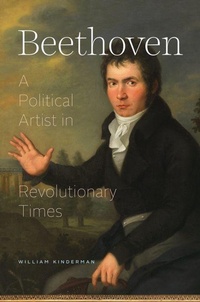
Beethoven
A Political Artist in Revolutionary Times
Published on 5. January 2021
Book
Hardback
256 pages
978-0-226-66905-2 (ISBN)
Description
We have long regarded Beethoven as a great composer, but we rarely appreciate that he was also an eminently political artist. This book unveils the role of politics in his oeuvre, elucidating how the inherently political nature of Beethoven's music explains its power and endurance. William Kinderman presents Beethoven as a civically engaged thinker faced with severe challenges. The composer lived through many tumultuous events--the French Revolution, the rise and fall of Napoleon Bonaparte, and the Congress of Vienna among them. Previous studies of Beethoven have emphasized the importance of his personal suffering and inner struggles; Kinderman instead establishes that musical tensions in works such as the Eroica, the Appassionata, and his final piano sonata in C minor reflect Beethoven's attitudes toward the political turbulence of the era. Written for the 250th anniversary of his birth, Beethoven takes stock of the composer's legacy, showing how his idealism and zeal for resistance have ensured that masterpieces such as the Ninth Symphony continue to inspire activists around the globe. Kinderman considers how the Fifth Symphony helped galvanize resistance to fascism, how the Sixth has energized the environmental movement, and how Beethoven's civic engagement continues to inspire in politically perilous times. Uncertain times call for ardent responses, and, as Kinderman convincingly affirms, Beethoven's music is more relevant today than ever before.
Reviews / Votes
"With a keen ear attuned to both musical and historical salience, Kinderman reveals the animating presence of the political in almost every aspect of Beethoven's life, his work, and his legacy. In doing so, he illuminates the crucial context from which to assess Beethoven's astonishing achievement of a moral ideal that has resounded from the Age of Revolution to our own times."--Scott Burnham, City University of New York "Kinderman has written a fresh and fascinating book packed with intriguing thoughts and unexpected alignments about how Beethoven's politics translated themselves into Beethoven's music. This is a book that awakens the reader not only with its content, but with the love and enthusiasm of its author."--Patrick Summers, artistic and music director, Houston Grand Opera "This book is a timely contribution to the current trend towards interpreting art primarily in political terms. Placing his aesthetic commentary in a well-grounded biographical and historical context, Kinderman illuminates the political aspects of Beethoven's life and outlook. He goes on to discuss the ways in which a number of Beethoven's important works reflect the composer's lifelong belief in freedom and progress as both personal and universal values."--Lewis Lockwood, author of 'Beethoven: The Music and the Life'More details
Language
English
Place of publication
Chicago
United States
Publishing group
The University of Chicago Press
Product notice
sewn/stitched
Cloth over boards
Dimensions
Height: 238 mm
Width: 162 mm
Thickness: 25 mm
Weight
515 gr
ISBN-13
978-0-226-66905-2 (9780226669052)
Copyright in bibliographic data and cover images is held by Nielsen Book Services Limited or by the publishers or by their respective licensors: all rights reserved.
Schweitzer Classification
Other editions
Additional editions
E-Book
10/2020
1st Edition
University of Chicago Press
from
€33.60
Available for download
Person
William Kinderman is professor of music and the Leo M. Klein and Elaine Krown Klein Chair in Performance Studies at the University of California, Los Angeles. His many books include Beethoven, The Creative Process in Music from Mozart to Kurtag, and, most recently, Wagner's "Parsifal."
Content
Preface
I. A Tale of Two Cities: Bonn to Vienna
II. The Sublime and Inverted Sublime
III. Beethoven in Heiligenstadt
IV. Path to the Eroica
V. Leonore as "Angel of Freedom"
VI. From Graetz to Wagram and Leipzig
VII. A Double Chill: Beethoven in Metternich's Vienna
VIII. Then and Now: The Ninth Symphony
Acknowledgments
List of Illustrations and Examples
Note about Abbreviations
Sources and Documents
Index
I. A Tale of Two Cities: Bonn to Vienna
II. The Sublime and Inverted Sublime
III. Beethoven in Heiligenstadt
IV. Path to the Eroica
V. Leonore as "Angel of Freedom"
VI. From Graetz to Wagram and Leipzig
VII. A Double Chill: Beethoven in Metternich's Vienna
VIII. Then and Now: The Ninth Symphony
Acknowledgments
List of Illustrations and Examples
Note about Abbreviations
Sources and Documents
Index