

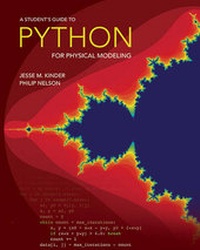
A Student's Guide to Python for Physical Modeling
Published on 22. September 2015
Book
Hardback
160 pages
978-0-691-16958-3 (ISBN)
Description
Python is a computer programming language that is rapidly gaining popularity throughout the sciences. A Student's Guide to Python for Physical Modeling aims to help you, the student, teach yourself enough of the Python programming language to get started with physical modeling. You will learn how to install an open-source Python programming environment and use it to accomplish many common scientific computing tasks: importing, exporting, and visualizing data; numerical analysis; and simulation. No prior programming experience is assumed. This tutorial focuses on fundamentals and introduces a wide range of useful techniques, including: * Basic Python programming and scripting* Numerical arrays* Two- and three-dimensional graphics* Monte Carlo simulations* Numerical methods, including solving ordinary differential equations* Image processing* Animation Numerous code samples and exercises--with solutions--illustrate new ideas as they are introduced. Web-based resources also accompany this guide and include code samples, data sets, and more.
Reviews / Votes
"The text serves as an excellent stepping stone into the world of using Python in computational science for undergraduate students with a strong background in mathematics."---Kevin Thielen and Vivienne Tien, Computing in Science & Engineering "At a brief 160 pages, it is quite possible for a motivated student to complete it in just a few sittings. . . . [A] fine introduction." * American Journal of Physics *More details
Language
English
Place of publication
New Jersey
United States
Target group
College/higher education
Product notice
Trade binding
Illustrations
3 line illus.
Dimensions
Height: 254 mm
Width: 203 mm
Weight
595 gr
ISBN-13
978-0-691-16958-3 (9780691169583)
Copyright in bibliographic data and cover images is held by Nielsen Book Services Limited or by the publishers or by their respective licensors: all rights reserved.
Schweitzer Classification
Persons
Jesse M. Kinder earned his PhD in physics and astronomy at the University of Pennsylvania, completed a postdoctoral fellowship in quantum chemistry at Cornell University, and taught physics at Case Western Reserve University. He currently works as a consultant in Rio Rancho, New Mexico. Philip Nelson is professor of physics at the University of Pennsylvania. He is the author of Biological Physics and Physical Models of Living Systems.