

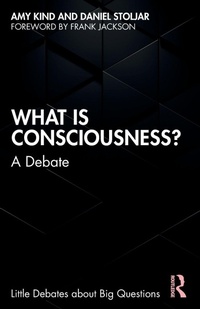
What is Consciousness?
A Debate
1st Edition
Published on 30. June 2023
Book
Paperback/Softback
224 pages
978-0-367-33242-6 (ISBN)
Description
What is consciousness and why is it so philosophically and scientifically puzzling? For many years philosophers approached this question assuming a standard physicalist framework on which consciousness can be explained by contemporary physics, biology, neuroscience, and cognitive science. This book is a debate between two philosophers who are united in their rejection of this kind of "standard" physicalism - but who differ sharply in what lesson to draw from this. Amy Kind defends dualism 2.0, a thoroughly modern version of dualism (the theory that there are two fundamentally different kinds of things in the world: those that are physical and those that are mental) decoupled from any religious or non-scientific connotations. Daniel Stoljar defends non-standard physicalism, a kind of physicalism different from both the standard version and dualism 2.0. The book presents a cutting-edge assessment of the philosophy of consciousness and provides a glimpse at what the future study of this area might bring.
Key Features
Outlines the different things people mean by "consciousness" and provides an account of what consciousness is
Reviews the key arguments for thinking that consciousness is incompatible with physicalism
Explores and provides a defense of contrasting responses to those arguments, with a special focus on responses that reject the standard physicalist framework
Provides an account of the basic aims of the science of consciousness
Written in a lively and accessibly style
Includes a comprehensive glossary
Key Features
Outlines the different things people mean by "consciousness" and provides an account of what consciousness is
Reviews the key arguments for thinking that consciousness is incompatible with physicalism
Explores and provides a defense of contrasting responses to those arguments, with a special focus on responses that reject the standard physicalist framework
Provides an account of the basic aims of the science of consciousness
Written in a lively and accessibly style
Includes a comprehensive glossary
More details
Series
Language
English
Place of publication
London
United Kingdom
Publishing group
Taylor & Francis Ltd
Target group
College/higher education
Professional and scholarly
Academic, General, Postgraduate, Undergraduate Advanced, and Undergraduate Core
Dimensions
Height: 216 mm
Width: 140 mm
Thickness: 13 mm
Weight
313 gr
ISBN-13
978-0-367-33242-6 (9780367332426)
Copyright in bibliographic data and cover images is held by Nielsen Book Services Limited or by the publishers or by their respective licensors: all rights reserved.
Schweitzer Classification
Other editions
Additional editions
E-Book
06/2023
1st Edition
Routledge
€45.99
Available for download
Book
06/2023
1st Edition
Routledge
€185.80
Shipment within 10-20 days
E-Book
06/2023
1st Edition
Routledge
€45.99
Available for download
Persons
Amy Kind is Russell K. Pitzer of Philosophy at Claremont McKenna College. She has authored numerous articles in philosophy of mind, as well as two books, Persons and Personal Identity (Polity, 2015) and Philosophy of Mind: The Basics (Routledge, 2020); she has also edited and co-edited four volumes, the most recent of which is Epistemic Uses of Imagination (Routledge, 2021).
Daniel Stoljar is Professor of Philosophy and Director of the Centre for Consciousness in the Research School of Social Sciences at the Australian National University. He is the author of many papers in philosophy of mind and related topics, as well as the books, Ignorance and Imagination: The Epistemic Origin of the Problem of Consciousness (OUP, 2006), Physicalism (Routledge, 2010), and Philosophical Progress: In Defence of a Reasonable Optimism (OUP, 2017).
Daniel Stoljar is Professor of Philosophy and Director of the Centre for Consciousness in the Research School of Social Sciences at the Australian National University. He is the author of many papers in philosophy of mind and related topics, as well as the books, Ignorance and Imagination: The Epistemic Origin of the Problem of Consciousness (OUP, 2006), Physicalism (Routledge, 2010), and Philosophical Progress: In Defence of a Reasonable Optimism (OUP, 2017).
Content
Foreword by Frank Jackson
Opening Statements
First Round of Replies
Second Round of Replies
Opening Statements
First Round of Replies
Second Round of Replies