

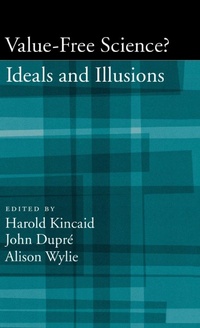
Value-Free Science?
Ideals and Illusions
Published on 5. April 2007
Book
Hardback
256 pages
978-0-19-530896-9 (ISBN)
Description
It has long been thought that science is our best hope for realizing objective knowledge, but that, to deliver on this promise, it must be value free. Things are not so simple, however, as recent work in science studies makes clear. The contributors to this volume investigate where and how values are involved in science, and examine the implications of this involvement for ideals of objectivity.
Reviews / Votes
Historians of science whose work has led them to puzzle over their own and their historical actors' judgments of the relations between value and scientific fact will find much of value here. * Alan Richardson, Isis *More details
Language
English
Place of publication
New York
United States
Target group
College/higher education
Professional and scholarly
Dimensions
Height: 222 mm
Width: 145 mm
Thickness: 19 mm
Weight
497 gr
ISBN-13
978-0-19-530896-9 (9780195308969)
Copyright in bibliographic data and cover images is held by Nielsen Book Services Limited or by the publishers or by their respective licensors: all rights reserved.
Schweitzer Classification
Other editions
Additional editions
E-Book
03/2007
1st Edition
OUP eBook
€39.49
Available for download
E-Book
03/2007
1st Edition
OUP eBook
€31.49
Available for download
Persons
Harold Kincaid is Professor of Philosophy at the University of Alabama.
John Dupre is Professor of Philosophy of Science and Director of the ESRC Centre for Genomics in Society at the University of Exeter.
John Dupre is Professor of Philosophy of Science and Director of the ESRC Centre for Genomics in Society at the University of Exeter.
Content
Chapter 1: Introduction
Part I: Case Studies
Chapter 2: John Dupre: Fact and Value
Chapter 3: Michael Root: How Should Sociologists Study Social Problems?
Chapter 4: Lynn Hankinson and Allison Wylie: Coming to Terms with the Value(s) of Science: Insights from Feminist Science Scholarship
Chapter 5: Brad Wray: Evaluating Scientists
Part II: Evidence and Values
Chapter 6: Elliott Sober: Evidence and Value Freedom
Chapter 7: Heather Douglas: Rejecting the Ideal of Value Free Science
Chapter 8: John Roberts: Is Logical Empiricism Committed to the Ideal of Value Free Science?
Chapter 9: Sherri Roush: Constructive Empiricism and the Role of Social Values in Science
Chapter 10: Gerald Doppelt: The Value Ladenness of Scientific Knowledge
Chapter 11: Harold Kincaid: Contextualist Morals and Science
Index
Part I: Case Studies
Chapter 2: John Dupre: Fact and Value
Chapter 3: Michael Root: How Should Sociologists Study Social Problems?
Chapter 4: Lynn Hankinson and Allison Wylie: Coming to Terms with the Value(s) of Science: Insights from Feminist Science Scholarship
Chapter 5: Brad Wray: Evaluating Scientists
Part II: Evidence and Values
Chapter 6: Elliott Sober: Evidence and Value Freedom
Chapter 7: Heather Douglas: Rejecting the Ideal of Value Free Science
Chapter 8: John Roberts: Is Logical Empiricism Committed to the Ideal of Value Free Science?
Chapter 9: Sherri Roush: Constructive Empiricism and the Role of Social Values in Science
Chapter 10: Gerald Doppelt: The Value Ladenness of Scientific Knowledge
Chapter 11: Harold Kincaid: Contextualist Morals and Science
Index