

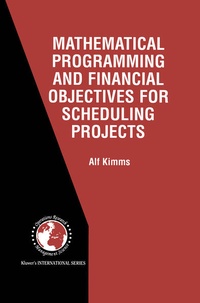
Mathematical Programming and Financial Objectives for Scheduling Projects
Published on 23. October 2012
Book
Paperback/Softback
VIII, 187 pages
978-1-4613-5561-8 (ISBN)
Description
Mathematical Programming and Financial Objectives for Scheduling
Projects
focuses on decision problems where the performance is measured in terms of money. As the title suggests, special attention is paid to financial objectives and the relationship of financial objectives to project schedules and scheduling. In addition, how schedules relate to other decisions is treated in detail. The book demonstrates that scheduling must be combined with project selection and financing, and that scheduling helps to give an answer to the planning issue of the amount of resources required for a project. The author makes clear the relevance of scheduling to cutting budget costs.
The book is divided into six parts. The first part gives a brief introduction to project management. Part two examines scheduling projects in order to maximize their net present value. Part three considers capital rationing. Many decisions on selecting or rejecting a project cannot be made in isolation and multiple projects must be taken fully into account. Since the requests for capital resources depend on the schedules of the projects, scheduling taken on more complexity. Part four studies the resource usage of a project in greater detail. Part five discusses cases where the processing time of an activity is a decision to be made. Part six summarizes the main results that have been accomplished.
The book is divided into six parts. The first part gives a brief introduction to project management. Part two examines scheduling projects in order to maximize their net present value. Part three considers capital rationing. Many decisions on selecting or rejecting a project cannot be made in isolation and multiple projects must be taken fully into account. Since the requests for capital resources depend on the schedules of the projects, scheduling taken on more complexity. Part four studies the resource usage of a project in greater detail. Part five discusses cases where the processing time of an activity is a decision to be made. Part six summarizes the main results that have been accomplished.
More details
Series
Edition
Softcover reprint of the original 1st ed. 2001
Language
English
Place of publication
New York
United States
Target group
Professional and scholarly
Research
Illustrations
VIII, 187 p.
Dimensions
Height: 235 mm
Width: 155 mm
Thickness: 12 mm
Weight
312 gr
ISBN-13
978-1-4613-5561-8 (9781461355618)
DOI
10.1007/978-1-4615-1453-4
Schweitzer Classification
Other editions
Additional editions
Book
06/2001
Kluwer Academic Publishers
€53.49
Shipment within 15-20 days
Content
1. Focus.- 2. Modeling Projects.- 3. Central Problem.- 4. Resource-Constrained Scheduling.- 5. Network Decomposition.- 6. Relaxation of Resource Constraints.- 7. Computational Studies.- 8. Capital Rationing.- 9. Budget Elimination.- 10. Computational Studies.- 11. Resource Leveling.- 12. Optimization Guided Scheduling I.- 13. Optimization Guided Scheduling II.- 14. Computational Studies.- 15. Crashing.- 16. Preprocessing.- 17. Network Decomposition.- 18. Computational Studies.- 19. Concluding Remarks.- 20. Future Work.