

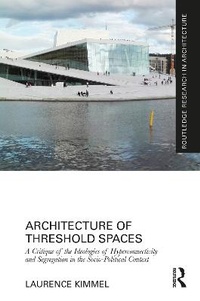
Architecture of Threshold Spaces
A Critique of the Ideologies of Hyperconnectivity and Segregation in the Socio-Political Context
1st Edition
Published on 31. December 2021
Book
Hardback
232 pages
978-0-367-68020-6 (ISBN)
Description
This book explores the relationship between architecture and philosophy through a discussion on threshold spaces linking public space with publicly accessible buildings. It explores the connection between exterior and interior and how this creates and affects interactions between people and the social dynamics of the city.
Building on an existing body of literature, the book engages with critical philosophy and discusses how it can be applied to architecture. In a similar vein to Walter Benjamin's descriptions of the Parisian Arcades in the nineteenth century, the book identifies the conditions under which thresholds reveal and impact social life. It utilises a wide range of illustrated international case studies from architects in Japan, Norway, Finland, France, Portugal, Italy, the USA, Australia, Mexico, and Brazil. Within the examples, thresholds become enhancers of social interactions and highlight broader socio-political contexts in public and private space.
Architecture of Threshold Spaces is an enlightening contribution to knowledge on contemporary architecture, politics and philosophy for students, academics, and architects.
Building on an existing body of literature, the book engages with critical philosophy and discusses how it can be applied to architecture. In a similar vein to Walter Benjamin's descriptions of the Parisian Arcades in the nineteenth century, the book identifies the conditions under which thresholds reveal and impact social life. It utilises a wide range of illustrated international case studies from architects in Japan, Norway, Finland, France, Portugal, Italy, the USA, Australia, Mexico, and Brazil. Within the examples, thresholds become enhancers of social interactions and highlight broader socio-political contexts in public and private space.
Architecture of Threshold Spaces is an enlightening contribution to knowledge on contemporary architecture, politics and philosophy for students, academics, and architects.
More details
Series
Language
English
Place of publication
London
United Kingdom
Publishing group
Taylor & Francis Ltd
Target group
College/higher education
Illustrations
21 s/w Abbildungen, 21 s/w Photographien bzw. Rasterbilder, 1 s/w Tabelle
1 Tables, black and white; 21 Halftones, black and white; 21 Illustrations, black and white
Dimensions
Height: 234 mm
Width: 156 mm
Weight
580 gr
ISBN-13
978-0-367-68020-6 (9780367680206)
Copyright in bibliographic data and cover images is held by Nielsen Book Services Limited or by the publishers or by their respective licensors: all rights reserved.
Schweitzer Classification
Other editions
Additional editions
Laurence Kimmel
Architecture of Threshold Spaces
A Critique of the Ideologies of Hyperconnectivity and Segregation in the Socio-Political Context
Book
10/2023
1st Edition
Routledge
€65.30
Shipment within 15-20 days
Laurence Kimmel
Architecture of Threshold Spaces
A Critique of the Ideologies of Hyperconnectivity and Segregation in the Socio-Political Context
E-Book
12/2021
1st Edition
Routledge
€59.49
Available for download
Laurence Kimmel
Architecture of Threshold Spaces
A Critique of the Ideologies of Hyperconnectivity and Segregation in the Socio-Political Context
E-Book
12/2021
1st Edition
Routledge
€59.49
Available for download
Person
Laurence Kimmel is a Lecturer at the Faculty of Built Environment at the University of New South Wales. She is an architect (MArch, Ecole Nationale Superieure d'Architecture de Lyon, 1998) and a philosopher of architecture (PhD, University Paris 10 Nanterre, 2006). Her research focuses on boundaries and gradients between public and private space. Her book Architecture as Landscape (2010) describes experiences of architectures as a succession of heterogeneous spaces of different statuses, and shows how architectural shapes mediate the perception of adjacent spaces and the landscape. The objects of her research cover architecture, artworks, landscape architecture, and urban planning, all of which she analyses in a cross-disciplinary way. Her research also addresses the notion of "critical practice": architects who consider and express tensions, paradoxes or contradictions of the socio-political context in their practice.
Content
Part 1 Thresholds: Some Theoretical Background 1 Threshold Spaces are Singular Spaces 2 Threshold Spaces Express Dialectics 3 Observations on Threshold Spaces Part 2 Thresholds of Buildings of Different Functions 4 Thresholds in Cultural Architecture 5 Thresholds of Services Areas and Retail Shops 6 Thresholds in Architecture for Age-Specific Groups 7 Public Space as Threshold Space 8 Thresholds around Semi-Private Pockets in Public Space Part 3 Constraints to the Existence of Thresholds and Proposals of Resistance Strategies 9 Thresholds in the Context of Security Strategies 10 Thresholds in the Context of Excessive Morality or Denial of Social Practices 11 Thresholds in the Context of Homogenisation of Space 12 A Critique of Homogenisation and Segregation Part 4 Towards a Concept of Threshold Architecture 13 Artworks in Public Space: The Role of Thresholds 14 Design Principles of Threshold Architecture, and Theoretical Implications 15 Implications of Threshold Spaces for Communities