

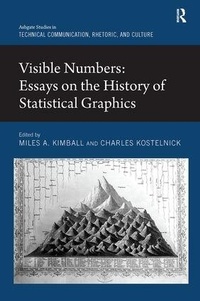
Visible Numbers
Essays on the History of Statistical Graphics
1st Edition
Published on 22. December 2017
Book
Paperback/Softback
330 pages
978-0-8153-8650-6 (ISBN)
Description
Bringing together scholars from around the world, this collection examines many of the historical developments in making data visible through charts, graphs, thematic maps, and now interactive displays. Today, we are used to seeing data portrayed in a dizzying array of graphic forms. Virtually any quantified knowledge, from social and physical science to engineering and medicine, as well as business, government, or personal activity, has been visualized. Yet the methods of making data visible are relatively new innovations, most stemming from eighteenth- and nineteenth-century innovations that arose as a logical response to a growing desire to quantify everything-from science, economics, and industry to population, health, and crime. Innovators such as Playfair, Alexander von Humboldt, Heinrich Berghaus, John Snow, Florence Nightingale, Francis Galton, and Charles Minard began to develop graphical methods to make data and their relations more visible. In the twentieth century, data design became both increasingly specialized within new and existing disciplines-science, engineering, social science, and medicine-and at the same time became further democratized, with new forms that make statistical, business, and government data more accessible to the public. At the close of the twentieth century and the beginning of the twenty-first, an explosion in interactive digital data design has exponentially increased our access to data. The contributors analyze this fascinating history through a variety of critical approaches, including visual rhetoric, visual culture, genre theory, and fully contextualized historical scholarship.
Reviews / Votes
"The present volume is a collection of ten essays on the subject, mainly written by humanities (especially English) professors. Given this fact, the focus is, as one might expect, on rhetoric and epistemology. (...) those individuals finding the perspective on the subject more in line with their own will be pleased by the 25-page annotated bibliography that is supplied, in addition to the 24 pages of cited works. Summing Up: Recommended."- C. Bauer, York College of Pennsylvania in CHOICE
More details
Series
Language
English
Place of publication
New York
United States
Publishing group
Taylor & Francis Inc
Target group
College/higher education
Postgraduate and Undergraduate
Dimensions
Height: 234 mm
Width: 156 mm
Weight
610 gr
ISBN-13
978-0-8153-8650-6 (9780815386506)
Copyright in bibliographic data and cover images is held by Nielsen Book Services Limited or by the publishers or by their respective licensors: all rights reserved.
Schweitzer Classification
Other editions
Additional editions
E-Book
07/2017
Routledge
€68.49
Available for download
E-Book
07/2017
Routledge
€68.49
Available for download
Book
12/2015
1st Edition
Routledge
€259.70
Shipment within 10-20 days
Persons
Miles A. Kimball is Professor and Department Head of Communication and Rhetoric at Rensselaer Polytechnic Institute, USACharles Kostelnick is Professor of English at Iowa State University, USA.
Content
Introduction (Charles Kostelnick and Miles A. Kimball) Part 1 Visualizing Bodies: Health, Disease, Evolution The shape of things to come: geometric morphometrics, growth, and evolution (Alan Gross) Florence Nightingale's statistical tables for medical care (Lee Brasseur) Visualizing public health: smallpox epidemics, communicating risk, and changing representations of disease rates (Candice A. Welhausen and Rebecca E. Burnett) Part 2 Visualizing Nations: Moral Statistics, War, Nationalism Moral statistics and the thematic maps of Joseph Fletcher (Robert Cook and Howard Wainer) Innovation and inertia in statistical mapping in 19th- and 20th-century America (Mark Monmonier) Mountains of wealth, rivers of commerce: Michael G. Mulhall's graphics and the imperial gaze (Miles A. Kimball) 'A scheme of cross-roads, orderly and mad': British trench maps of World War I (Marguerite Helmers) Part 3 Examining Visible Numbers: Forms, Methods, Historiographies Mosaics, culture, and rhetorical resiliency: the convoluted genealogy of a data display genre (Charles Kostelnick) The 20th century computer graphics revolution in statistics (Dianne Cook) The milestones project: a database for the history of data visualization (Michael Friendly, Matthew Sigal, and Derek Harnanansingh) Annotated bibliography of scholarship on the history of data graphics (Kevin Van Winkle)