

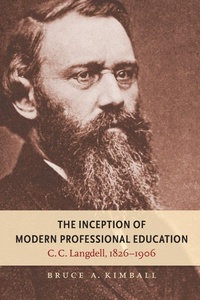
The Inception of Modern Professional Education
C. C. Langdell, 1826-1906
Published on 30. March 2014
Book
Paperback/Softback
448 pages
978-1-4696-1481-6 (ISBN)
Description
Christopher C. Langdell (1826-1906) is one of the most influential figures in the history of American professional education. As dean of Harvard Law School from 1870 to 1895, he conceived, designed, and built the educational model that leading professional schools in virtually all fields subsequently emulated. In this first full-length biography of the educator and jurist, Bruce Kimball explores Langdell's controversial role in modern professional education and in jurisprudence.
Langdell founded his model on the idea of academic meritocracy. According to this principle, scholastic achievement should determine one's merit in professional life. Despite fierce opposition from students, faculty, alumni, and legal professionals, he designed and instituted a formal system of innovative policies based on meritocracy. This system's components included the admission requirement of a bachelor's degree, the sequenced curriculum and its extension to three years, the hurdle of annual examinations for continuation and graduation, the independent career track for professional faculty, the transformation of the professional library into a scholarly resource, the inductive pedagogy of teaching from cases, the organization of alumni to support the school, and a new, highly successful financial strategy.
Langdell's model was subsequently adopted by leading law schools, medical schools, business schools, and the schools of other professions. By the time of his retirement as dean at Harvard, Langdell's reforms had shaped the future model for professional education throughout the United States.
Langdell founded his model on the idea of academic meritocracy. According to this principle, scholastic achievement should determine one's merit in professional life. Despite fierce opposition from students, faculty, alumni, and legal professionals, he designed and instituted a formal system of innovative policies based on meritocracy. This system's components included the admission requirement of a bachelor's degree, the sequenced curriculum and its extension to three years, the hurdle of annual examinations for continuation and graduation, the independent career track for professional faculty, the transformation of the professional library into a scholarly resource, the inductive pedagogy of teaching from cases, the organization of alumni to support the school, and a new, highly successful financial strategy.
Langdell's model was subsequently adopted by leading law schools, medical schools, business schools, and the schools of other professions. By the time of his retirement as dean at Harvard, Langdell's reforms had shaped the future model for professional education throughout the United States.
More details
Series
Edition
New edition
Language
English
Place of publication
Chapel Hill
United States
Target group
College/higher education
Professional and scholarly
Edition type
New edition
Dimensions
Height: 234 mm
Width: 156 mm
Thickness: 26 mm
Weight
758 gr
ISBN-13
978-1-4696-1481-6 (9781469614816)
Copyright in bibliographic data and cover images is held by Nielsen Book Services Limited or by the publishers or by their respective licensors: all rights reserved.
Schweitzer Classification
Other editions
Additional editions
E-Book
06/2009
The University of North Carolina Press
€29.49
Available for download
Person
Bruce A. Kimball is professor and director of the School of Educational Policy and Leadership at the Ohio State University. This is his fifth book on American educational history.