

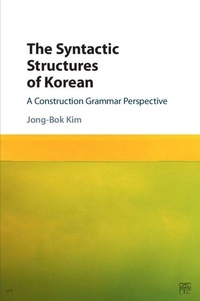
The Syntactic Structures of Korean
A Construction Grammar Perspective
Published on 15. December 2022
Book
Paperback/Softback
360 pages
978-1-107-50325-0 (ISBN)
Description
Covering both core and peripheral phenomena, The Syntactic Structures of Korean is a concrete and precise grammar of the language. Based on the framework of Sign-based Construction Grammar, it provides a grammar of Korean which is computationally implementable and cognitively viable. Remarkably broad, yet in-depth, it is an outstanding analysis of Korean syntax and semantics which will be welcomed by those working in linguistics and the Korean language.
More details
Language
English
Place of publication
Cambridge
United Kingdom
Target group
Professional and scholarly
Product notice
Paperback (trade)
Illustrations
7 Tables, black and white; 1 Halftones, black and white; 2 Line drawings, black and white
Dimensions
Height: 229 mm
Width: 152 mm
Thickness: 19 mm
Weight
522 gr
ISBN-13
978-1-107-50325-0 (9781107503250)
Copyright in bibliographic data and cover images is held by Nielsen Book Services Limited or by the publishers or by their respective licensors: all rights reserved.
Schweitzer Classification
Other editions
Additional editions
Book
07/2016
Cambridge University Press
€150.80
Shipment within 15-20 days
Person
Professor Jong-Bok Kim teaches at the School of English at Kyung Hee University, Seoul. He received his PhD in Linguistics from Stanford University, California in 1996 and works on the syntax and semantics of Korean and English. He has published numerous papers and is also co-author of English Syntax: An Introduction (2008), which is used worldwide as an undergraduate and graduate textbook.
Content
1. Theoretical foundations; 1.1 Derivational vs constraint-based views; 1.2 Linguistic signs and feature structures; 1.3 Constructions and multiple inheritance hierarchy; 1.4 Korean phrase structure grammar; 1.5 Conclusion; 2. Noun phrases; 2.1 Basic properties; 2.2 Basic ordering restrictions; 2.3 Simple NP structures; 2.4 NPs with phrasal determinants; 2.5 Conclusion; 3. Case system; 3.1 Two basic issues; 3.2 Forming case-marked nominal expressions; 3.3 A construction-based case assignment system; 3.4 Complex case phenomena and predictions; 3.5 Case assignments in the auxiliary constructions; 3.6 Case assignments to the non-nominal expression; 3.7 Conclusion; 4. Auxiliary and complex predicate constructions; 4.1 Types of auxiliary verbs and morphosyntactic properties; 4.2 Three possible analyses; 4.3 Syntactic properties of complex predicates; 4.4 A construction-based analysis; 4.5 Conclusion; 5. Gerundive phrases and mixed categories; 5.1 Verbal and nominal properties; 5.2 Derivational analyses; 5.3 Inflectional treatment of the gerundive nominalizers; 5.4 A mixed-category analysis; 5.5 Consequences and further issues; 5.6 Conclusion; 6. Verbal nouns and light verb construction; 6.1 Basic properties; 6.2 On the properties of the light verb; 6.3 On the mixed properties of the verbal nouns; 6.4 Mixed properties within a multiple inheritance system; 6.5 Argument composition and syntactic structures; 6.6 Dissolving variations; 6.7 Conclusion; 7. Serial verb construction; 7.1 Serial verbs and general properties; 7.2 Grammatical properties of the SVCs; 7.3 Types of serial verb constructions; 7.4 A construction-based view; 7.5 Conclusion; 8. Negation and related phenomena; 8.1 Short form and long form negation; 8.2 Reviews on the derivational view; 8.3 Short form negation; 8.4 Long form negation; 8.5 Implications of the analysis; 8.6 Conclusion; 9. Coordination; 9.1 Two main types of nominal and verbal coordination; 9.2 Lexical properties of the coordinators; 9.3 More on the syntactic aspects; 9.4 Symmetric and asymmetric verbal coordination; 9.5 Conclusion; 10. Passive constructions; 10.1 Lexical vs syntactic passive; 10.2 Auxiliary syntactic passive; 10.3 A construction-based analysis; 10.4 Light-verb syntactic passive; 10.5 Inchoative and stative pseudo syntactic passive; 10.6 Conclusion; 11. Wh-questions; 11.1 Dependency between Wh-question and Q-particle; 11.2 Wh-questions and indefiniteness; 11.3 A construction-based analysis; 11.4 Key predictions; 11.5 Conclusion; 12. Topic and focus constructions; 12.1 Topic constructions; 12.2 Encoding focus; 12.3 Focus constructions; 12.4 Conclusion; 13. Relative clause constructions; 13.1 Some key properties; 13.2 Morpho-syntax of Korean relatives; 13.3 Standard relative clauses: externally headed; 13.4 Double relative clauses; 13.5 Internally headed relative clauses; 13.6 Pseudo-relative clauses; 13.7 Concluding remarks; 14. Honorification; 14.1 Basic properties of honorific agreement; 14.2 Honorification in a constraint-based grammar; 14.3 Conclusion.