

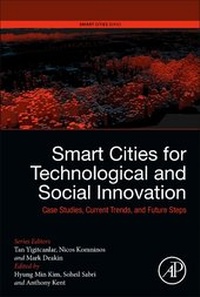
Smart Cities for Technological and Social Innovation
Case Studies, Current Trends, and Future Steps
Published on 21. September 2020
Book
Paperback/Softback
332 pages
978-0-12-818886-6 (ISBN)
Description
Smart Cities for Technological and Social Innovation establishes a key theoretical framework to understand the implementation and development of smart cities as innovation drivers, in terms of lasting impacts on productivity, livability and sustainability of specific initiatives. This framework is based on empirical analysis of 12 case studies, including pioneer projects from Europe, Asia, the Middle East, and more. It explores how successful smart cities initiatives nurture both technological and social innovation using a combination of regulatory governance and private agency. Typologies of smart city-making approaches are explored in depth. Integrative analysis identifies key success factors in establishing innovation relating to the effectiveness of social systems, institutional thickness, governance, the role of human capital, and streamlining funding of urban development projects.
More details
Series
Language
English
Place of publication
San Diego
United States
Publishing group
Elsevier Science Publishing Co Inc
Target group
Professional and scholarly
Graduate students and researchers in Smart Cities, Sustainability, Urban Planning, and Social Science. Institutional readers including all stakeholders in the city: planners, legislators, NGOs, elected representatives, community groups
Dimensions
Height: 229 mm
Width: 152 mm
Weight
520 gr
ISBN-13
978-0-12-818886-6 (9780128188866)
Copyright in bibliographic data and cover images is held by Nielsen Book Services Limited or by the publishers or by their respective licensors: all rights reserved.
Schweitzer Classification
Other editions
Additional editions
Hyung Min Kim | Soheil Sabri | Anthony Kent
Smart Cities for Technological and Social Innovation
Case Studies, Current Trends, and Future Steps
E-Book
09/2020
Academic Press
€109.00
Available for download
Persons
Kim's teaching and research activities focus on economic and spatial dynamics of cities in the Asia-Pacific region. His research projects have investigated urban implications of global activities such as Foreign Direct Investment, knowledge workers, international students and international real estate investment. Sabri has research interests in application of geospatial technology in smart urban planning. He has more than 13 years of experience in consultancy and research in urban and regional planning with a current research focus on spatial enablement of governments and industries for smart urban planning. Anthony Kent is an economic geographer who teaches urban and environmental economics. He is a long-term Board Member of Urban Policy and Research and is immediate past Secretary of the Eastern Regional Organisation for Planning and Human Settlements (Australia). His research interests include industrial clusters, labour markets and regional economies. He has also worked as a consultant on tertiary education capacity building in Indonesia.
Content
1. Introduction: being smarter for productivity, livability and sustainability
2. Fundamentals of smart cities: Governance, innovations and cities
3. Smart city in Singapore: How Environmental and Geospatial Innovation lead to urban livability and environmental sustainability cities
5. Japanese Smart Cities
6. 'Being First Comes Naturally': The Smart City and Progressive Urbanism in Australia
7. Understanding the Stakeholders' Perceptions in Smart Cities: The Experience of Using Q Methodology for Smart Gusu Project, China
8. Stimulating Innovation for Smart Cities in Hong Kong
9. Urban form, the use of ICT and informal smart cities in Vietnam
10. Smart urban development strategies in Africa? An analysis of multiple rationalities for Accra's City Extension Project
11. Smart Dubai IoT Strategy: Aspiration to promoting happiness for residents and visitors through a continuous commitment to innovation
12. Governing security by coding: a case of "smartness" in the Chilean context
13. Smart City Technologies in the USA: Smart Grid and Transportation Initiatives in Columbus, Ohio
14. Building the Future City of Glasgow: An evolutionary perspective
15. Autonomous Vehicles and Smart Cities: Where We Are
16. Evaluating recent trends: Diversified development paths of smart cities
17. Conclusion: steps for future smart cities
2. Fundamentals of smart cities: Governance, innovations and cities
3. Smart city in Singapore: How Environmental and Geospatial Innovation lead to urban livability and environmental sustainability cities
5. Japanese Smart Cities
6. 'Being First Comes Naturally': The Smart City and Progressive Urbanism in Australia
7. Understanding the Stakeholders' Perceptions in Smart Cities: The Experience of Using Q Methodology for Smart Gusu Project, China
8. Stimulating Innovation for Smart Cities in Hong Kong
9. Urban form, the use of ICT and informal smart cities in Vietnam
10. Smart urban development strategies in Africa? An analysis of multiple rationalities for Accra's City Extension Project
11. Smart Dubai IoT Strategy: Aspiration to promoting happiness for residents and visitors through a continuous commitment to innovation
12. Governing security by coding: a case of "smartness" in the Chilean context
13. Smart City Technologies in the USA: Smart Grid and Transportation Initiatives in Columbus, Ohio
14. Building the Future City of Glasgow: An evolutionary perspective
15. Autonomous Vehicles and Smart Cities: Where We Are
16. Evaluating recent trends: Diversified development paths of smart cities
17. Conclusion: steps for future smart cities