

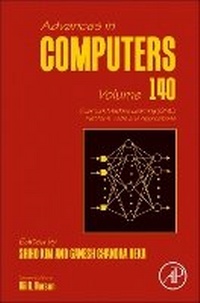
Quantum Machine Learning (QML): Platform, Tools and Applications: Volume 140
Will be published approx. on 1. February 2026
Book
Hardback
310 pages
978-0-443-22382-2 (ISBN)
Description
Quantum Machine Learning (QML): Platform, Tools and Applications, Volume 140 in the Advances in Computers series, explores the intersection of quantum computing and artificial intelligence, highlighting the latest advances that promise to revolutionize computational science. This volume introduces foundational concepts in quantum computing and circuits, building toward the practical implementation of quantum machine learning (QML) algorithms. Chapters address challenges such as the gradient vanishing problem in variational quantum circuits, and explore powerful optimization methods enabled by quantum mechanics. The volume also covers advanced applications including quantum approaches to smart grid management, quantum Monte Carlo simulations, and predictive modeling in numerical solvers using quantum neural networks. Real-world relevance is underscored through discussions of transformative quantum algorithms and their potential to reshape machine learning, enabling unprecedented performance in data analysis, optimization, and beyond.
More details
Series
Language
English
Place of publication
San Diego
United States
Publishing group
Elsevier Science Publishing Co Inc
Target group
Professional and scholarly
Dimensions
Height: 229 mm
Width: 152 mm
Weight
450 gr
ISBN-13
978-0-443-22382-2 (9780443223822)
Copyright in bibliographic data and cover images is held by Nielsen Book Services Limited or by the publishers or by their respective licensors: all rights reserved.
Schweitzer Classification
Other editions
Additional editions
E-Book
02/2026
Elsevier
€130.00
Available for download
Persons
Shiho Kim is a professor in the school of integrated technology at Yonsei University, Seoul, Korea. His previous assignment includes, System on chip design engineer, at LG Semicon Ltd. (currently SK Hynix), Korea, Seoul [1995-1996], Director of RAVERS (Research center for Advanced Hybrid Electric Vehicle Energy Recovery System, a government-supported IT research center. Associate Director of the ICT consilience program, which is a Korea National program for cultivating talented engineers in the field of information and communication Technology, Korea [2011-2012], Director of Seamless Transportation Lab, at Yonsei university, Korea [since 2011-]. His main research interest includes Development of software and hardware technologies for intelligent vehicles, Blockchain technology for intelligent transportation systems, and reinforcement learning for autonomous vehicles. He is the member of the editorial board and reviewer for various Journals and International conferences. So far he has organized 2 International Conference as Technical Chair/General Chair. He is a member of IEIE (Institute of Electronics and Information Engineers of Korea), KSAE (Korean Society of Automotive Engineers), vice president of KINGC (Korean Institute of Next Generation Computing), and a senior member of IEEE. He is the co-author for over 100 papers and holding more than 50 patents in the area of information and communication technology. Ganesh Chandra Deka is currently Deputy Director (Training) at Directorate General of Training, Ministry of Skill Development and Entrepreneurship, Government of India, New Delhi-110001, India. His research interests include e-Governance, Big Data Analytics, NoSQL Databases and Vocational Education and Training.
He has 2 books on Cloud Computing published by LAP Lambert, Germany. He is the Co-author for 4 text books on Fundamentals of Computer Science (3 books published by Moni Manik Prakashan, Guwahati, Assam, India and 1 IGI Global, USA). As of now he has edited 14 books (6 IGI Global, USA, 5 CRC Press, USA, 2 Elsevier & 1 Springer) on Big data, NoSQL and Cloud Computing and authored 10 Book Chapters.
He has published around 47 research papers in various IEEE conferences. He has organized 08 IEEE International Conferences as Technical Chair in India. He is the Member of the editorial board and reviewer for various Journals and International conferences. Member of IEEE, the Institution of Electronics and Telecommunication Engineers, India and Associate Member, the Institution of Engineers, India
He has 2 books on Cloud Computing published by LAP Lambert, Germany. He is the Co-author for 4 text books on Fundamentals of Computer Science (3 books published by Moni Manik Prakashan, Guwahati, Assam, India and 1 IGI Global, USA). As of now he has edited 14 books (6 IGI Global, USA, 5 CRC Press, USA, 2 Elsevier & 1 Springer) on Big data, NoSQL and Cloud Computing and authored 10 Book Chapters.
He has published around 47 research papers in various IEEE conferences. He has organized 08 IEEE International Conferences as Technical Chair in India. He is the Member of the editorial board and reviewer for various Journals and International conferences. Member of IEEE, the Institution of Electronics and Telecommunication Engineers, India and Associate Member, the Institution of Engineers, India
Content
1. Introduction to Quantum Machine Learning (QML)
2. Quantum Computing Basics
3. Basic circuits for Quantum Computations
4. Quantum Machine Learning
5. Addressing the Gradient Vanishing Problem in Parametrized Quantum Circuit Training and Optimization
6. Quantum Optimization techniques and applications
7. Next-Gen Smart Grids: A Quantum Approach
8. Quantum Monte Carlo simulations
9. QPDE - Quantum Neural Network Based Stabilization Parameter Prediction for Numerical Solvers for Partial Differential Equations
10. Transforming Machine Learning: An In-Depth Exploration of Quantum Algorithms and Their Applications
2. Quantum Computing Basics
3. Basic circuits for Quantum Computations
4. Quantum Machine Learning
5. Addressing the Gradient Vanishing Problem in Parametrized Quantum Circuit Training and Optimization
6. Quantum Optimization techniques and applications
7. Next-Gen Smart Grids: A Quantum Approach
8. Quantum Monte Carlo simulations
9. QPDE - Quantum Neural Network Based Stabilization Parameter Prediction for Numerical Solvers for Partial Differential Equations
10. Transforming Machine Learning: An In-Depth Exploration of Quantum Algorithms and Their Applications