

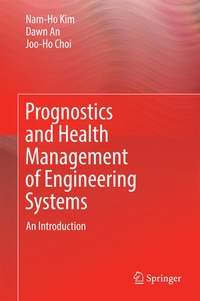
Prognostics and Health Management of Engineering Systems
An Introduction
Published on 2. November 2016
Book
Hardback
XIV, 347 pages
978-3-319-44740-7 (ISBN)
Description
This book introduces the methods for predicting the future behavior of a system's health and the remaining useful life to determine an appropriate maintenance schedule. The authors introduce the history, industrial applications, algorithms, and benefits and challenges of PHM (Prognostics and Health Management) to help readers understand this highly interdisciplinary engineering approach that incorporates sensing technologies, physics of failure, machine learning, modern statistics, and reliability engineering. It is ideal for beginners because it introduces various prognostics algorithms and explains their attributes, pros and cons in terms of model definition, model parameter estimation, and ability to handle noise and bias in data, allowing readers to select the appropriate methods for their fields of application.Among the many topics discussed in-depth are: Prognostics tutorials using least-squares Bayesian inference and parameter estimation Physics-based prognostics algorithms including nonlinear least squares, Bayesian method, and particle filter Data-driven prognostics algorithms including Gaussian process regression and neural network Comparison of different prognostics algorithms The authors also present several applications of prognostics in practical engineering systems, including wear in a revolute joint, fatigue crack growth in a panel, prognostics using accelerated life test data, fatigue damage in bearings, and more. Prognostics tutorials with a Matlab code using simple examples are provided, along with a companion website that presents Matlab programs for different algorithms as well as measurement data. Each chapter contains a comprehensive set of exercise problems, some of which require Matlab programs, making this an ideal book for graduate students in mechanical, civil, aerospace, electrical, and industrial engineering and engineering mechanics, as well asresearchers and maintenance engineers in the above fields.
More details
Edition
1st ed. 2017
Language
English
Place of publication
Cham
Switzerland
Publishing group
Springer International Publishing
Target group
Professional and scholarly
Illustrations
11 s/w Abbildungen, 155 farbige Abbildungen
XIV, 347 p. 166 illus., 155 illus. in color.
Dimensions
Height: 241 mm
Width: 160 mm
Thickness: 26 mm
Weight
711 gr
ISBN-13
978-3-319-44740-7 (9783319447407)
DOI
10.1007/978-3-319-44742-1
Schweitzer Classification
Other editions
Additional editions
Nam-Ho Kim | Dawn An | Joo-Ho Choi
Prognostics and Health Management of Engineering Systems
An Introduction
Book
06/2018
Springer
€128.39
Shipment within 10-15 days
Nam-Ho Kim | Dawn An | Joo-Ho Choi
Prognostics and Health Management of Engineering Systems
An Introduction
E-Book
10/2016
Springer
€117.69
Available for download
Persons
Dr. Nam-Ho Kim is Professor of Mechanical and Aerospace Engineering at the University of Florida. His research areas is structural design optimization, design sensitivity analysis, design under uncertainty, structural health monitoring, nonlinear structural mechanics, and structural-acoustics. He has published three books and more than hundred refereed journal and conference papers in the above areas.Dr. Dawn An received a Bachelor and Master of mechanical engineering from Korea Aerospace University in 2008 and 2010, respectively. She started a joint Ph.D. at Korea Aerospace University and the University of Florida in 2011, and received her Ph.D. in 2015 as a jointly conferred degree. She is now a postdoctoral associate at the University of Florida. Her current research is focused on enhancing prognostics methods for real damage data having limitation in terms of insufficient number of data and large noise in data without physical model.Joo Ho Choi is Professor in the School of Aerospace and Mechanical Engineering, Korea Aerospace University.
Content
Introduction.- Tutorials for Prognostics.- Bayesian Statistics for Prognostics.- Physics-Based Prognostics.- Data-Driven Prognostics.- Study on Attributes of Prognostic Methods.- Applications of Prognostics.