

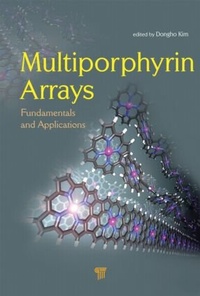
Multiporphyrin Arrays
Fundamentals and Applications
1st Edition
Published on 12. January 2012
Book
Hardback
796 pages
978-981-4316-60-6 (ISBN)
Description
This book provides a comprehensive review of the fundamentals and applications of multiporphyrin arrays ranging from basic spectroscopic features to a wide range of promising applications such as molecular wires, switches, sensors, artificial photosynthetic devices, and dye-sensitized solar cells based on a variety of multiporphyrin architectures using covalent and/or noncovalent molecular assemblies. Particularly, it focuses on energy and electron transfer processes occurring in multiporphyrin arrays in various environments such as single-molecule level, composite materials, LB films, and solid surface to provide better understanding of photofunctional molecular architectures.
Reviews / Votes
Multiporphyrin Arrays is a must-read for all those interested in the fast-evolving area of applied porphyrin research. It brings together in one comprehensive collection articles from top researchers whose combined contributions serve to introduce and define the field of multiporphyrin arrays - systems built up through the covalent and non-covalent linking of multiple porphyrin chromophores - and detail its importance in terms of topic areas running the gamut from the very fundamental to the fully applied. The book thus provides a tutorial on how detailed research endeavors can lead to practical payoffs with real-world utility. It is highly recommended for those currently working in the porphyrin field and students at all levels who want a facile entry into this fascinating area.-Jonathan Sessler, The University of Texas at Austin, USA
The design, synthesis, and characterization of multiporphyrinic systems continue to be driven by both fundamental scientific inquiry into the properties of photonic materials and the diverse applications that range from solar energy harvesting to biomedical. Two overarching strategies are used to form these arrays, covalent chemistry and supramolecular chemistry. Multiporphyrin Arrays brings together some of the top scientists in the field to yield a timely, coherent, and thorough summary of the current state of the art of these extraordinary functional materials. This book should be a valuable resource for all those who are interested in porphyrinic materials and molecular photonics.
-Charles Michael Drain, Hunter College of the City University of New York, USA
This excellent book is a timely publication because of the rapidly increasing attention toward porphyrin functional materials for the development of solar energy conversion, which should be of great interest not only to porphyrin chemists but also scientists and engineers working in the related fields of applied physics and biology. Because each chapter includes a good introduction and the contents are well organized, this book serves as a first-rate resource for graduate students or anyone who is new to the fields of porphyrins and photophysics and their applications.
-Shunichi Fukuzumi, Osaka University, Japan
More details
Language
English
Place of publication
Singapore
Singapore
Target group
College/higher education
Professional and scholarly
Academic and Postgraduate
Illustrations
331 s/w Abbildungen, 62 farbige Abbildungen
62 Illustrations, color; 331 Illustrations, black and white
Dimensions
Height: 229 mm
Width: 152 mm
Weight
1750 gr
ISBN-13
978-981-4316-60-6 (9789814316606)
Copyright in bibliographic data and cover images is held by Nielsen Book Services Limited or by the publishers or by their respective licensors: all rights reserved.
Schweitzer Classification
Other editions
Additional editions
E-Book
01/2012
Pan Stanford Publishing Pte Ltd
€251.99
Available for download
Person
Dongho Kim received his BS in 1980 from Seoul National University, Seal, South Korea, and Ph.D. in 1984 from Washington University, Washington, DC. After postdoctoral research at Princeton University, New Jersey, he joined the Korea Research Institute of Standards and Science, Daejeon, South Korea, in 1986. In 2000, he moved to Yonsei University, Seal, South Korea as a professor of chemistry. He received the Scientist of the Month Award (1999), the Sigma-Aldrich Award (2005), the Korea Science Award in Chemistry (2006), and the Star Faculty Award (2006) and was selected as the Underwood Professor at Yonsei University (2007). Since 2002, he has been a fellow of The Korea Academy of Science and Technology. Currently, he is leading the Center for Smart Nano-Conjugates through the World Class University Program. His research activity is focused on the experimental investigation of pi-conjugated molecular systems such as porphyrin, pyrene, perylenebisimide, and thiophene and their assemblies with particular interest in excitation dynamics both in ensemble and at single-molecule level. He has coauthored more than 350 articles and about 15 reviews in journals and books. He has served as an editorial board member for Bulletin of the Korean Chemical Society, Journal of Porphyrins and Phthalocyanines, and Journal of Physical Chemistry.
Content
Single-Molecule Photophysical Properties of Various Directly linked Porphyrin Arrays,. Electron Transfer Through Butadiyne-Linked Porphyrin-Based Molecular Wires. Recent Applications of MCD Spectroscopy to Porphyrinoids. Phthalocyanine-Porphyrin Heteroarrays: A Perfect Marriage Between Two Unique Macrocycles. Primary Photoevents in Self-Assembled Complexes: Multiporphyrin Arrays and "Semiconductor CdSe/ZnS Nanocrystal-Porphyrin" Composites. Structural and Functional Mimics of Light-Harvesting Systems in Bacterial Photosynthesis. Light-Harvesting, Excitation Energy/Electron Transfer and Photo-Regulation in Artificial Photosynthetic Systems. Artificial Photosynthetic Antenna-Reaction Center Mimics. Application of Multiporphyrin Arrays to Solar Energy Conversion. Self-Assembled Composite Materials of Porphyrins for Optoelectronics. Vectorial Photoinduced Charge Transfer in Langmuir-Blodgett Films of Porphyrin-Based Donor-Acceptor Systems. Supramolecular Energy and Electron Transfer Processes and Their Switching. Porphyrin Nanoclusters for Sensoring Chemical and Physical Stimuli. Energy and Electron Transfer Processes in Porphyrin Dendrimers. Push-Pull Porphyrins for Efficient Dye-Sensitized Solar Cells.