

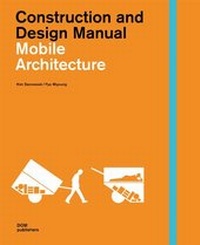
Mobile Architecture. Construction and Design Manual
1st Edition
Published in May 2012
Book
Hardback
844 pages
978-3-86922-218-9 (ISBN)
Description
Seit Einsteins Theorie des Raum-Zeit-Kontinuums vor gut 100 Jahren ist Architektur immer wieder mit dem Thema der Bewegung konfrontiert. Im heutigen Zeitalter des digitalen Nomadentums ist die Baukunst, die traditionell Immobilien für einen festen Ort gestaltet, der Versuchung ausgeliefert, ihre charakterisierende Ortsbindung aufzugeben und in den Sog der zunehmenden Mobilität gezogen zu werden. Avantgarde-Architekten formulieren in unzähligen Manifesten, wie sie Gebäude und ganze Städte aufzulösengedenken, der Architektur eine Maschinenästhetik und damit eine Fähigkeit zur Bewegung zu verleihen oder den Gebäuden Füße oder Räder anzuverleiben.Parallel zu den zahlreichen apokalyptischen Polemiken, in denen die Architektur der Geschwindigkeit geopfert wird, stellen sich Architekten bis heute der Herausforderung, 'mobile Immobilien' zu entwerfen. Dass dabei aber immer wieder auch pragmatische und innovative Konzepte entstehen, dokumentiert dieses Constructionand Design Manual auf über 800 Seiten. 43 internationale Design-Teams präsentieren ihre Arbeiten im Spannungsfeld zwischen architektonischen Follies, barrierefreien Möbeln und lebensrettenden Schutzbauten.
There never was a time when there was not motion, and never will be a time when there will not be motion. Aristotle
Mobility is a challenge that architecture has always had to confront; Aristotle was merely the first to philosophize about it. In the present age of digital nomadism, the art of building, with its traditional focus on immobility in fixed places, finds itself confronted by the temptation to relinquish its characteristic rootedness and to abandon itself to the irresistible pull of mobility. In countless manifestos, avant-garde architects describe how they intend to dissolve buildings and indeed whole cities, create an architecture based on a machine aesthetic that prominently involves mobility, and give their buildings legs or wheels.Notwithstanding the many prophets of doom that see solid, sedentary architecture sacrificed to mobile lifestyles, architects continue to take up the challenge and design portable houses. The results are often both practical and innovative, as is demonstrated on the more than 800 pages of this new title in the Construction and Design Manual series, in which 43 international design teams present works ranging from architectural follies to handicapped accessible furnishings and life-saving shelters.
There never was a time when there was not motion, and never will be a time when there will not be motion. Aristotle
Mobility is a challenge that architecture has always had to confront; Aristotle was merely the first to philosophize about it. In the present age of digital nomadism, the art of building, with its traditional focus on immobility in fixed places, finds itself confronted by the temptation to relinquish its characteristic rootedness and to abandon itself to the irresistible pull of mobility. In countless manifestos, avant-garde architects describe how they intend to dissolve buildings and indeed whole cities, create an architecture based on a machine aesthetic that prominently involves mobility, and give their buildings legs or wheels.Notwithstanding the many prophets of doom that see solid, sedentary architecture sacrificed to mobile lifestyles, architects continue to take up the challenge and design portable houses. The results are often both practical and innovative, as is demonstrated on the more than 800 pages of this new title in the Construction and Design Manual series, in which 43 international design teams present works ranging from architectural follies to handicapped accessible furnishings and life-saving shelters.
More details
Content
Essays:
Everything is moving _ Eduard Böhtlingk; Mobile Architecture and Design _ Toshihiko Suzuki; Going Mobile _ Andrew Thurlow & Maia Small; Architecture on the Move _ Arturo Vittori & Andreas Vogler
Architects and designers: 2RAM, 3GATTI, Andrew Kline, Andrew Maynard Architects, Architecture and Vision, Arch Group, ARCHI[TE]NSIONS, atelierBASE, Atelier OPA, BAKOKO, Böhtlingk Architectuur, Donatello Amabile, Encore Heureux, Facundo Arana & associated architects, Figura Arquitetos, FRAMA Architects, Höweler+Yoon Architecture, Interface Studio Architects, Jägnefält Milton, John Paananen, Kraaijvanger Urbis, LIKEarchitects, NICE ARCHITECTS, Nohotel, OBRA Architects, Office of Small Architecture, Ogrydziak/Prillinger Architects, raumlaborberlin, remote-controlled, studio Anne Holtrop, studio dass, Tectoniks, Thurlow Small Architecture, Tim Vinke, UGO architecture & design, Vallo & Sadovsky Architects, Vincent Callebaut Architecte, visiondivision, VOLIDO, WISE Architecture, XCOOP, zerOgroup, Zo_Loft
Everything is moving _ Eduard Böhtlingk; Mobile Architecture and Design _ Toshihiko Suzuki; Going Mobile _ Andrew Thurlow & Maia Small; Architecture on the Move _ Arturo Vittori & Andreas Vogler
Architects and designers: 2RAM, 3GATTI, Andrew Kline, Andrew Maynard Architects, Architecture and Vision, Arch Group, ARCHI[TE]NSIONS, atelierBASE, Atelier OPA, BAKOKO, Böhtlingk Architectuur, Donatello Amabile, Encore Heureux, Facundo Arana & associated architects, Figura Arquitetos, FRAMA Architects, Höweler+Yoon Architecture, Interface Studio Architects, Jägnefält Milton, John Paananen, Kraaijvanger Urbis, LIKEarchitects, NICE ARCHITECTS, Nohotel, OBRA Architects, Office of Small Architecture, Ogrydziak/Prillinger Architects, raumlaborberlin, remote-controlled, studio Anne Holtrop, studio dass, Tectoniks, Thurlow Small Architecture, Tim Vinke, UGO architecture & design, Vallo & Sadovsky Architects, Vincent Callebaut Architecte, visiondivision, VOLIDO, WISE Architecture, XCOOP, zerOgroup, Zo_Loft