

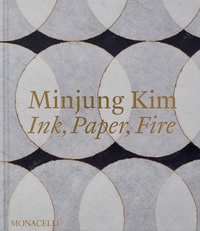
Minjung Kim
Ink, Paper, Fire
Will be published approx. on 24. September 2026
Book
Hardback
240 pages
978-1-58093-754-2 (ISBN)
Description
An exquisite monograph on contemporary artist Minjung Kim, whose abstract works created from traditional Korean materials have garnered her global acclaim
Minjung Kim: Ink, Paper, Fire is the first monograph of one of today's most exciting contemporary artists. Known for manipulating paper and ink to produce an extraordinary variety of abstract works, Kim's practice incorporates distinctive elements: her use of traditional Korean hanji paper (made from mulberry bark), calligraphic ink, and brushes, echoes her early education in traditional arts at Hongik University in Seoul, while her abstract composition and mark-making, and painstaking process of cutting, burning, and layering the paper, became a consistent part of her practice later, while studying at the Accademia di Belle Arti di Brera in Milan.
Kim works in series, creating multiple works in similar styles using similar techniques, all bearing the same title. Selections from more than 50 series are included here, revealing work in dramatically different color schemes, compositions, and scales. Organized by series, rather than chronologically, the book invites readers to see the how different works influence and grow out of one another, and how the artist revisits certain bodies of work after years have passed. The cyclical nature of Kim's process speaks to themes of nature, spirituality, creation, and time.
The book's stunning, spare design gives her work the primary focus while echoing its simplicity and materiality. Image banks are punctuated with texts, including essays and a conversation between Minjung Kim and critic Andrew Russeth, printed on different paper stocks.
Minjung Kim: Ink, Paper, Fire is the first monograph of one of today's most exciting contemporary artists. Known for manipulating paper and ink to produce an extraordinary variety of abstract works, Kim's practice incorporates distinctive elements: her use of traditional Korean hanji paper (made from mulberry bark), calligraphic ink, and brushes, echoes her early education in traditional arts at Hongik University in Seoul, while her abstract composition and mark-making, and painstaking process of cutting, burning, and layering the paper, became a consistent part of her practice later, while studying at the Accademia di Belle Arti di Brera in Milan.
Kim works in series, creating multiple works in similar styles using similar techniques, all bearing the same title. Selections from more than 50 series are included here, revealing work in dramatically different color schemes, compositions, and scales. Organized by series, rather than chronologically, the book invites readers to see the how different works influence and grow out of one another, and how the artist revisits certain bodies of work after years have passed. The cyclical nature of Kim's process speaks to themes of nature, spirituality, creation, and time.
The book's stunning, spare design gives her work the primary focus while echoing its simplicity and materiality. Image banks are punctuated with texts, including essays and a conversation between Minjung Kim and critic Andrew Russeth, printed on different paper stocks.
More details
Language
English
Place of publication
New York
United States
Illustrations
175 Illustrations
Dimensions
Height: 290 mm
Width: 250 mm
ISBN-13
978-1-58093-754-2 (9781580937542)
Copyright in bibliographic data and cover images is held by Nielsen Book Services Limited or by the publishers or by their respective licensors: all rights reserved.
Schweitzer Classification
Persons
Minjung Kim (b. 1962) studied traditional painting East Asian painting in Seoul. Confronted with the male-dominated Korean art scene she decided in 1991 to study overseas at Milan's Accademia di Belle Arti di Brera. There, Kim's practice shifted to abstract paintings, then cutting and burning traditional hanjii paper, disassembling and reimagining the canons of East Asian painting in favor of a meditative yet experimental process all her own.
Sam Bardaouil is a curator and museum director. Currently co-director of the Hamburger Bahnhof - Nationalgalerie der Gegenwart in Berlin, he was also curator of the 14th Taipei Biennial, and multiple national pavilions at the Venice Biennale.
Andrew Russeth is an art critic based in New York. Currently an editor at Artnet News, he has been executive editor of ARTnews and an editor at Surface and The New York Observer. From late 2020 to early 2024, he was based in Seoul. In 2019, he was awarded the Rabkin Prize for visual arts journalism.
Jun Hu is Assistant Professor of Chinese Art and Architecture at University of California Berkeley. His work engages with the history of Chinese architecture and its connections to other scholarly and cultural traditions, and interregional interactions between China, Japan, and Korea.
Sam Bardaouil is a curator and museum director. Currently co-director of the Hamburger Bahnhof - Nationalgalerie der Gegenwart in Berlin, he was also curator of the 14th Taipei Biennial, and multiple national pavilions at the Venice Biennale.
Andrew Russeth is an art critic based in New York. Currently an editor at Artnet News, he has been executive editor of ARTnews and an editor at Surface and The New York Observer. From late 2020 to early 2024, he was based in Seoul. In 2019, he was awarded the Rabkin Prize for visual arts journalism.
Jun Hu is Assistant Professor of Chinese Art and Architecture at University of California Berkeley. His work engages with the history of Chinese architecture and its connections to other scholarly and cultural traditions, and interregional interactions between China, Japan, and Korea.