

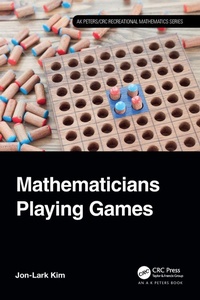
Mathematicians Playing Games
1st Edition
Published on 14. December 2023
Book
Paperback/Softback
124 pages
978-1-032-21305-7 (ISBN)
Description
Mathematicians Playing Games explores a wide variety of popular mathematical games, including their historical beginnings and the mathematical theories that underpin them. Its academic level is suitable for high school students and higher, but people of any age or level will find something to entertain them, and something new to learn. It would be a fantastic resource for high school mathematics classrooms or undergraduate mathematics for liberal arts course and belongs on the shelf of anyone with an interest in recreational mathematics.
Features
Suitable for anyone with an interest in games and mathematics, and could be especially useful to middle and high school students and their teachers
Includes various exercises for fun for readers
Features
Suitable for anyone with an interest in games and mathematics, and could be especially useful to middle and high school students and their teachers
Includes various exercises for fun for readers
More details
Series
Language
English
Place of publication
London
United Kingdom
Target group
College/higher education
General
Illustrations
165 farbige Abbildungen, 19 Farbfotos bzw. farbige Rasterbilder, 146 farbige Zeichnungen
146 Line drawings, color; 19 Halftones, color; 165 Illustrations, color
Dimensions
Height: 234 mm
Width: 156 mm
Thickness: 8 mm
Weight
219 gr
ISBN-13
978-1-032-21305-7 (9781032213057)
Copyright in bibliographic data and cover images is held by Nielsen Book Services Limited or by the publishers or by their respective licensors: all rights reserved.
Schweitzer Classification
Other editions
Additional editions
Jon-Lark Kim
Mathematicians Playing Games
E-Book
12/2023
1st Edition
Taylor & Francis
€35.49
Available for download
Jon-Lark Kim
Mathematicians Playing Games
Book
12/2023
1st Edition
Taylor & Francis
€130.60
Shipment within 10-20 days
Jon-Lark Kim
Mathematicians Playing Games
E-Book
12/2023
1st Edition
Taylor & Francis
€35.49
Available for download
Person
Jon-Lark Kim was born in 1970 in South Korea. He received the BS degree in Mathematics from POSTECH, the MS degree in Mathematics from Seoul National University, South Korea, in 1997, and the PhD degree from the Department of Mathematics, University of Illinois at Chicago, in 2002. He was an Associate Professor at the University of Louisville until 2012. He is currently a Professor at the Department of Mathematics, Sogang University, and the Director of the Institute for Mathematical and Data Science, Seoul, South Korea. He is also CEO of DeepHelix, a start-up based on AI and healthcare.
He has authored more than 70 research papers on Coding Theory, Combinatorics, Cryptography, Games, and Machine Learning and a book titled Selected Unsolved Problems in Coding Theory. He is a Co-Editor of Concise Encyclopedia of Coding Theory published by Chapman and Hall/CRC in 2021. He was a recipient of the 2004 Kirkman Medal from the Institute of Combinatorics and its Applications.
He is a member of the Editorial Board of Designs, Codes and Cryptography and Journal of Applied Mathematics and Computing. His research interests include Coding Theory, Cryptography, Informatics, Fuzzy Theory, and Artificial Intelligence, hoping to find a method to unify all of these + alpha in his lifetime just as Rene Descartes discovered a Cartesian coordinate system which unifies Algebra and Geometry and included a quotation "Cogito ergo sum" ("I think, therefore I am") which unifies the human mind and body. His hobbies include playing soccer, reading, and writing.
He has authored more than 70 research papers on Coding Theory, Combinatorics, Cryptography, Games, and Machine Learning and a book titled Selected Unsolved Problems in Coding Theory. He is a Co-Editor of Concise Encyclopedia of Coding Theory published by Chapman and Hall/CRC in 2021. He was a recipient of the 2004 Kirkman Medal from the Institute of Combinatorics and its Applications.
He is a member of the Editorial Board of Designs, Codes and Cryptography and Journal of Applied Mathematics and Computing. His research interests include Coding Theory, Cryptography, Informatics, Fuzzy Theory, and Artificial Intelligence, hoping to find a method to unify all of these + alpha in his lifetime just as Rene Descartes discovered a Cartesian coordinate system which unifies Algebra and Geometry and included a quotation "Cogito ergo sum" ("I think, therefore I am") which unifies the human mind and body. His hobbies include playing soccer, reading, and writing.
Content
1. 15 Puzzle: A Tile Matching Game That Is Difficult Even for Computers.
2. Peg Solitaire: Jumping Game Where We Meet Algebra.
3. Chomp Game: Avoid a Poisoned Chocolate.
4. Super Tic-Tac-Toe: Stone Game over a Donut.
5. Mastermind: A Cryptographic Game.
6. Ramsey Theorem and Sim Game: Don't Draw a Red Triangle.
7. Nine Men's Morris: Three Soldiers' Side by Side.
8. The Game of Quatrainment: Flip Neighbor Stones.
9. n-Queens Game and Puzzle: Playing Chess Only with Queens.
10. Light Out: Turn Off Lights by Linear Equations.
11. 1258 Board Game: Magic Square and Orthogonal Latin Square.
12. Switching Game: Shannon's Network Game.
13. Dots and Boxes: Occupy More Boxes.
14. Matricking: Factorization and Cube Net Game.
15. SET Game: Steiner Triple System Game.
16. Dobble Game: Finite Projective Plane Game.
17. Find-a-Best-Friend Game: A Game of the Perfect Hamming Code.
2. Peg Solitaire: Jumping Game Where We Meet Algebra.
3. Chomp Game: Avoid a Poisoned Chocolate.
4. Super Tic-Tac-Toe: Stone Game over a Donut.
5. Mastermind: A Cryptographic Game.
6. Ramsey Theorem and Sim Game: Don't Draw a Red Triangle.
7. Nine Men's Morris: Three Soldiers' Side by Side.
8. The Game of Quatrainment: Flip Neighbor Stones.
9. n-Queens Game and Puzzle: Playing Chess Only with Queens.
10. Light Out: Turn Off Lights by Linear Equations.
11. 1258 Board Game: Magic Square and Orthogonal Latin Square.
12. Switching Game: Shannon's Network Game.
13. Dots and Boxes: Occupy More Boxes.
14. Matricking: Factorization and Cube Net Game.
15. SET Game: Steiner Triple System Game.
16. Dobble Game: Finite Projective Plane Game.
17. Find-a-Best-Friend Game: A Game of the Perfect Hamming Code.