

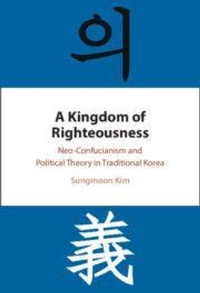
A Kingdom of Righteousness
Neo-Confucianism and Political Theory in Traditional Korea
Will be published approx. on 31. December 2026
Book
Paperback/Softback
310 pages
978-1-009-74093-7 (ISBN)
Description
Through an examination of the unfolding of Neo-Confucian politics in traditional Korea, this book explores how the Confucian monarchs and scholar-officials during the Joseon dynasty (1392-1910) struggled to navigate themselves in the complex political terrains within the normative parameters set by Neo-Confucian moral principles and ritual norms. It begins with how Neo-Confucianism emerged as a revolutionary political ideology in late Goryeo (918-1392) through the creative reappropriation of righteousness, one of the cardinal Confucian virtues, from a personal moral virtue into a public moral principle that undergirds Joseon's Confucian constitutional structure. It then shows how later Korean Neo-Confucians labored to maintain Joseon's Confucian constitutionality (or the Public Way) against all sorts of contingencies, in both domestic and interstate contexts, often altering the very nature of Joseon's statehood and Confucian identity. Special attention is given to various visions of political realism developed by the Korean Neo-Confucian political actors, who actively used 'expediency'.
Reviews / Votes
'Analyzing how generations of Choson rulers and scholars wrestled with the dilemma of upholding Neo-Confucian ideals while operating within the real world, Kim unveils one of the sources of the creativity which allowed Choson to survive for centuries. In doing so, he highlights diversity within Korean Neo-Confucian political thought.' Don Baker, University of British Columbia 'Sungmoon Kim, the eminent and prolific scholar of Confucian political theory, turns his attention to the development of Neo-Confucianism as a philosophical system and ethical practice as it unfolds in dynamic relationship with the political history of Korea from the late fourteenth to the late eighteenth centuries. With his deep and broad knowledge of multiple traditions, Kim is at his best here in illuminating varieties of Confucianism as well as fundamental questions of politics - old and new, East and West.' Sharon R. Krause, William R. Kenan, Jr. University Professor of Political Science, Brown University 'The revival of Confucian political thought has, understandably, focused its attention on the classic Chinese texts in this tradition. With this ground-breaking intellectual reconstruction of how Korean Neo-Confucianism negotiated the tensions between Confucian ideals and shifting political realities from the late fourteenth century to the late eighteenth century, Sungmoon Kim vividly demonstrates the wider range of conceptual practices and normative institutions within the Confucian tradition. This book provides both a model for the further development of Confucian political thought and a set of novel resources for contemporary Confucian political philosophy.' David Owen, Professor of Social and Political Philosophy, University of SouthamptonMore details
Language
English
Place of publication
Cambridge
United Kingdom
Product notice
Paperback (trade)
Illustrations
Worked examples or Exercises
Weight
250 gr
ISBN-13
978-1-009-74093-7 (9781009740937)
Copyright in bibliographic data and cover images is held by Nielsen Book Services Limited or by the publishers or by their respective licensors: all rights reserved.
Schweitzer Classification
Person
Sungmoon Kim is Chair Professor of Political Philosophy at City University of Hong Kong, where he also serves as Director of the Center for East Asian and Comparative Philosophy. He is the author of seven books, including Theorizing Confucian Virtue Politics (2019), Public Reason Confucianism (2016), and Confucian Democracy in East Asia (2014), all published by Cambridge University Press.
Content
Acknowledgements; Conventions; Introduction: contingency and the public way; 1. The rise of revolutionary neo-Confucianism: Jeong Dojeon's Xunzian moment; 2. The way of the foreign vassal state: Byeon Gyeryang on heavenly rituals and Korean statehood; 3. Contingency and neo-Confucian constitutionality: the case of King Sejo; 4. The utmost order, here and now: Jo Gwangjo's radical Confucianism; 5. The way of the hegemon toward the kingly way: Yi I's Xunzian turn; 6. Making peace with the barbarians: Choe Myeonggil's pro-peace argument; 7. Remaking the center: King Jeongjo's enactment of sage-kingship; Conclusion: the expedient and varieties of Confucian realism; Bibliography; Index.