

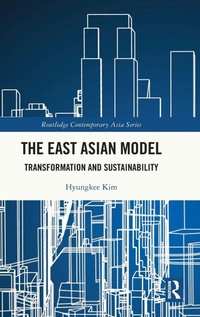
The East Asian Model
Transformation and Sustainability
1st Edition
Published on 24. February 2023
Book
Hardback
182 pages
978-1-032-36576-3 (ISBN)
Description
Hyungkee Kim analyses the model of East Asian development as it existed during periods of high growth and how it was transformed by pressures from both the Washington consensus and its own internal contradictions.
Many have discussed the successes and failures of the East Asian model, but Kim is concerned rather with the story of its transformation, and its long-term sustainability. He uses a Five Sector Model, which focuses on the, state, corporate, financial, labour, and foreign sectors to identify the core of East Asian model and examine the variants in Korea, Japan and China. He also outlines the distinctions between the East Asian model and Western development models including the Anglo-American, Rhine, and Nordic models. He analyses in detail the institutional changes such as marketization, privatization, liberalization, and flexibilization that have transformed the East Asian model. Highlighting the major problems that emerged from the transformation of the East Asian model, Kim assesses its prospects for economic, social and ecological sustainability and proposes an agenda for institutional reforms.
An essential reading for scholars of East Asian political economy.
Many have discussed the successes and failures of the East Asian model, but Kim is concerned rather with the story of its transformation, and its long-term sustainability. He uses a Five Sector Model, which focuses on the, state, corporate, financial, labour, and foreign sectors to identify the core of East Asian model and examine the variants in Korea, Japan and China. He also outlines the distinctions between the East Asian model and Western development models including the Anglo-American, Rhine, and Nordic models. He analyses in detail the institutional changes such as marketization, privatization, liberalization, and flexibilization that have transformed the East Asian model. Highlighting the major problems that emerged from the transformation of the East Asian model, Kim assesses its prospects for economic, social and ecological sustainability and proposes an agenda for institutional reforms.
An essential reading for scholars of East Asian political economy.
More details
Series
Language
English
Place of publication
London
United Kingdom
Publishing group
Taylor & Francis Ltd
Target group
College/higher education
Professional and scholarly
Academic, Postgraduate, and Undergraduate Advanced
Illustrations
16 s/w Abbildungen, 16 s/w Zeichnungen, 75 s/w Tabellen
75 Tables, black and white; 16 Line drawings, black and white; 16 Illustrations, black and white
Dimensions
Height: 240 mm
Width: 161 mm
Thickness: 16 mm
Weight
476 gr
ISBN-13
978-1-032-36576-3 (9781032365763)
Copyright in bibliographic data and cover images is held by Nielsen Book Services Limited or by the publishers or by their respective licensors: all rights reserved.
Schweitzer Classification
Other editions
Additional editions
Book
08/2024
1st Edition
Routledge
€62.80
Shipment within 10-20 days
E-Book
02/2023
1st Edition
Routledge
€55.49
Available for download
E-Book
02/2023
1st Edition
Routledge
€55.49
Available for download
Person
Hyungkee Kim is Professor Emeritus of Economics at Kyungpook National University in Korea. He studied at Fudan University, UC Berkeley, and Harvard University. And he taught at Kyoto University. He published books and articles on economic development and labor economics. His recent researches focus on the East Asian economies. Major books include New Political Economy, 2001, and An Alternative Development Model: Beyond Neo-liberalism, 2007. Major articles include "A Solidaristic Knowledge Policy for Sustainable Human Development", International Critical Review , Vol.1, No.3, 2011
Content
1. Introduction 2. The East Asian Miracle and Crisis Revisited 3. The Core of the East Asian Model and Its Variants 4. The Transformation of the East Asian Model 5. The Growth and Crisis in the East Asian Model 6. Miracle, Crisis, and Transformation of a Developmental State: The Case of Korea 7. The Sustainability of the East Asian Model 8. Towards a New East Asian Model 9. Conclusion